

Organising with cork wallets: your daily workflow guide
TL;DR:
- Most people carry multiple unused and expired cards, receipts, and clutter that overload their wallets. Organising with a minimalist cork wallet and regular weekly refreshes helps reduce friction, maintain order, and encourage sustainable habits. Incorporating digital storage and routine audits ensures the wallet remains slim, functional, and aligned with your current lifestyle.
Most people carry at least five cards they haven’t touched in a month, two expired loyalty cards, and a fistful of receipts they’ll never read. Organising with cork wallets workflow isn’t just a nice idea for the sustainably minded. It’s a genuinely practical system that reduces the daily friction of finding what you need, when you need it. Cork wallets are eco-friendly and practical by nature, and with the right approach, they become a tool that works with your habits rather than against them.
Table of Contents
- Key takeaways
- Organising with cork wallets: setting up your workspace
- Step-by-step workflow for sorting cards, cash, and receipts
- Best practices for efficiency and cork wallet care
- Troubleshooting common cork wallet organisation problems
- My honest take on cork wallet organisation
- Discover cork wallet collections from Thecorkstore
- FAQ
Key takeaways
| Point | Details |
|---|---|
| Start with a full empty-out | Lay every item on a clean surface before deciding what stays in your cork wallet. |
| Sort cards by frequency | Place daily-use cards at the front so muscle memory takes over during transactions. |
| Build a weekly refresh habit | A 5-minute weekly process removes receipts and re-evaluates what you’re carrying. |
| Alternate card orientation | Placing every other card upside down distributes thickness and prevents bulging. |
| Digitise what you rarely use | Loyalty and medical cards stored in an app reduce physical clutter without losing access. |
Organising with cork wallets: setting up your workspace
Before you touch a single card, you need the right conditions. Rushed organisation on a cluttered table produces cluttered results. Give yourself a clean, flat surface, good lighting, and five uninterrupted minutes. That’s genuinely all it takes to get started well.
Empty your cork wallet completely. Every card, every note, every receipt, every coin. Lay it all out in front of you so you can see the full picture. Most people are surprised by what they find at this stage. Duplicate membership cards, a gym pass for a gym they left two years ago, a bus ticket from last spring.
Here’s what to gather before you begin:
- A microfibre cloth to wipe down the interior of your cork wallet
- A small envelope or resealable bag for cards you’re setting aside temporarily
- Your smartphone with a digitisation app installed (apps like Google Drive, Stocard, or your phone’s native wallet work well)
- A waste bin for receipts and expired cards
- A notepad to log cards you need to request replacements for
Pro Tip: Write down any cards you find that are expired or damaged so you can request replacements immediately. Leaving that note to memory means it never gets done.
The mindset here matters as much as the method. Treating your wallet as permanent storage is the root cause of most wallet clutter. Shifting to the view that your wallet is a dynamic tool, not a filing cabinet, is what makes any organisation system stick long-term.
| Item | Purpose |
|---|---|
| Microfibre cloth | Removes dust and debris from cork interior without causing wear |
| Digitisation app | Stores infrequently used cards and receipts digitally |
| Storage envelope | Holds cards removed during the audit for review or shredding |
| Notepad | Tracks cards needing replacement or cancellation |
Step-by-step workflow for sorting cards, cash, and receipts
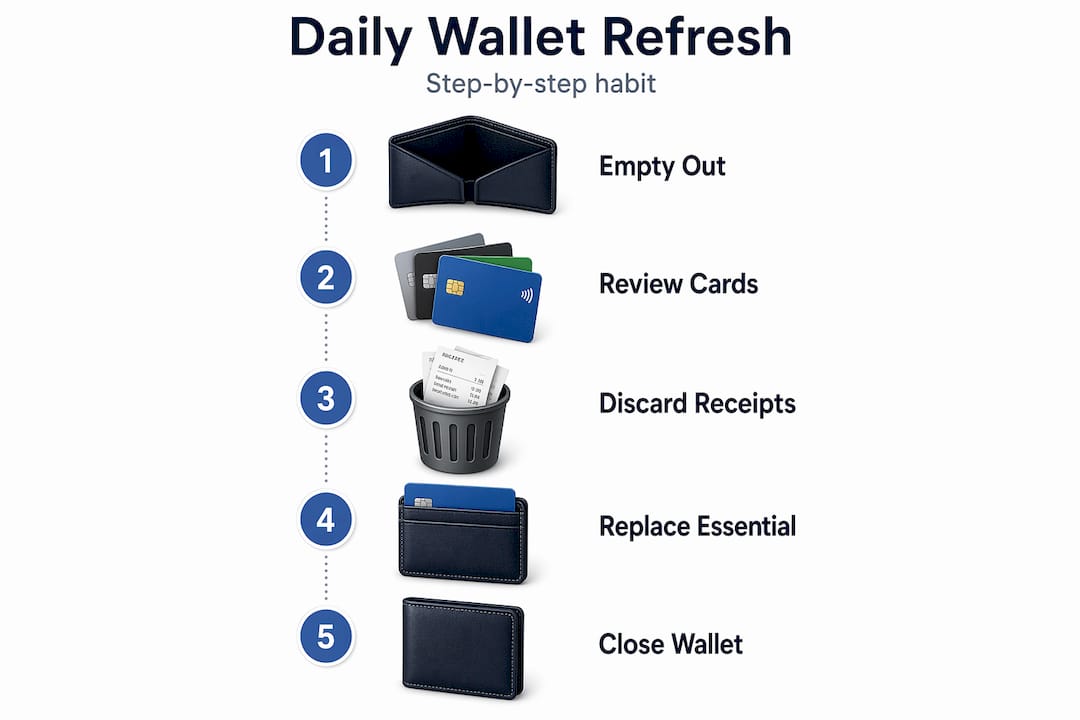
With everything laid out in front of you, start with a ruthless edit. The rule is straightforward: remove cards unused in 30 days unless you have a specific, scheduled reason to carry them. Most people discover they’ve been carrying three to five cards that have no business being in their daily wallet.

Once you’ve cut the list down, group what remains into four categories: payment cards, identification, loyalty and retail, and emergency. This grouping isn’t arbitrary. It maps directly to how often you’ll actually reach for each category.
Now follow these steps to load your cork wallet back up:
- Place payment cards at the very front. These are the cards you access multiple times a day. Arranging by frequency means your hand knows exactly where to go without looking. That muscle memory alone speeds up every transaction you make.
- Position your ID cards directly behind payment cards. You need these regularly but not constantly. A separate slot or the second position works well in most cork wallet layouts.
- Place loyalty and retail cards at the back. These are used occasionally. You don’t want them cluttering the front. Better yet, digitise loyalty cards using a card app and remove the physical versions entirely.
- Reserve one back slot for emergency items. A single emergency card, a folded note of cash, or both. This slot should be treated as off-limits for anything else.
- Alternate card orientation throughout. Every other card should go in upside down. This simple habit prevents uneven bulging and distributes thickness evenly across the wallet, preserving its shape over time.
- Sort cash by denomination, largest to smallest. Fold notes neatly in half and slot them flat. Never roll or scrunch them. Keeping coins separate is equally worth doing since mixing coins with notes damages the wallet’s structure over time and creates unnecessary bulk.
- Remove all receipts at the end of every day. Either digitise the ones you need to keep or discard them immediately. Receipts are the fastest way for a tidy wallet to become a mess again.
Pro Tip: Set a recurring five-minute slot every Sunday evening as your weekly wallet refresh. Empty it, discard receipts, and reassess whether every card still earns its place. Pair this with a monthly full audit and you’ll never deal with a bulging, chaotic wallet again.
A weekly 5-minute refresh paired with monthly audits creates a genuinely sustainable habit. It takes less time than finding a card you can’t locate because your wallet is overloaded.
Best practices for efficiency and cork wallet care
A good system only holds if your daily habits support it. The most common reason organisation breaks down isn’t a flawed method. It’s small, repeated choices that slowly undo the work.
- Never overfill card slots. Cork is a natural, slightly flexible material, but every slot has a designed capacity. Forcing two cards into a one-card slot deforms both the slot and the cork over time.
- Wipe the interior every six weeks. A quick pass with a dry microfibre cloth removes dust and debris that accumulates in the card slots. This is especially worth doing if you carry the wallet in a bag with other items.
- Rotate secondary cards periodically. If you have three loyalty cards you use roughly equally, rotate which one lives in your physical wallet each week. This keeps your load light without losing access. Digital backups of seldom-used cards add security alongside the physical reduction.
- Keep an emergency note discreetly. A folded £20 note tucked behind your emergency card costs you nothing and has saved countless people from an awkward situation. Store it in the same place every time so you don’t accidentally spend it.
- Use your phone’s digital wallet actively. Contactless payments via smartphone reduce how much your physical cards are handled, which extends their lifespan and keeps the wallet thinner.
The cork wallet benefits from being treated as a companion to a digital wallet rather than a replacement for all the cards you own. The combination is where the real efficiency with cork wallets shines.
Troubleshooting common cork wallet organisation problems
Even with a solid system, real life creates friction. Here are the most frequent problems and how to resolve them quickly.
The wallet is bulging despite following the system. The usual cause is cards that have crept back in without a proper audit. Do an immediate card count. Most slim cork wallets are designed to carry four to eight cards. If you’re above that, something needs to go. Revisit auditing cards quarterly as a non-negotiable habit rather than an optional extra.
Cards are hard to remove cleanly. Check whether you’ve been placing too many cards per slot and whether you’ve stopped alternating orientation. Alternating card direction enhances grip for removal significantly. A slot that has been overstuffed may also have slightly deformed. In that case, leave it with one card for a week to allow the material to recover.
Organisation keeps breaking down after a few days. This is a habits problem, not a product problem. The fix is reducing the activation cost of maintenance. Keep a small envelope on your desk or in your bag for daily receipt collection. Make the Sunday refresh non-negotiable by pairing it with something you already do, such as preparing your bag for the week ahead.
| Problem | Likely cause | Solution |
|---|---|---|
| Wallet bulging | Too many cards in slots | Audit and remove cards not used in 30 days |
| Cards difficult to remove | No alternation of card orientation | Apply upside-down alternation method consistently |
| Clutter returning quickly | No daily receipt removal habit | Use a dedicated envelope for daily receipts |
| System breaking down | No regular audit schedule | Schedule weekly refresh and monthly full audit |
As your lifestyle changes, your card usage changes too. A wallet layout that worked perfectly six months ago may no longer suit your current routine. Rearranging the layout twice a year as part of your seasonal audit is a smart, low-effort way to keep the system genuinely relevant.
My honest take on cork wallet organisation
I’ve spent time thinking about what actually separates people who maintain a tidy wallet from those who don’t. It’s rarely the wallet itself. It’s whether they treat it as a dynamic tool or a passive container.
The shift that made the biggest difference for me was the weekly refresh. Not because it’s complicated, but because it forces a small, regular decision: does this card still earn its place? That question, asked consistently, prevents the slow accumulation that leads to a bulging mess. It also creates a moment of reflection that, unexpectedly, feeds into broader sustainable habits. When you practise deliberate curation in one area of daily life, you start doing it elsewhere too.
Cork wallets do present a challenge that leather alternatives don’t. They have a designed capacity that’s genuinely slimmer, which means they hold you accountable in a way a traditional billfold never does. I’d argue that’s a feature, not a limitation. The constraint sharpens your editing. You can explore choosing the right eco-friendly wallet to find a style that matches your carrying habits before committing.
The minimalist cork wallet setup isn’t about carrying less for its own sake. It’s about carrying exactly what you need and nothing you don’t. Once that becomes habit, the daily friction of wallet fumbling simply disappears.
— Aaron
Discover cork wallet collections from Thecorkstore
If this guide has you thinking about upgrading to a wallet that genuinely supports a minimal, organised carry, Thecorkstore has a collection worth exploring. Their cork wallet gift set is made from all-natural cork, fully vegan, and designed to work with the slim-carry principles covered throughout this article. The slot layout supports the alternating card method without forcing it. It’s also one of the more thoughtful gift options for anyone in your life who is making the move toward sustainable accessories.
For a wider browse, the vegan cork gift collection brings together cork wallets, purses, and accessories that align with eco-conscious, organised living. Every product is cruelty-free and built to last, which means the investment in a good organisational workflow pays off over years, not months.
FAQ
How do I start organising my cork wallet?
Empty the wallet completely onto a flat surface and sort every item into keep, digitise, or discard. Apply the 30-day rule: if you haven’t used a card in the past month and have no scheduled reason to, remove it.
How often should I audit my cork wallet?
A brief five-minute refresh once a week handles daily receipts and quick reassessments. A full monthly audit covers expired or unused cards and keeps the wallet relevant to your current lifestyle.
Why does alternating card orientation matter?
Placing every other card upside down distributes the thickness of the card stack evenly, which prevents one-sided bulging and makes individual cards easier to grip and remove cleanly.
Can I use a digital wallet alongside my cork wallet?
Yes, and it’s recommended. Storing loyalty cards, travel tickets, and medical cards in a digital app reduces the physical load significantly, keeping your cork wallet slim and your most-used cards immediately accessible.
How do I stop my organisation system from breaking down?
Pair your weekly refresh with a habit you already have, such as packing your bag for the week. Keeping a small envelope for daily receipt collection removes the biggest source of recurring clutter before it enters your wallet at all.