

Cork accessories: a sustainable, vegan leather alternative
For this article, “cork flooring in kitchen” is treated as shorthand for something else entirely: cork accessories, meaning handbags, wallets, backpacks and similar items made from cork fabric. If you’re browsing for durable vegan bags rather than actual flooring, you’re in the right place. The verdict: cork accessories are a genuinely sustainable, cruelty-free leather alternative when the cork is responsibly harvested and properly finished.
That last part matters more than most product pages let on.
- Main benefits: lightweight, naturally water-repellent, biodegradable at its core, and made without harming a single tree.
- Main cautions: watch for plastic-heavy backings, check water resistance claims before soaking anything, and expect some wear on high-friction edges over time.
Key Takeaways
Cork accessories deliver genuine sustainability and durability only when responsible sourcing meets a quality, non-plastic backing and finish.
| Point | Details |
|---|---|
| Origin matters | Cork is harvested from living cork oak bark, so the tree survives and forests keep sequestering carbon. |
| Certifications are proof, not decoration | FSC, PETA-Approved Vegan and OEKO-TEX each verify a different part of the sustainability claim. |
| Backing decides circularity | A cork veneer bonded to plastic undermines biodegradability even if the cork itself is genuine. |
| Care stays gentle | Spot clean with a damp cloth, avoid heat and soaking, and air dry away from direct sun. |
| Thecorkstore covers the checklist | Every product page lists FSC sourcing, PETA-Approved Vegan status and OEKO-TEX certified linings upfront. |
Table of Contents
- What cork fabric is and how it’s made
- Why cork accessories are genuinely sustainable
- Best uses for cork handbags, wallets and backpacks
- How to care for cork accessories
- What to check before buying a cork bag or wallet
- Cork’s balance of strengths and weaknesses as a bag material
- Getting the fit and finish right when you buy
- Cork versus other vegan leather materials
- Why humidity and temperature affect cork accessories
- Cleaning cork accessories the right way
- Common problems with cork accessories and how to fix them
- Why sourcing and finishing decide whether cork lives up to its promise
- Shop cork accessories built to last
- Frequently asked questions
- Sources
What cork fabric is and how it’s made
Cork fabric starts as bark, not wood. Harvesters strip the outer layer from cork oak trees roughly every nine years, and the tree keeps growing because the trunk itself is never touched. That’s the whole appeal in one sentence: cork forests survive the harvest, often standing for well over a century.
Once harvested, the bark gets sliced into thin veneer sheets, then bonded to a textile backing so it can be sewn into bags, wallets and straps. This backing is where the story gets complicated. A cork veneer on organic cotton is a very different product to the same veneer glued onto polyurethane.
- Suberin, the waxy compound in cork’s cell walls, gives it natural water resistance and antimicrobial properties.
- The material is remarkably light for its structure, which is why cork totes rarely feel bulky even when roomy.
- Cork veneer bonded to cotton or poly backing is standard practice, and the backing choice affects both feel and end-of-life recyclability.
Pro Tip: Check the product description for the word “backing” specifically. If it only mentions “cork leather” with no detail on what’s underneath, ask before you buy.
Why cork accessories are genuinely sustainable
Cork oak forests are carbon sinks that support some of the richest biodiversity in the Mediterranean basin, and none of that changes when the bark is harvested. A 2024 academic review of vegan leather materials found that cork-based alternatives use less water and produce fewer greenhouse gas emissions than conventional animal leather, though the same review flagged that durability and water resistance often depend on the quality of coatings applied afterwards. That’s a fair trade-off worth knowing about upfront rather than discovering it after a rainy commute.
Three certifications are worth actually checking for, not just skimming past:
- FSC certification confirms the cork came from a forest managed to environmental and social standards, not an unregulated supply chain.
- PETA-Approved Vegan confirms no animal-derived materials or testing were involved anywhere in production.
- OEKO-TEX Standard 100 matters for linings and backings, confirming the textile components are free from harmful substance levels.
Where things go wrong: a brand markets “sustainable cork” while backing it with virgin PVC, or finishes it with dyes that undercut the biodegradability cork otherwise offers. Sustainable fashion reporting has repeatedly flagged this exact pattern as the industry’s biggest greenwashing risk in cork goods.
Pro Tip: A product page that names its backing material and lists a certification logo is worth more trust than one with glossy photography and vague “eco-friendly” language.
Best uses for cork handbags, wallets and backpacks
Cork performs best where it’s asked to hold its shape rather than flex constantly. Structured totes, crossbody bags and wallets suit the material well because the veneer keeps its form without cracking the way some faux leathers do after a few months.
- Structured handbags and totes show off cork’s natural mottled grain, and no two pieces look identical.
- Wallets and small cardholders benefit from cork’s light weight and the way it resists sweat and everyday grime.
- Light daypacks and backpacks work well for cork, though heavy-load straps carrying more than a few kilos daily will show wear faster than on leather or ballistic nylon.
The surface is naturally hypoallergenic, which makes it a sensible pick if you’ve reacted to synthetic leather coatings before. Where cork struggles is constant abrasion against rough surfaces (think gym bag floors) and prolonged submersion in water. A splash is fine. A swim is not.
How to care for cork accessories
Cork rewards a light touch far more than scrubbing.
- Wipe the surface with a soft, slightly damp cloth for everyday dirt. Skip the soap unless the product care guide specifically allows it.
- Never machine wash or soak a cork accessory. The backing textile can warp even when the cork face survives fine.
- Let any dampness air dry away from direct heat. Skip the radiator and skip the hairdryer.
- Store bags folded softly or stuffed with tissue rather than crushed flat, and keep straps away from constant contact with zips or buckles on other items.
- For small scuffs, a gentle buff with a soft cloth often lifts surface marks. For anything deeper, professional leather goods repair services can usually work on cork the same way they would treat suede.
Sewing and craft specialists who work with cork fabric daily advise finger-pressing rather than ironing, since heat can flatten or discolour the surface permanently. Many finished cork pieces also arrive with a factory-applied protective spray, which is exactly why manufacturers warn against harsh solvents that strip it away.
Cork doesn’t ask for much. It asks you to not treat it like something it isn’t: not suede, not full-grain leather, not a machine-washable canvas tote. Respect that, and it lasts.
Thecorkstore’s own maintenance guide for cork accessories covers stain-specific advice in more depth if you want a reference to bookmark.
What to check before buying a cork bag or wallet
- Confirm the certifications. Look for FSC sourcing statements and a PETA-Approved Vegan mark rather than taking “vegan” at face value.
- Read the full materials list. The backing fabric, adhesive type and any coating should be stated, not implied.
- Inspect construction photos closely. Check stitching density, how straps attach to the body, and whether edges are finished cleanly or left raw.
- Check the returns policy and warranty. A brand confident in its stitching and backing usually offers a reasonable returns window.
- Be sceptical of claims with no detail behind them. “100% eco-friendly” with no backing material named is a marketing line, not a fact.
Pro Tip: Zoom into product photos at the strap attachment points. That’s the first place a poorly constructed cork bag fails, long before the cork itself does.
Cork’s balance of strengths and weaknesses as a bag material
Every material trades one advantage for another, and cork is no exception. Its biggest strength doubles as its biggest limitation: the same rigidity that gives cork bags their structured shape and resistance to stretching also means they don’t flex and soften with age the way leather does. Some shoppers love that consistency. Others miss the broken-in feel.
On the plus side, cork resists water far better than canvas or untreated cotton, thanks to suberin’s natural repellent properties, and it shrugs off everyday spills without staining the way suede would. It’s also genuinely light, which matters more than people expect once a bag is loaded with a laptop, a water bottle and the usual daily clutter.
The downside shows up with sustained abrasion. Set a cork tote down repeatedly on rough concrete or drag it against a car door often enough, and the veneer can develop fine surface scuffs, similar to how leather picks up scratches but without the same ability to buff them fully invisible. Corners and base panels take the most punishment, which is why well-made cork bags often reinforce those specific areas with extra stitching or a slightly thicker veneer cut.
Heat is the other weak point. Cork left in a hot car or near a radiator for extended periods can dry out and become brittle faster than it would at room temperature, so where you store the bag between uses matters as much as how you clean it.
None of this makes cork a fragile choice. It makes it a material with a specific personality, best suited to buyers who want structure and water resistance over broken-in softness.
Getting the fit and finish right when you buy
There’s no “installation” involved in a cork handbag or wallet the way there might be for a hard material, but fit and construction quality function the same way fitting does for any accessory: get it wrong at the manufacturing stage and no amount of care afterwards fixes it.
The construction detail that matters most is how the cork veneer meets its backing fabric at seams and stress points. Poorly bonded cork can start lifting at the edges within months, particularly around zip pulls and strap rings where the material flexes constantly. Better-made pieces reinforce these exact zones with double stitching or a bonded edge tape, which is worth checking in close-up product photography before you buy rather than after a seam starts to separate.
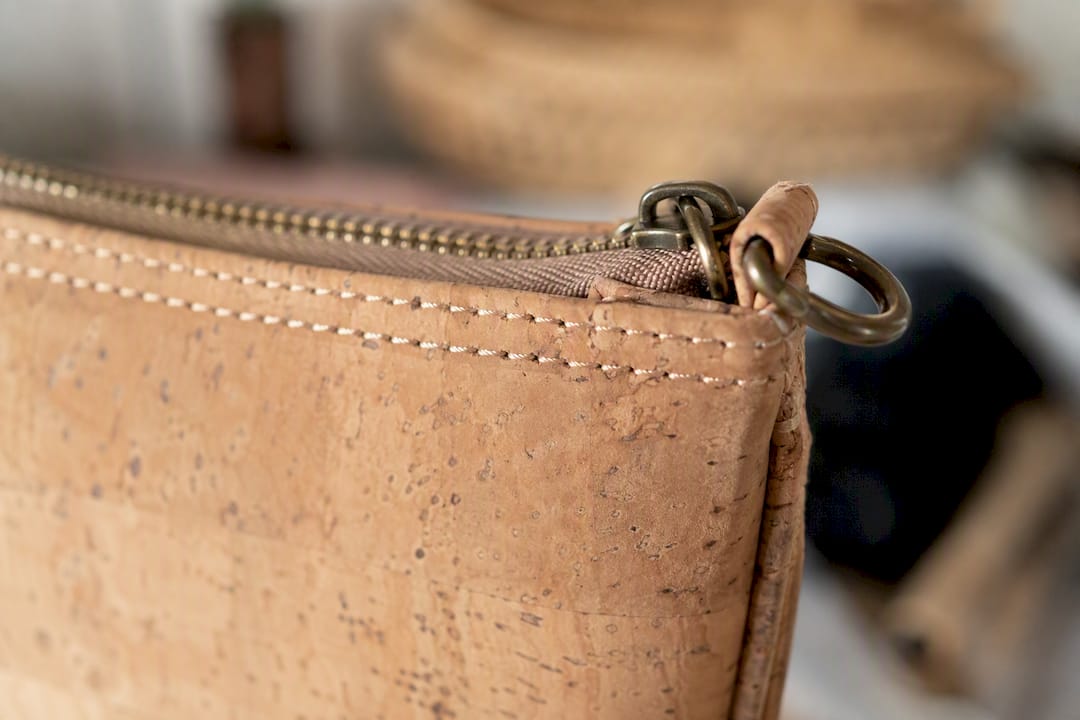
Strap attachment is the second area worth scrutinising. Cork straps that bear weight need metal D-rings or riveted anchor points rather than stitching alone, since repeated tension on cork-and-fabric composite straps will eventually pull thread loose if there’s nothing metal taking the load. A wallet or clutch doesn’t face this issue, which is part of why cork performs more reliably in smaller accessories than in daily-carry backpacks loaded with heavy textbooks or laptops.
Lining choice also affects how a finished piece performs day to day. A cotton or OEKO-TEX certified lining breathes and resists odour build-up far better than a cheap polyester insert, and it’s a detail cut corners are most likely to hide in.
Cork versus other vegan leather materials
Shoppers comparing vegan bag materials usually land on three broad categories: cork, plant-based leathers such as those made from apple or cactus fibre, and synthetic PU or PVC “pleather.”
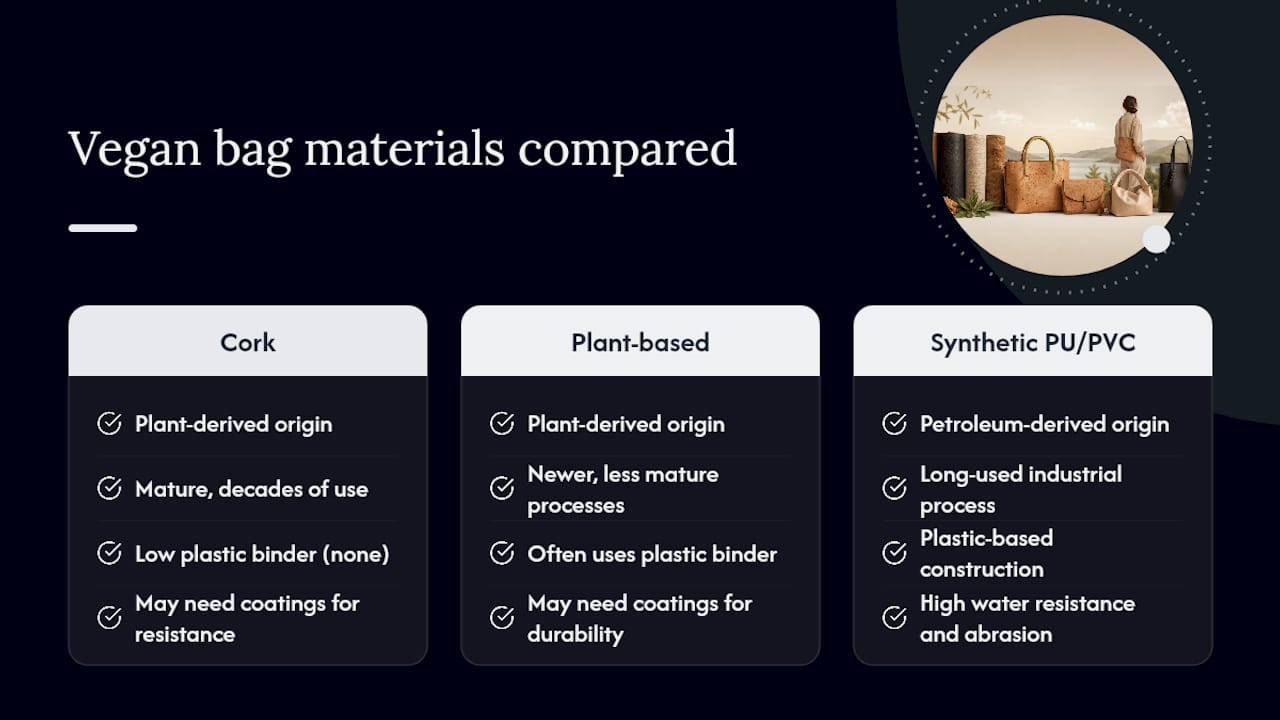
Cork’s advantage over most plant-based alternatives is maturity. It’s been used in fashion and furnishings for decades, so the manufacturing process, from bark to bonded veneer, is well understood and consistent. Apple leather and similar newer materials often still rely on a significant percentage of plastic binder to hold fibres together, which can undercut their eco credentials in ways that aren’t always obvious from marketing copy.
Against synthetic PU leather, cork wins clearly on origin and end-of-life impact. PU is petroleum-derived and doesn’t biodegrade in any meaningful timeframe, whereas cork’s plant-derived structure means the material itself breaks down eventually, provided it isn’t bonded to a plastic backing that cancels that benefit out. The academic review of vegan leather innovation noted this exact tension: materials with genuinely lower environmental footprints often need advanced coatings to match synthetic leather’s water resistance and abrasion durability, and those coatings are where sustainability claims can quietly slip.
Where cork loses ground is flexibility. PU leather drapes and folds more like traditional leather, which suits certain bag styles, particularly slouchy totes, better than cork’s stiffer structure ever will. If you want a bag that softens and moulds to your shoulder over years of use, cork isn’t that material and won’t become that material no matter how you care for it.
Why humidity and temperature affect cork accessories
Cork is porous at a microscopic level, which is exactly what gives it that light, springy feel. It also means environmental conditions matter more for cork than for a fully sealed synthetic material.
High humidity isn’t a major threat to a finished cork bag in normal use, since the suberin content already resists moisture reasonably well. The bigger risk comes from sustained dampness with no chance to dry, such as leaving a cork bag in a damp cupboard or a gym locker overnight. Trapped moisture against the backing fabric, rather than the cork face itself, is usually where mould risk actually starts.
Heat is the more damaging factor. Direct sun exposure through a car window, or storage near a radiator, can dry cork out over time and make it more prone to fine surface cracking. This isn’t the dramatic warping you’d worry about with a wooden object. It’s a gradual loss of the material’s natural flexibility, which shows up as small stress lines at fold points after a year or two of poor storage.
Cold itself doesn’t damage cork the way heat does, but rapid temperature swings, cold overnight bag storage followed by a hot car boot, for example, aren’t ideal for any bonded composite material long term. Consistency matters more than any single extreme.
Cleaning cork accessories the right way
The cleaning routine for cork accessories is deliberately gentle, and that’s by design rather than a limitation. A soft, barely damp cloth handles the vast majority of everyday marks, from dust to light finger grease around handles.
For anything more stubborn, a small amount of mild soap diluted heavily in water works on most factory-finished cork, though it’s worth testing on an inconspicuous patch first since finishes vary between manufacturers. Avoid anything containing alcohol, ammonia or bleach outright: these strip the protective coating that many cork accessories arrive with and can leave patchy discolouration that no amount of buffing fixes afterwards.
Cork sewing specialists who work with the raw fabric regularly recommend avoiding heat during any cleaning or drying process, which rules out tumble dryers, hairdryers and direct sun as a quick-dry fix. Air drying flat, away from direct heat sources, is the only reliable method.
For general surface upkeep between deeper cleans, the same principles that apply to caring for other natural, porous surfaces hold true: gentle, pH-neutral products and consistent light maintenance outperform occasional aggressive scrubbing every time, whether you’re maintaining a natural surface at home or a cork accessory in daily use. Thecorkstore’s own cork accessory maintenance guide breaks this down by specific stain types if you want a more detailed reference.
Common problems with cork accessories and how to fix them
Surface scuffing is the complaint that comes up most often, usually at corners and base panels that take repeated contact with hard surfaces. A soft cloth buff often lifts light marks; deeper scuffs sometimes respond to a small dab of natural oil worked in gently, though this should be tested on a hidden area first since it can slightly darken the cork’s tone.
Seam separation at the backing fabric is the second common issue, typically appearing after a year or more of heavy use rather than early on. This is a construction flaw more than a cork flaw. A well-bonded veneer on quality backing rarely lifts, which circles back to why checking construction closely before buying matters so much.
Colour fading from prolonged sun exposure is largely irreversible, since it affects the cork’s natural pigment rather than a surface coating. Prevention beats any cure here: keep bags out of direct sunlight in storage and rotate use if you’re carrying the same piece daily in bright conditions.
Odour build-up occasionally affects cork bags with lower-quality linings, since a cheap polyester insert traps moisture and skin oils far more than a breathable cotton or OEKO-TEX certified lining would. A light airing out and occasional wipe-down of the interior usually resolves it; if it persists, the lining material itself, not the cork, is usually the underlying cause.
None of these issues are dealbreakers. They’re maintenance realities, the same as any material that isn’t fully synthetic and sealed.
Why sourcing and finishing decide whether cork lives up to its promise
The honest problem with cork accessories isn’t the cork. It’s that “cork” has become a marketing word almost as loosely used as “eco-friendly,” and the two failures usually travel together. A veneer that’s genuinely FSC-sourced can still end up bonded to virgin PVC with zero disclosure, and from a product photo alone, you’d never know the difference.
What gets underestimated is how much the backing and lining decide a piece’s real environmental footprint, far more than the cork face itself does. Cork oak forests do their conservation work regardless of what the bark becomes. The sustainability story only holds together if what’s bonded underneath doesn’t quietly cancel it out. That’s the detail worth actually reading for, not the word “vegan” printed in large letters on a listing.
The other underappreciated point: cork’s stiffness is routinely treated as a flaw when it’s closer to a design feature. Buyers expecting leather’s slouch and drape from cork are comparing it to the wrong material. Judged on its own terms, as a structured, water-resistant, plant-derived fabric, it holds up extremely well, and expecting it to behave like something it was never built to be sets shoppers up for disappointment that has nothing to do with cork’s actual performance.
Shop cork accessories built to last
Everything covered above, the certifications worth checking, the backing materials that decide circularity, the construction details that separate a bag that lasts from one that doesn’t, is exactly what Thecorkstore’s product listings are built around. Every piece in the collection is sourced from FSC-certified cork, carries PETA-Approved Vegan status, and uses OEKO-TEX certified linings where fabric touches your belongings, so you’re not left guessing at what’s underneath the veneer.
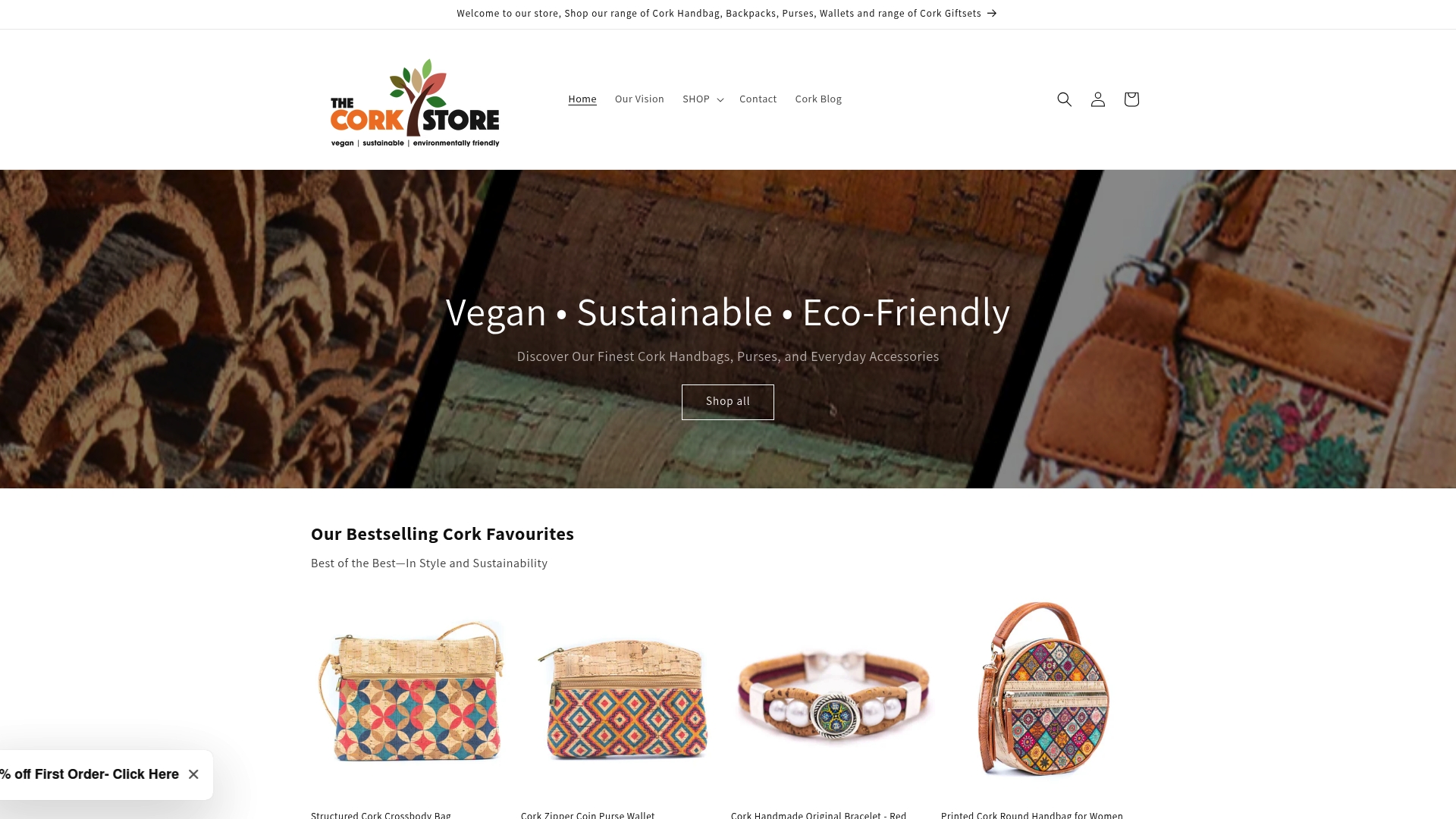
That means less time cross-referencing vague “eco-friendly” claims against a checklist, and more confidence that what you’re buying actually holds up to daily use. Browse the curated cork handbag and accessory collection to find a piece with the backing, certification and construction details already laid out on the product page, rather than buried somewhere you have to ask for them.
Frequently asked questions
Is cork a good material for a vegan handbag? Yes. Cork is naturally water-repellent, lightweight and biodegradable at its core, making it one of the more credible leather alternatives, provided the backing and finish avoid heavy plastic use.
Does cork fabric scratch easily? Cork resists everyday scuffs reasonably well but can show fine surface marks with sustained abrasion against rough surfaces. Corners and base panels wear first.
Can I get a cork bag wet? Light rain and splashes are fine thanks to cork’s natural suberin content. Prolonged soaking or submersion isn’t advisable, since it can affect the backing fabric even if the cork face survives.
How do I clean a cork wallet or bag? Wipe with a soft, slightly damp cloth. Avoid soaking, machine washing, ironing and any cleaner containing alcohol, ammonia or bleach.
What should I check before buying a cork accessory? Confirm FSC sourcing and PETA-Approved Vegan status, read the full materials list for backing type, and inspect stitching and strap attachment points in product photos.
Sources
- What is cork fabric? Is cork leather sustainable? - Sustainable Jungle
- Cork’s Champagne Moment Is Happening in Sustainable Fashion - Ethos
Recommended
- Cork: The Sustainable Vegan Leather Alternative That’s Good for the Ea – The Cork Store
- Cork vs Leather: The Sustainable Style Choice – The Cork Store
- Cork Accessories: The Ultimate Guide to Vegan Fashion Alternatives – The Cork Store
- Vegan cork eco accessories: stylish and sustainable picks – The Cork Store