
How to select cruelty-free wallets with confidence
TL;DR:
- Many wallets labeled “cruelty-free” may still contain animal-derived components hidden within linings, adhesives, or dyes. Verifying independent certifications like OEKO-TEX and GRS ensures materials and supply chains are genuinely ethical and sustainable. Full transparency at the component level and checking all internal parts are essential for truly cruelty-free wallet selection.
Not all wallets labelled “cruelty-free” actually are. Many brands use the term loosely, covering only the exterior material while staying silent on adhesives, dyes, and linings. If you are serious about knowing how to select cruelty-free wallets, you need more than a good-looking label. You need a framework that cuts through vague marketing, checks the right certifications, and scrutinises every component. This guide gives you exactly that, from understanding certification standards to comparing plant-based materials and spotting the pitfalls most shoppers miss entirely.
Table of Contents
- How to select cruelty-free wallets: certifications that actually matter
- Materials to look for in cruelty-free wallets
- Evaluating recycled and sustainable components in wallets
- Common pitfalls and non-obvious components to verify
- Step-by-step guide to selecting the perfect cruelty-free wallet
- Why trusting certifications and transparency matters more than brand stories
- Explore stylish cruelty-free wallets at The Cork Store
- Frequently asked questions
Key Takeaways
| Point | Details |
|---|---|
| Third-party certifications | Look for verified certifications like OEKO-TEX Standard 100 and B Corp rather than vague marketing claims. |
| Material transparency | Verify all materials including adhesives and linings to ensure the wallet is completely cruelty-free. |
| Plant-based alternatives | Choose proven, durable plant-based leathers like cactus or pineapple fibres with documented performance data. |
| Recycled content matters | Check for Global Recycled Standard (GRS) certification to confirm genuine recycled material and supply chain integrity. |
| Avoid greenwashing | Trust lab-tested safety certificates and supply chain transparency over brand stories or buzzwords. |
How to select cruelty-free wallets: certifications that actually matter
The first thing most eco-conscious shoppers reach for is a “vegan” or “eco-friendly” label on a product page. The problem is those phrases carry no legal definition and require no third-party verification. A brand can print them freely. What does carry weight is a recognised certification backed by independent testing or auditing.
OEKO-TEX Standard 100 is one of the most rigorous textile certifications available. It is based on analytical lab testing across the production chain and covers over 1,000 regulated and non-regulated substances, with criteria updated annually. If a wallet material carries this certification, you know it has been tested for harmful residues, which is especially relevant for items you handle daily. This goes far beyond what any brand’s self-written sustainability statement can claim.
For broader business accountability, B Corp certification is worth understanding. It measures a company’s social and environmental performance, transparency, and accountability using the B Impact Assessment. Brands must score at least 80 out of 200 points and recertify regularly. This means a B Corp wallet brand is not just making a nice product. It is being held to account across its entire operation.
When choosing vegan wallets, cross-referencing official certification directories is far more reliable than reading product descriptions. Here are the key certifications to look for:
- OEKO-TEX Standard 100 for lab-tested textile safety
- B Corp certification for company-wide social and environmental accountability
- PETA-Approved Vegan for product-level animal-free verification
- The Vegan Society Trademark for independently assessed vegan credentials
- Global Organic Textile Standard (GOTS) if the wallet uses any natural plant fibres
Materials to look for in cruelty-free wallets
Certifications tell you a brand is trustworthy. Materials tell you what you are actually buying. The range of animal-free wallet materials has expanded considerably, and the best cruelty-free wallets now use options that are genuinely impressive on performance metrics too.

Desserto cactus leather is one of the most talked-about alternatives. Made from nopal cactus with a bio-polyurethane base, it is listed with quantifiable mechanical properties including tensile strength figures of 650 N/5cm along the grain and abrasion resistance of up to 125,000 cycles for certain variants. That is performance data you can actually compare against traditional materials, rather than relying on vague claims. Pineapple-fibre leather is another option worth exploring, produced from agricultural waste and marketed as PVC-free and 100% vegan.
Tyvek wallet materials offer a different approach entirely. DuPont Tyvek is made from high-density polyethylene fibres fused into a strong web. It is a single, synthetic, animal-free material with a completely known composition, which makes it easier to verify than complex multi-layer alternatives. It is not a low-plastic solution, but for shoppers who prioritise component transparency, it is one of the clearest-cut options available.
One area that most guides overlook is the wallet’s non-surface components. Even if the exterior is cactus or cork, the non-animal wallet materials used in linings, thread, and internal layers need equal scrutiny. Always ask whether the full wallet, not just its face, is verified as animal-free.
Pro Tip: When comparing plant-based alternatives, request or search for the material’s published technical datasheet. If a supplier cannot provide tensile strength, tear resistance, or abrasion cycle data, that is a reason to look elsewhere. Numbers are harder to greenwash than adjectives.
Evaluating recycled and sustainable components in wallets
A wallet being animal-free is one part of the picture. Whether its materials were produced responsibly is another. This is where recycled content standards become relevant, and where choosing eco friendly wallets requires a sharper eye.
The Global Recycled Standard (GRS) is the benchmark here. It applies to products containing at least 20% recycled material and includes a full chain-of-custody verification system alongside social and environmental requirements for manufacturers. It is specifically designed to address greenwashing in recycled content claims, because tracking recycled input through a supply chain is complex and easy to misrepresent without third-party oversight.
Here is how GRS-certified wallets compare to those with vague recycled claims:
| Criteria | Vague “recycled” claim | GRS-certified wallet |
|---|---|---|
| Recycled content % | Unspecified or unverified | Minimum 20%, verified |
| Chain-of-custody | No requirement | Independently audited |
| Chemical safety | Not assessed | Included in standard |
| Worker rights | Not covered | Social requirements included |
| Traceability | Brand’s word only | Third-party documentation |
Beyond materials, look for brands that publish information about their manufacturing facilities, worker conditions, and environmental audits. Sustainable wallet sourcing encompasses the full production chain, not just the fabric you touch.
Pro Tip: Search the GRS certification body’s public database for a brand’s certification number before purchasing. If they claim GRS compliance but cannot provide a certificate number, that claim has not been independently verified.
Common pitfalls and non-obvious components to verify
This is where most cruelty-free wallet searches quietly fall apart. You research the material, check the brand’s values page, and feel confident. Then six months later you discover the edge paint on your wallet contained shellac, or the adhesive was casein-based. Both are animal-derived, and neither would have appeared anywhere in the product description.
Overlooking non-obvious components is described as the most common cruelty-free selection failure. Even when a wallet exterior is genuinely plant-based or synthetic, adhesives, dyes, coatings, linings, and edge paints may still contain animal derivatives or have been tested on animals. These are rarely covered by surface-level vegan claims.
The components to verify in any wallet include:
- Adhesives: Can contain casein (milk protein) or other animal-derived binding agents
- Dyes and colourants: Some dyes use carmine (derived from insects) or other animal-based pigments
- Linings: Fabric linings may be silk or contain wool-blend materials
- Edge paint and finishing: Often uses shellac, a resin secreted by lac bugs
- Thread: Can be silk rather than synthetic or cotton
- Hardware coatings: Occasionally involve animal-product-based lacquers
“Vegan claims can be incomplete at the component level. A wallet’s exterior can be 100% plant-based while hidden components introduce animal-derived materials at multiple points in the construction.”
Use the vegan wallet selection tips as your checklist framework, and always contact brands directly if their full material disclosure is not published. A genuinely transparent brand will have that information readily available.
Pro Tip: Ask brands one specific question: “Can you confirm that all adhesives, dyes, linings, and edge finishes in this wallet are free from animal-derived ingredients and have not been tested on animals?” A vague response or deflection is answer enough.
Step-by-step guide to selecting the perfect cruelty-free wallet
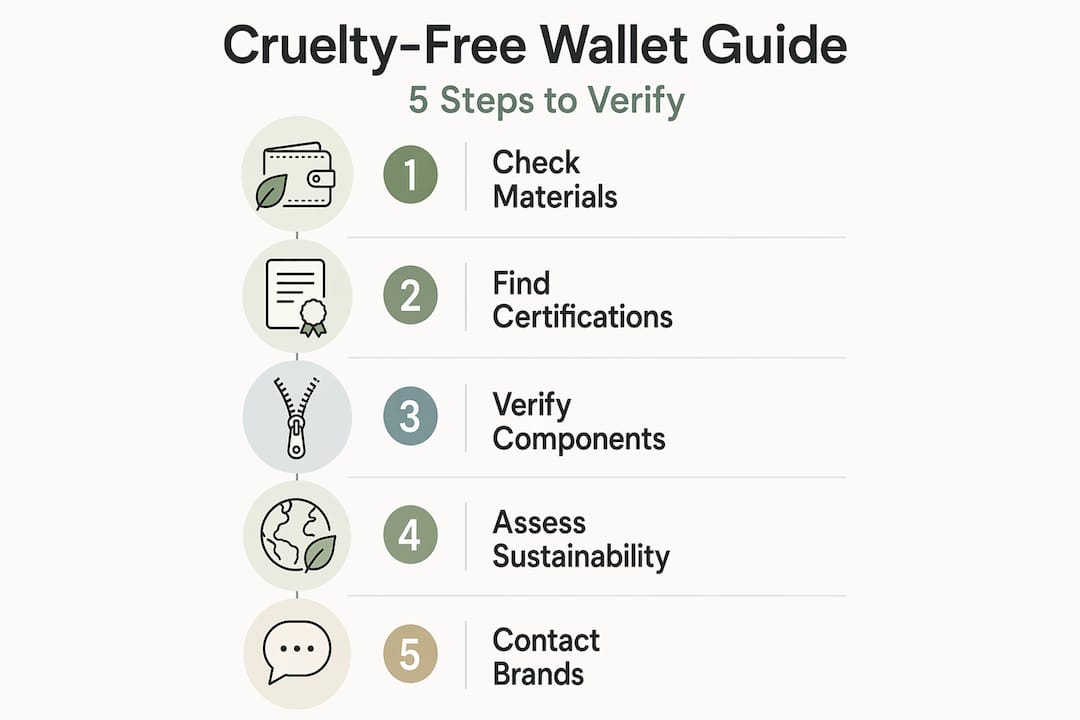
Now that you understand what to look for, here is a practical sequence to follow every time you shop for a cruelty-free wallet.
- Define your priorities. Decide which factors matter most to you: fully vegan, recycled content, low environmental impact, chemical safety, or all of the above. This shapes which certifications to prioritise.
- Check for OEKO-TEX Standard 100 or equivalent. This confirms the material has been lab-tested against 1,000+ substances. It is the most concrete safety benchmark available for textiles.
- Look up certification status independently. Use official directories for OEKO-TEX, B Corp, GRS, and PETA-Approved Vegan rather than relying on claims on the product page.
- Request or find published material data. For plant-based leather comparison, compare tensile strength, abrasion resistance, and durability metrics rather than brand narratives alone.
- Verify all wallet components. Confirm that linings, adhesives, dyes, thread, and edge paints are all covered by the brand’s vegan commitment or certification scope.
- Check recycled content claims against GRS. If recycled materials are featured, confirm a GRS certificate number exists and is current.
- Assess durability for long-term sustainability. A wallet that lasts five or more years has a lower environmental footprint than a cheaper one that needs replacing annually.
Here is a quick comparison framework to use when evaluating vegan wallet options side by side:
| Evaluation area | What to check | Strong signal | Weak signal |
|---|---|---|---|
| Certification | Third-party standard | OEKO-TEX, GRS, B Corp | “Eco-friendly” label only |
| Material | Published datasheet | Tensile/abrasion data | “Sustainable” description |
| Recycled content | GRS certificate number | Verified 20%+ recycled | “Made with recycled materials” |
| Component transparency | Full disclosure | All parts listed | Exterior material only |
| Durability | Performance metrics | Quantified test data | Lifestyle photography |
Pro Tip: Never rely on a single certification. The best cruelty-free wallets combine material-level testing with company-level accountability. One certification plugs gaps that another may leave open.
Why trusting certifications and transparency matters more than brand stories
Here is something most buying guides will not tell you plainly: a beautifully written brand story about sustainability is often inversely correlated with actual transparency. The brands that genuinely have the credentials tend to lead with the certificate numbers and datasheets. The brands that lean heavily on narrative and photography tend to have less to show behind the curtain.
This matters because greenwashing in the accessories market has become sophisticated. It is no longer just a false claim on a label. It is carefully chosen language, selective disclosure, and aesthetic cues (natural tones, leaf imagery, handwritten fonts) designed to create the feeling of sustainability without the substance.
The strongest protection against this is lab-tested sustainability standards. OEKO-TEX Standard 100, for instance, is anchored in analytical chemical testing with enumerated substance criteria that are updated annually. It does not care how your brand story reads. Either the material passes the lab tests or it does not. That objectivity is exactly what eco-conscious buyers need.
We have seen, working in the sustainable accessories space, that the brands most willing to share supplier names, component-level material disclosures, and third-party audit results are almost always the ones whose products genuinely hold up. Transparency is not just an ethical stance. It is a differentiator that separates brands built on real standards from those built on marketing.
The benefits of vegan wallets extend well beyond avoiding leather. They include reduced chemical exposure for the wearer, lower environmental impact across the supply chain, and contributing to market demand that accelerates better materials across the industry. But those benefits only materialise when the wallet is genuinely what it claims to be. Certifications and full-component transparency are how you know.
Explore stylish cruelty-free wallets at The Cork Store
Putting this knowledge into practice is far easier when you start with a curated collection that already meets high standards. At The Cork Store, our stylish vegan cork wallets are crafted from natural cork, a material that is harvested without cutting down trees, requires no animals, and is naturally water-resistant and durable.
Cork is one of the few materials that ticks every box discussed in this guide: animal-free, sustainably sourced, biodegradable, and available with transparent supply chain information. Our collection is designed for eco-conscious buyers who want a wallet that looks genuinely good without compromising their values. Explore our vegan wallet buying guide for more detailed guidance on what to look for, and read about the benefits of vegan wallets to understand why the switch is worth making.
Frequently asked questions
What does cruelty-free mean for wallets?
Cruelty-free wallets are made using no animal-derived materials and in processes that avoid animal testing or harm at any stage, covering both the exterior and all internal components. This means full production verification including materials, adhesives, and dyes, not just the outer surface.
How can I verify if a wallet is truly vegan and cruelty-free?
Look for recognised third-party certifications like OEKO-TEX Standard 100 and consult official certification directories rather than product page claims alone. A brand’s B Corp certification profile is also publicly searchable and verifiable independently.
Are plant-based leathers like cactus or pineapple really sustainable?
Plant-based leathers significantly reduce carbon emissions and avoid animal harm, but durability and certification data must also be checked before buying. Pineapple fibre materials are marketed as offering up to 91% CO2 reduction versus traditional leather and are 100% vegan and PVC-free, though published technical benchmarks vary by supplier.
What common mistakes do consumers make when choosing cruelty-free wallets?
Most shoppers overlook non-visible components like adhesives and dyes that may contain animal products, focusing only on the exterior material. Checking a brand’s full component disclosure or asking directly about linings, edge paints, and thread is the only reliable way to close that gap.
Does RFID-blocking technology affect a wallet’s cruelty-free status?
RFID-blocking features do not inherently compromise cruelty-free status, but the materials used to achieve that protection should still be assessed for vegan credentials and chemical safety standards. Always confirm the full material composition, including any shielding layers, is covered by the brand’s cruelty-free commitment.