

Cork and Leather Compared – Choosing Eco-Friendly Style
Every stylish wardrobe refresh brings a tricky question: can you look good and stand by your values? The choice between cork and leather goes far beyond appearances for those passionate about cruelty-free accessories. Cork is harvested without harming trees and helps actively absorb carbon, making it a truly sustainable vegan material, unlike traditional leather that relies on animal farming and intensive chemical processing. This guide gives you clear, honest answers on durability, ethics, and environmental impact, so you can shop with confidence and align your fashion with your principles.
Table of Contents
- Cork And Leather Defined And Debunked
- Comparing Types, Origins, And Processing
- Durability, Appearance, And Everyday Use
- Environmental Impact And Ethical Considerations
- Cost, Maintenance, And Long-Term Value
Key Takeaways
| Point | Details |
|---|---|
| Cork and Leather are Distinct Materials | Cork is a renewable, environmentally friendly material, while leather production involves animal farming and chemical processing. |
| Durability and Maintenance | Cork is lightweight, durable, and low-maintenance, contrasting with leather, which requires regular care and has a shorter lifespan. |
| Environmental Impact | Cork production supports forest ecosystems and carbon sequestration, while leather contributes to pollution and deforestation. |
| Cost-Effectiveness | Although cork accessories may have higher initial costs, they often become more economical over time due to lower maintenance and longer lifespan. |
Cork And Leather Defined And Debunked
Let’s get straight to it. Cork and leather are fundamentally different materials, and understanding those differences is crucial before you make your next accessory purchase. Cork is harvested from the bark of cork oak trees, primarily grown in Portugal, Spain, and North Africa. The bark regenerates naturally after harvesting, meaning the tree isn’t harmed or felled. The cork’s cellular structure gives it remarkable properties: it’s lightweight, water-resistant, flexible, and naturally antimicrobial. Traditional leather, conversely, comes from animal hides (typically cattle), requiring tanning processes that involve chemical treatments like chromium or vegetable tannins. This distinction matters enormously when you’re evaluating environmental impact and ethical considerations.
One major myth we need to debunk right now: cork isn’t just some trendy substitute that performs worse than leather. Cork has been used for centuries in everything from wine bottles to flooring, proving its durability and reliability. The material is naturally durable, lasting for years when properly cared for, and it actually improves with age, developing a patina similar to quality leather. Another common misconception is that cork accessories are flimsy or impractical. In reality, cork handbags, wallets, and backpacks are sturdy enough for daily use, resistant to stains and spills, and genuinely lighter than their leather equivalents, which appeals to anyone carrying their life around London or Manchester.
Here’s what often gets glossed over in the leather versus cork debate: leather production involves significant water consumption (around 24,000 litres per tonne), chemical pollutants from tanning, and ongoing carbon emissions from livestock farming. Cork production, by contrast, actually sequesters carbon. Cork oak forests act as carbon sinks, absorbing atmospheric CO2 throughout their lifecycle. The harvesting process is sustainable because the bark regenerates without requiring replanting or tree felling. This makes cork objectively the greener choice from an environmental standpoint. Neither material is perfect, but cork carries far fewer environmental costs while delivering comparable quality and longevity.
Pro tip: When evaluating cork versus leather, check the product’s care instructions and ask whether the cork has been treated with water-resistant sealants, as this determines how well it handles everyday moisture and extends its lifespan significantly.
Comparing Types, Origins, And Processing
When you’re comparing cork and leather, understanding where they come from and how they’re processed reveals just how different these materials truly are. Cork originates exclusively from cork oak trees (Quercus suber), which grow predominantly in Portugal, Spain, Algeria, and Morocco. These trees thrive in Mediterranean climates and can live for over 200 years. The harvesting process involves stripping the bark every 9 to 12 years, and here’s the key: the tree survives and regenerates new bark naturally. This cycle repeats multiple times throughout the tree’s lifetime, making cork production fundamentally renewable. Leather, by contrast, begins with animal farming. Cattle are raised specifically for their hides, requiring vast land use, water resources, and feed production. Once harvested, cork fabric preparation involves backing textiles for structural durability, whereas leather requires extensive chemical tanning to preserve and soften the hide.
The processing differences are striking. Cork bark is boiled, dried, ground, and pressed into sheets. These sheets are then bonded to a textile backing (usually cotton or polyester) to create cork fabric suitable for handbags, wallets, and accessories. This process is remarkably straightforward and relies on minimal chemical interventions. Leather processing, conversely, involves multiple stages: salting, soaking, liming, deliming, bating, pickling, and tanning. Each stage uses significant quantities of water and chemical treatments. Chrome tanning, the most common method, introduces hexavalent chromium into the process, which poses environmental and health risks. Vegetable tanning is gentler but takes considerably longer and costs more, which is why mainstream leather producers favour chrome tanning. The water consumption for leather production reaches approximately 24,000 litres per tonne, creating substantial wastewater that often contaminates local ecosystems.
From a sustainability perspective, cork’s processing chain is leagues ahead. The forests themselves provide ecological benefits: cork oak woodlands sequester carbon, support biodiversity, and prevent soil erosion. Portugal alone has over 730,000 hectares of cork forest, acting as a massive carbon storage system. Leather production, meanwhile, contributes roughly 8% of global industrial water pollution and generates significant greenhouse gas emissions from livestock farming. When you’re choosing between a cork wallet and a leather one, you’re essentially choosing between a material harvested from a regenerating forest system versus one requiring ongoing animal farming and intensive chemical processing. Neither option is perfect, but the environmental footprint difference is substantial.
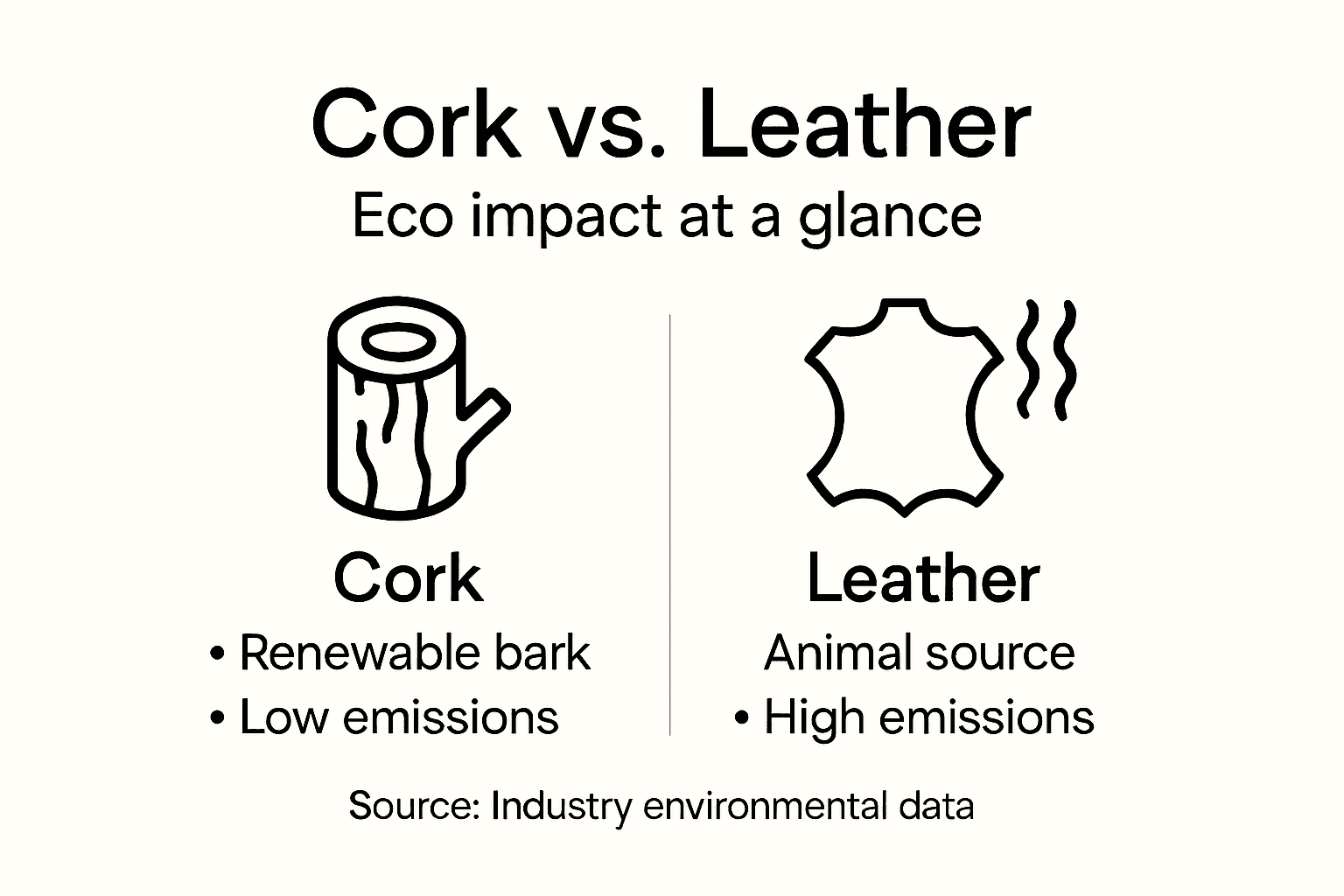
Here’s a concise comparison of the origin, processing, and sustainability of cork versus leather:
| Aspect | Cork | Leather |
|---|---|---|
| Source | Cork oak bark | Cattle hides from farming |
| Harvesting Impact | Tree remains unharmed | Animal killed for hide |
| Processing Chemicals | Minimal, mostly boiling | Extensive, tanning chemicals |
| Water Consumption | Very low per tonne | Around 24,000 litres/tonne |
| Sustainability | Renewable, carbon negative | High pollution, emissions |
Pro tip: When shopping for cork accessories, look for products where the cork is bonded to organic cotton or recycled textiles backing, as this maximises the sustainability credentials of your entire purchase.
Durability, Appearance, And Everyday Use
Here’s what most people get wrong about cork: they think it’s fragile. The reality is quite different. Cork is genuinely tough. It resists scratches better than you’d expect, bounces back from dents, and develops a beautiful patina over time rather than looking worn out. Research into cork products’ durability over time demonstrates that users consistently report satisfactory longevity for everyday fashion items. A cork handbag or wallet used daily will age gracefully, acquiring character marks that many people actually prefer to the pristine look of new leather. Leather, by contrast, requires regular conditioning and protection to maintain its appearance. Without proper care, leather cracks, fades, and shows water stains prominently. Cork handles moisture differently. Spill coffee on a cork bag and it wipes clean. The same accident on leather often leaves a permanent mark.
When it comes to appearance, the choice depends on your aesthetic preference. Cork has a warm, distinctive texture that photographs beautifully and catches light in subtle ways. The colour ranges from warm amber to deep honey tones, and it pairs effortlessly with virtually any outfit. Leather offers a sleeker, sometimes more formal appearance, though modern consumers increasingly view traditional leather as conventional rather than stylish. Cork accessories signal something different: an intentional choice towards sustainability and ethics. From a millennial and Gen Z perspective, that statement matters. You’re not just carrying a bag; you’re making a visible choice about your values. The aesthetic advantage here actually goes to cork among eco-conscious consumers who appreciate its unique visual character and the story it tells.

Everyday practicality favours cork significantly. It’s lighter than leather, meaning less strain on your shoulders during your commute across Birmingham or Brighton. Cork is naturally antimicrobial, so your wallet stays fresher without harbouring bacteria like leather can. It requires virtually no maintenance beyond occasional wiping with a damp cloth. Leather demands conditioning every few months, protective sprays before rain, and careful storage to prevent mould. Cork simply works harder for you without demanding constant attention. Users report that cork accessories integrate seamlessly into daily life, performing reliably whether you’re rushing to the office, heading to university, or travelling. The low maintenance aspect appeals enormously to people leading busy, active lives who want quality accessories that don’t become another responsibility.
Pro tip: If you’re transitioning from leather to cork, start with a smaller item like a wallet or cardholder to experience how cork ages and performs before committing to a larger bag purchase.
Environmental Impact And Ethical Considerations
Let’s address the elephant in the room: when you buy leather, you’re supporting an industry built on animal farming and chemical pollution. Cattle ranching for leather drives deforestation, particularly in tropical regions like the Amazon, destroying habitats and accelerating climate change. The tanning process itself is brutal on the environment. Leather facilities release heavy metals, chromium, and sulphur compounds directly into waterways, poisoning ecosystems and affecting communities living downstream. Workers in tanning facilities face serious health risks from exposure to these chemicals. Cork presents a fundamentally different ethical picture. Cork harvesting supports ecosystems and carbon absorption because cork oak trees remain alive, continue growing, and actively sequester atmospheric carbon throughout their lifecycle. No animals are harmed. No workers are exposed to carcinogenic chemicals. The forests themselves thrive, providing habitat for endangered species like the Iberian lynx.
The climate impact difference is staggering. Leather production generates significant greenhouse gas emissions at every stage: raising cattle produces methane, transporting hides creates carbon footprint, and tanning processes consume energy and water. Cork production, conversely, is carbon negative. The harvesting actually encourages forest management and prevents wildfires that would release stored carbon. A cork oak forest sequesters approximately 14 tonnes of carbon per hectare annually. When you choose a cork wallet instead of leather, you’re not just avoiding harm, you are actively supporting carbon sequestration. The water pollution aspect cannot be overstated either. A single leather tannery can contaminate millions of litres of water with toxic chemicals. Cork processing requires minimal chemical intervention and generates negligible pollution.
From an ethical standpoint, the choice becomes clearer. Veganism matters to many people reading this. Cork is a cruelty-free and renewable material aligning with values of environmental consciousness and animal protection. Leather producers argue their industry is sustainable because hides are byproducts of meat production, but this ignores the fundamental issues: cattle farming still drives deforestation, still pollutes, and still generates emissions regardless of whether the hide gets used. Cork requires no such justification. It’s genuinely renewable, genuinely harmless, and genuinely better. Workers in cork forests earn fair wages in safer conditions. Local communities benefit from forest preservation. Biodiversity increases rather than decreases. When you’re choosing between cork and leather, you’re choosing between an extractive system and a regenerative one.
Pro tip: Before purchasing any leather item, research the tannery’s location and certifications; leather produced using vegetable tanning in certified facilities reduces environmental harm, though cork remains the genuinely sustainable option.
Cost, Maintenance, And Long-Term Value
Let’s talk money, because this is where cork accessories often surprise people. Yes, cork handbags and wallets typically cost more upfront than mass-produced leather alternatives. A quality cork bag might run you £60 to £150, whereas you can find leather bags for less. But here’s what matters: that initial price difference evaporates when you factor in maintenance costs over time. Leather demands constant attention and expense. You’re buying conditioning creams, protective sprays, waterproofing treatments, and if anything goes wrong, professional repair. A leather bag showing water damage or staining requires specialist cleaning that costs £30 to £80 per session. Over five years of ownership, these maintenance expenses add up significantly. Cork requires minimal upkeep and cleaning, meaning you spend less money maintaining your accessory. The occasional wipe with a damp cloth and perhaps a light conditioning treatment every couple of years covers it. That’s it. No expensive sprays. No urgent repairs. No professional cleaners.
When you calculate total cost of ownership, cork becomes the economical choice. A £100 cork wallet that lasts seven years with virtually no maintenance costs roughly £14 per year. A £50 leather wallet requiring £10 yearly in conditioning, protection sprays, and occasional repair work costs approximately £13 per year for the first few years, but escalates as the leather ages and develops problems. By year five, your leather wallet might need professional restoration costing £40 to £60, dramatically shifting the cost calculation. Cork accessories age beautifully without requiring intervention, maintaining their functionality and appearance throughout their lifespan. The durability factor cannot be understated either. Cork doesn’t degrade the way leather does. It won’t crack from dryness, won’t develop permanent water stains, won’t suffer mould damage from moisture exposure. Your investment holds its value and usability far longer.
From a long-term value perspective, cork accessories represent intelligent spending for eco-conscious consumers. You’re buying something that actually improves with age, performs reliably without demanding maintenance, and aligns with your ethical values. Many people report that cork bags become their favourite accessories precisely because they require so little fussing. You grab it, use it, and it handles whatever your day throws at it. No anxiety about weather conditions. No careful storage requirements. No guilt about environmental impact. For millennials juggling budgets whilst wanting quality, ethical products, cork offers genuine value. You’re not paying a sustainability premium for an item that costs more to maintain and replace frequently. You’re investing in something that lasts, performs better, and genuinely costs less to own over time.
To help with everyday decisions, compare cork and leather accessories on durability, maintenance and long-term value:
| Attribute | Cork Accessories | Leather Accessories |
|---|---|---|
| Typical Lifespan | 5-10 years, ages well | 5-7 years, prone to damage |
| Maintenance | Occasional damp wiping | Regular conditioning needed |
| Water Resistance | High, wipes clean easily | Sensitive, stains easily |
| Long-Term Cost | Low, minimal upkeep | High, ongoing expense |
Pro tip: Calculate the true cost of your accessories by adding the purchase price plus estimated annual maintenance and repairs, then compare over a five to seven year period to see where cork really delivers superior financial value.
Discover Stylish, Sustainable Accessories That Truly Make a Difference
The article sheds light on the challenge faced by conscious consumers aiming to choose accessories that align with their environmental and ethical values without compromising on style or durability. Understanding the significant differences between cork and leather reveals common pain points such as high maintenance demands, environmental pollution, and animal welfare concerns associated with leather products. Cork’s lightweight, water-resistant, and cruelty-free qualities offer an appealing alternative that lasts and improves with age, but finding quality cork accessories that meet these standards can be difficult.
At The Cork Store, we provide a curated range of premium cork handbags, wallets, and backpacks designed for everyday use and built to endure. Our products are crafted from sustainably harvested cork and bonded to eco-friendly fabrics for maximum durability and style. Experience the difference in care-free maintenance and timeless appeal that cork offers, backed by a commitment to reducing carbon footprints and promoting ethical fashion. Don’t settle for accessories that demand constant upkeep or carry hidden environmental costs.
Explore our collection today to embrace a genuine eco-friendly style. Visit our online store and choose accessories that reflect your values without compromise. Learning more about cork’s benefits on our site will empower you to make smarter, kinder fashion choices. Step confidently into sustainable living with accessories that perform and inspire you to lead by example.
Frequently Asked Questions
What are the main differences between cork and leather?
Cork is harvested from the bark of cork oak trees and is lightweight, water-resistant, and eco-friendly. Leather, on the other hand, is derived from animal hides and requires chemical tanning processes, making it less sustainable.
How durable are cork accessories compared to leather?
Cork accessories are surprisingly durable, resisting scratches and maintaining their appearance over time. They develop a patina similar to leather but without the need for regular conditioning, while leather can crack and show water stains if not properly cared for.
How do cork and leather materials impact the environment?
Cork is a renewable, carbon-negative material that supports ecosystems and prevents deforestation. In contrast, leather production contributes significantly to water pollution and greenhouse gas emissions due to animal farming and the tanning process.
What maintenance is required for cork compared to leather?
Cork requires minimal maintenance, needing only occasional wiping with a damp cloth to keep it clean. Leather, however, requires regular conditioning, protective sprays, and can incur significant costs for repairs and upkeep over time.
Recommended
- Cork Vs Traditional Leather – Sustainable Fashion Choices – The Cork Store
- Cork vs Leather: The Sustainable Style Choice – The Cork Store
- Understanding What is Cork Leather and Its Benefits – The Cork Store
- Why Cork Is Durable: Complete Guide to Its Longevity – The Cork Store
- Nachhaltige Möbel im Garten – Wert, Wirkung, Auswahl - AFUERA – outdoor steel design