

Is vegan PU leather actually cruelty-free? Here's the truth
Yes, standard PU leather is a synthetic material made without animal hide, so it counts as vegan. The catch is that “PU leather” gets used loosely: bicast and bonded leather often carry the same label despite containing real animal skin, and even pure PU still comes from petrochemical feedstocks. Vegan does not mean sustainable, and the two questions deserve separate answers.
TL;DR:
- Genuine PU leather is vegan, but bicast and bonded versions often contain real animal hide despite labeled as vegan or PU.
- High-quality PU is multilayered with thicker coatings and sturdier backing, while lower-quality versions crack and peel faster, often within two to five years.
- Environmental concerns for PU leather stem from its petrochemical origins, microplastic shedding, and limited recyclability, despite being animal-free.
- Verifying authenticity involves checking labels, feeling the backing, inspecting the grain pattern, and smelling for animal scent, as genuine PU has no animal odor.
- Plant-based alternatives like cork offer a renewable, water-resistant, and completely animal-free option that also avoids plastic reliance.
Table of Contents
- What is vegan PU leather, and how is it made?
- Is PU leather vegan? The exceptions you need to know
- Not all PU leather is built the same
- How long does PU leather last, and how do you look after it?
- The real trade-off: animal welfare versus environmental cost
- Practical checks before you buy
- Plant-based alternatives worth knowing about
- Health and safety concerns with PU leather
- Choosing between welfare, durability and sustainability
- An honest alternative: cork accessories from Thecorkstore
- Sources
What is vegan PU leather, and how is it made?
PU leather is a polyurethane coating bonded to a textile backing, usually polyester, cotton or nylon. That backing gives the material its structure; the polyurethane layer supplies the surface texture, the sheen, and the grain pattern that mimics animal hide. No hide, hair, or animal by-product enters the process when the material is genuine, standard PU, which is why PU leather is a polyurethane coating applied to a textile backing rather than anything derived from livestock.
Manufacturing runs through a handful of stages. A liquid polyurethane resin gets cast onto a release paper or directly onto the fabric backing, then laminated under heat and pressure so the two layers fuse. Embossing rollers press in the grain pattern next, giving the surface its leather-like texture, followed by a curing stage that hardens the coating and a finishing pass that adds colour, sheen, or a protective topcoat.
PU differs from PVC (polyvinyl chloride) leather in one important respect: PU coatings can be applied using water-based processes, which cuts down on the harsh solvents and chlorine by-products associated with PVC production. That is a meaningful reason PU dominates fashion accessories, handbags, and footwear over PVC. It also drapes and flexes more like real leather, whereas PVC tends to sit stiffer and crack sooner under repeated folding.
Is PU leather vegan? The exceptions you need to know
Pure PU leather is vegan by any reasonable definition: no hide, no animal-derived tanning agents, nothing sourced from a living creature. The confusion starts with two look-alike products that borrow the same shelf space and sometimes the same marketing language.
Bicast leather takes a split layer of genuine animal hide, usually the lower-quality fibrous portion left over after the top grain is removed, and coats it with a polyurethane film to disguise the rough texture underneath. Bonded leather goes further still, shredding leftover leather scraps and animal fibres, then binding them with a polyurethane or latex adhesive and pressing the mixture into sheets. Both products can appear on a label as “PU leather” or “leather with PU coating”, and bicast and bonded leather can be marketed as PU while containing genuine animal material, which is exactly the trap consumers fall into.
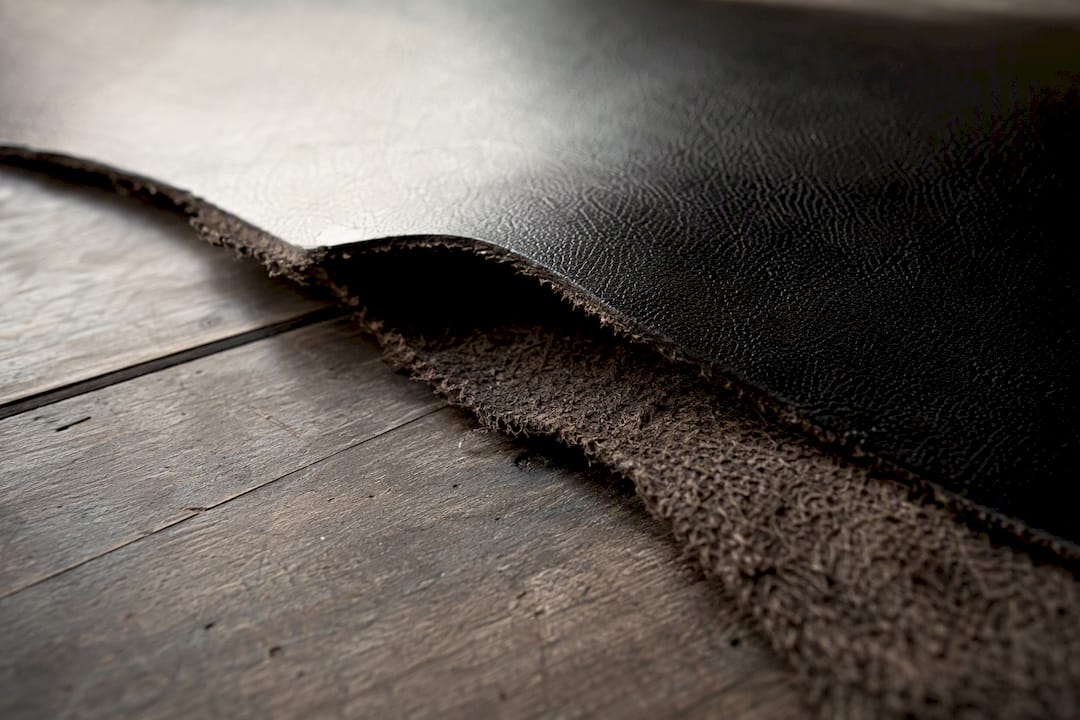
Reading the label carefully solves most of the problem. Look for explicit wording such as “100% synthetic”, “polyurethane” with no mention of hide content, or a recognised vegan certification mark, including PETA-Approved Vegan. When packaging is vague or the price seems unusually low for a “leather” product, that ambiguity itself is a signal worth taking seriously.
Not all PU leather is built the same
Quality in PU leather varies enormously, and that variation rarely shows up in the product name. A cheap tote and a well-made handbag can both say “PU leather” on the tag while representing completely different manufacturing standards underneath.
Single-layer PU coatings, applied thin and cheap over a lightweight backing fabric, represent the bottom tier. These crack and peel fastest because there is little coating thickness to absorb flexing stress, and the backing fabric itself often shows through at stress points like corners and handles within months of regular use.
Multilayer constructions sit higher up the quality ladder. Manufacturers apply the polyurethane in stages, sometimes with a foam or adhesive interlayer, over a sturdier woven or knitted backing. The extra thickness and the more robust base fabric both delay the point where cracking starts, and durability is closely tied to backing quality and coating thickness, with premium constructions using engineered coatings specifically to push that failure point further out.
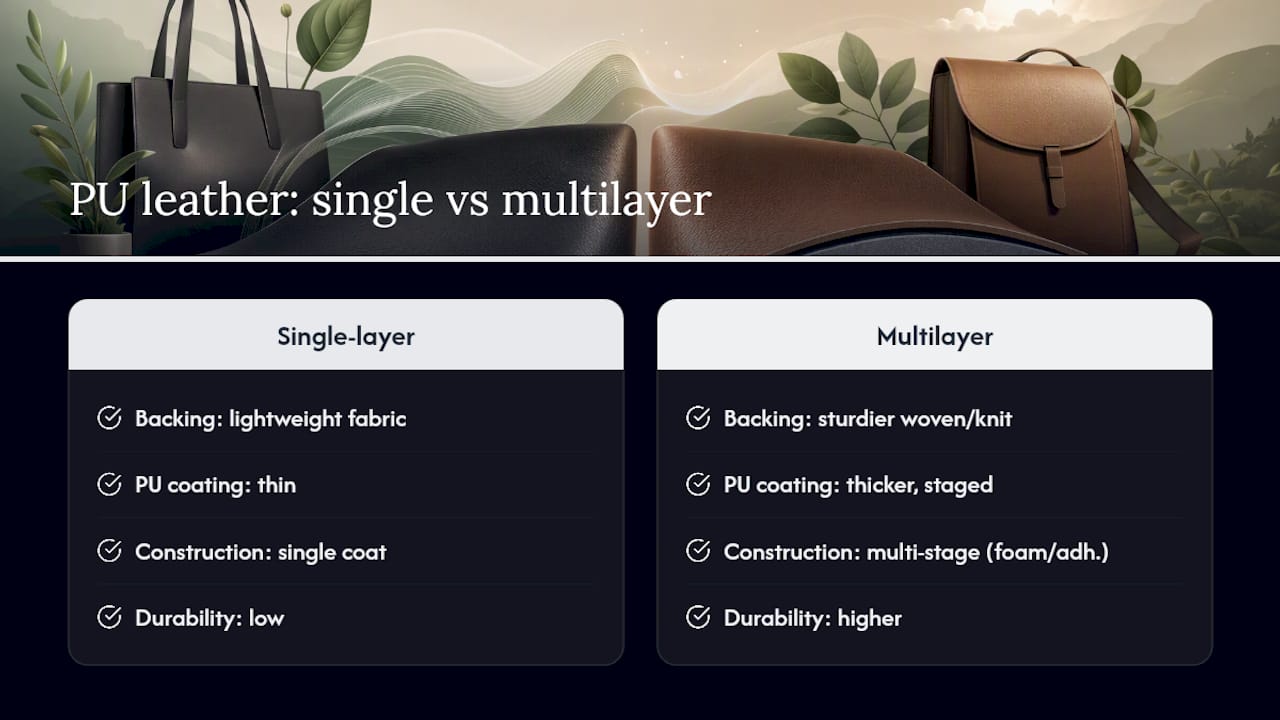
Retail naming rarely reflects any of this. “Vegan leather”, “faux leather”, “PU leather” and “leatherette” get used almost interchangeably by different brands, regardless of the actual construction underneath. The only reliable way to judge quality is to handle the item: flex a corner, check the backing where it is visible at a seam, and feel whether the coating has any give or sits rigid and papery.
How long does PU leather last, and how do you look after it?
Cheap PU items commonly last somewhere in the region of two to five years under normal use before the surface starts cracking or peeling, according to general guidance on PU leather. Premium constructions with thicker coatings and stronger backing fabric can outlast that range considerably, though eventually every PU surface reaches a point where the coating degrades. That is a structural limit rather than a maintenance failure: unlike aniline leather, which can be reconditioned and re-oiled for years, a cracked PU coating cannot be repaired, only replaced.
The common failure modes are worth recognising early, because catching them slows the damage:
- Peeling, where the polyurethane layer detaches from the backing fabric in visible flakes or sheets
- Cracking, fine surface lines that deepen with repeated flexing, especially at fold points like handles and creases
- Delamination, where heat or moisture breaks down the adhesive bond between coating and backing entirely
- Microplastic shedding, tiny polyurethane particles releasing from the surface as the coating ages, particularly during washing or heavy abrasion
Simple habits extend the life of any PU item considerably. Wipe surfaces with a damp cloth rather than soaking them, avoid direct heat sources such as radiators or car dashboards in summer, keep items away from abrasive surfaces that scuff the coating, and store bags stuffed with tissue paper rather than flat, which prevents the coating from creasing permanently along fold lines.
The real trade-off: animal welfare versus environmental cost
PU leather’s clearest advantage is straightforward: it requires no animal skin, so no livestock is farmed or slaughtered to produce it. For shoppers whose priority is avoiding animal-derived materials outright, that single fact settles the question.
The environmental side is considerably less tidy. PU is a petrochemical product, manufactured from polyurethane resins derived from crude oil, and vegan leather is not a single material with the environmental impact varying enormously depending on whether it is PU, PVC, or a plant-based alternative. Production involves solvents and curing chemicals, and while water-based PU processes reduce hazardous emissions compared with PVC, the material still sheds microplastics over its lifespan and offers limited options for recycling once it reaches the end of its usable life. Landfill is the usual destination.
This is precisely where the word “vegan” becomes a loaded label. As sustainability researchers have pointed out, vegan describes what a material excludes, not its overall footprint, and a product can be entirely animal-free while still relying on fossil fuel feedstocks and generating plastic waste at disposal.
None of that erases PU’s practical strengths. It costs a fraction of genuine leather, resists water far better than untreated hide, comes in an enormous range of colours and finishes that leather simply cannot match, and needs no animal husbandry supply chain at all. For a budget-conscious shopper who wants a specific bright colour or a fully waterproof finish, PU remains a genuinely useful option. It just is not automatically the “green” choice its marketing often implies.
Practical checks before you buy
Verifying a product’s actual composition takes only a few minutes, and it is worth doing before you hand over money for anything marketed as vegan leather.
- Check the label wording first. Look specifically for “100% synthetic”, “polyurethane” with no leather content listed, or a recognised certification such as PETA-Approved Vegan.
- Inspect the grain pattern. Genuine PU shows a repeating, mechanically embossed texture, since the pattern is pressed on by rollers. Real hide, and bicast leather that uses a real hide base, shows natural, irregular variation instead.
- Feel the backing at a seam or edge. If you can see or feel woven textile beneath the coating, that supports a fully synthetic construction. A fibrous, felt-like backing can indicate bonded leather instead.
- Smell the material. Genuine leather carries a distinct, oily hide odour. PU has a different, often faintly chemical smell with no trace of animal scent, and checking for a hide odour and grain uniformity is one of the simplest ways to catch a mislabelled product.
- Ask the seller directly. A legitimate seller of genuine PU items should be able to confirm composition and point to certification without hesitation.
Pro Tip: Run your thumbnail lightly across the surface in a corner that will not show. Genuine PU tends to have slight give and a faint texture; a rigid, glossy surface with zero flex often signals a lower grade coating or a PVC substitute mislabelled as PU.
Plant-based alternatives worth knowing about
PU is not the only route to a cruelty-free material, and it is not the greenest one either. A handful of plant-derived alternatives have matured into genuinely usable fabrics over the past decade, each with its own strengths and compromises.
Pineapple leather, made from pineapple leaf fibre left over from fruit harvesting, makes good use of an agricultural by-product but shares a similar reliance on synthetic backing. Mycelium leather, grown from fungal networks, is promising but remains limited in scale and consistency for now.
Cork sits in a distinct position among these options. Harvested from the bark of cork oak trees without felling them, and regrown over multiple years before the next harvest, cork is genuinely renewable at the source rather than merely plant-derived in name. It carries a natural grain that varies piece to piece, resists water well, and holds up to daily use in bags, wallets and accessories without needing a thick polyurethane coating to do the structural work. Cork offers a renewable source with a distinct aesthetic and practical durability that makes it a credible option for anyone weighing PU against plant-based alternatives.
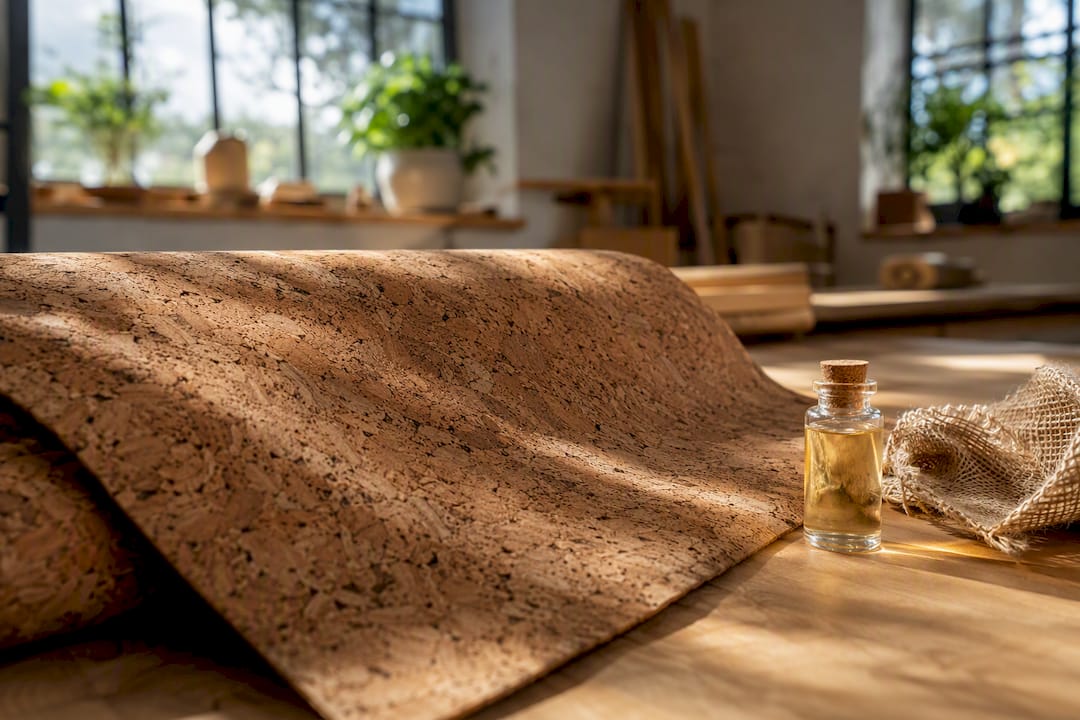
If animal welfare is your only concern, PU answers it adequately. If reducing reliance on petrochemical polymers matters just as much as avoiding hide, cork occupies a genuinely useful middle ground that most synthetic leathers cannot match.
Health and safety concerns with PU leather
Manufacturing PU leather involves solvents, curing agents, and in some processes, compounds such as dimethylformamide (DMF) used to help the polyurethane cure correctly. Facilities using water-based processes generate fewer hazardous fumes than older solvent-based methods, but not every manufacturer has switched over, and regulatory oversight varies significantly by country and by factory.
For the person actually wearing or carrying a finished PU item, day-to-day exposure risk is low. The coating is generally considered stable once cured, and most consumer-facing safety concerns centre on manufacturing environments rather than finished retail products. That said, some people report skin sensitivity to certain PU-coated items, particularly cheaper products where residual processing chemicals have not fully off-gassed before reaching shelves. Airing a new item for a few days before extended skin contact is a reasonable precaution.
The bigger, less visible concern is microplastic shedding over the product’s working life. As PU coatings age and begin to crack, tiny plastic particles release into the environment, including during machine washing of PU-coated clothing or accessories. This is an emerging area of research rather than a settled one, but it is worth factoring into any honest assessment of PU’s overall footprint, alongside the production-side chemical questions.
Buyers who want to sidestep both concerns entirely tend to gravitate toward plant-based materials that need no synthetic coating at all, cork among them.
Choosing between welfare, durability and sustainability
Most buying decisions come down to which priority you rank first, because no single material wins on all three fronts. If animal welfare is your only non-negotiable, well-made PU satisfies it outright. If you want something repairable and built to last decades, genuine leather still has the edge, PU simply cannot match that longevity. If reducing plastic and fossil fuel reliance matters most, materials like cork deserve serious consideration.
At Thecorkstore, that third priority shapes everything we make. Before buying, ask yourself three questions: how long do I actually need this to last, can it be repaired if it fails, and how much plastic am I comfortable carrying? Your answers will point you toward the right material faster than any label ever could.
— Aaron
An honest alternative: cork accessories from Thecorkstore
If you have read this far, you already know PU leather solves the animal welfare question without solving the plastic one. Cork does both: no animal hide, and no reliance on petrochemical coatings to hold the material together. It comes from renewable bark harvests, wears in with a natural grain rather than a cracking surface, and resists water without a synthetic film doing the work.
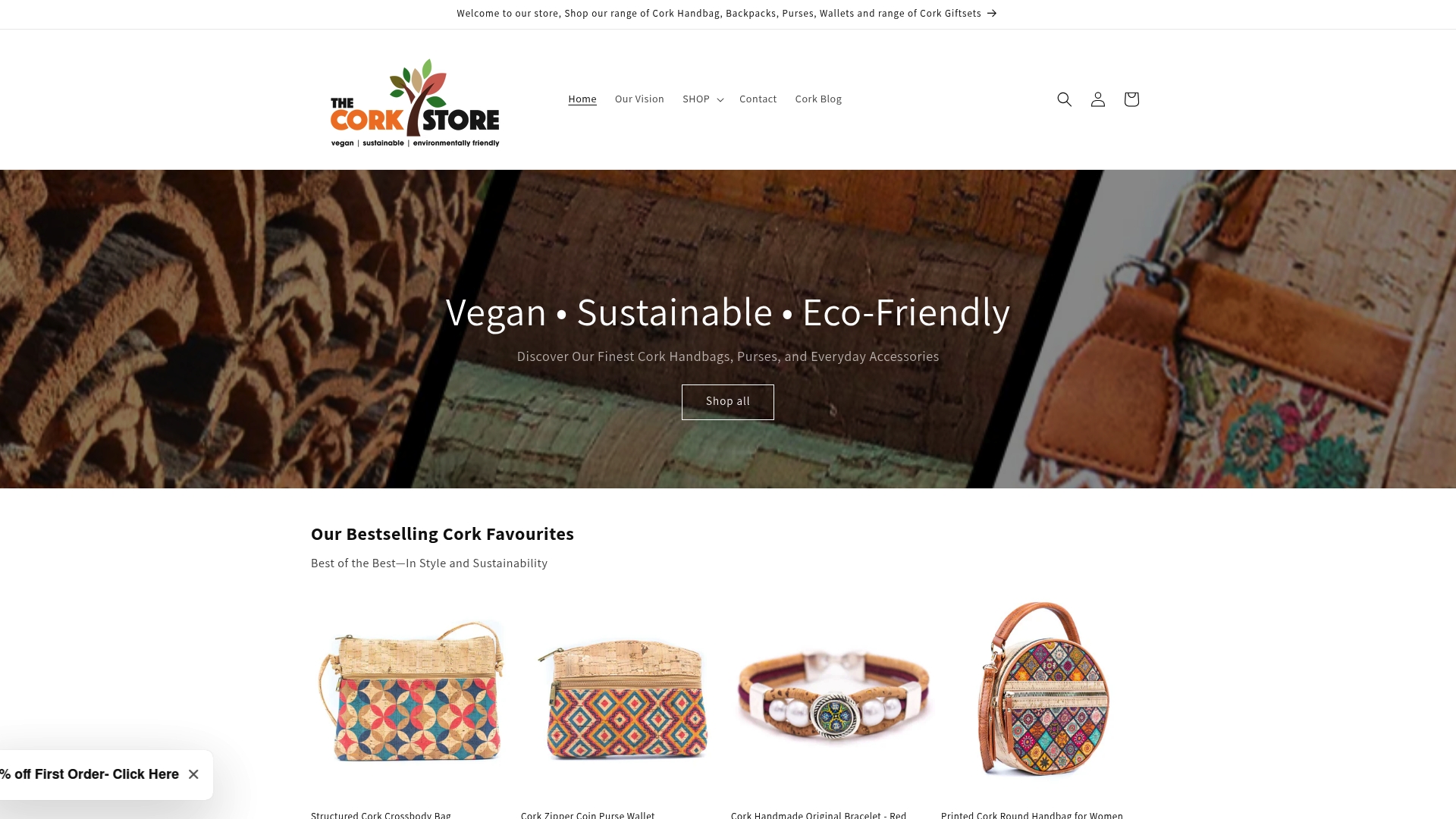
Thecorkstore’s handbags, wallets and accessories are built from cork rather than PU precisely for that reason: a lower-plastic material that still holds up to daily use. If lower plastic content and renewable sourcing matter as much to you as avoiding animal hide, browse the current collection and see which piece fits how you actually use a bag or a wallet day to day.
Sources
- Is PU Leather Vegan? Material Facts & Alternatives | Vegan Wiki
- Making sustainability fashionable | Columbia Engineering magazine