
Cork vs PU leather: making better ethical fashion choices
TL;DR:
- Cork leather is a natural, renewable, biodegradable material that actively supports environmental health.
- PU leather is petroleum-based, non-biodegradable, and contributes to plastic pollution and climate change.
- Cork offers superior durability, water resistance, and unique aesthetic qualities compared to synthetic vegan options.
Not all vegan leathers are created equal, and assuming they are could be the most costly mistake you make as a conscious shopper. While both cork and PU (polyurethane) leather position themselves as animal-friendly alternatives to traditional leather, their environmental credentials, physical properties, and ethical implications sit at opposite ends of the spectrum. If you’re serious about making fashion choices that align with your values, understanding exactly what separates these two materials is essential before you part with your money.
Table of Contents
- What are cork and PU leather?
- Environmental impact: cork vs PU leather
- Physical performance and daily practicality
- Style, ethics, and consumer perception
- Which is right for you? Choosing based on your values
- Why ‘vegan’ isn’t always better: rethinking sustainable leather choices
- Discover sustainable cork leather alternatives
- Frequently asked questions
Key Takeaways
| Point | Details |
|---|---|
| Cork is renewably sourced | Cork leather comes from bark that is harvested without harming trees, supporting healthy forests. |
| PU leather is plastic-based | PU leather is derived from petroleum and does not biodegrade, leading to ongoing pollution concerns. |
| Durability favours cork | Cork’s natural structure gives it greater long-term resilience compared to most PU options. |
| Biodegradability differences | Cork can break down naturally if untreated, while PU accumulates in landfills as microplastics. |
| Style and values matter | Choosing between cork and PU leather reflects your commitment to design, ethics, and mindful consumption. |
What are cork and PU leather?
Before comparing their merits, it helps to understand precisely what each material is, where it comes from, and how it reaches the shelves.
Cork leather is a natural textile derived from the bark of cork oak trees, primarily found in Portugal, Spain, and parts of North Africa. As detailed by Sustainable Jungle, cork leather is harvested from renewable bark every 9 to 12 years without felling the trees, with the process involving boiling, drying, cutting into thin sheets, and backing with fabric. Crucially, once the bark is stripped, the tree regenerates completely. The result is a naturally textured, warm-toned material that carries the unique visual fingerprint of each individual tree.
PU leather, by contrast, is an entirely synthetic product. It is created by coating a fabric base, typically polyester or cotton, with layers of polyurethane plastic. This process requires petrochemicals, industrial solvents, and significant energy consumption. PU leather was popularised partly because it looks similar to traditional leather at a low price point, and partly because it avoids animal hide. However, its foundations are firmly in fossil fuels.
| Feature | Cork leather | PU leather |
|---|---|---|
| Origin | Natural, plant-based | Synthetic, petroleum-based |
| Harvest/production | Bark stripped every 9 to 12 years | Manufactured using petrochemicals |
| Animal involvement | None | None |
| Plastic content | Minimal (backing fabric only) | High (polyurethane coating) |
| Renewable | Yes | No |
Both materials have gained ground as vegan leather alternatives, and the fashion industry has embraced them enthusiastically. But the moment you look beyond the “vegan” label, the differences become impossible to ignore.
Environmental impact: cork vs PU leather
Now that you know how each material is made, let’s weigh their impact on the planet, where real differences emerge.
Cork oak forests are remarkable carbon sinks. Cork oaks sequester up to 14.7 tonnes of CO2 per hectare per year, and the production process itself carries a negative carbon balance, meaning more CO2 is captured than is emitted throughout the supply chain. No tanning chemicals or toxic wastewater enter the environment. No trees are cut down. The forests themselves provide habitat for endangered species, prevent desertification, and actively improve regional air quality.
PU leather cannot claim any of this. Because it is derived from plastics, it neither biodegrades naturally nor contributes positively to its surrounding ecosystem. As the empirical benchmarks confirm, cork carries a negative LCA carbon balance (LCA stands for Life Cycle Assessment, the standard method for measuring a product’s full environmental footprint), whereas PU leather produces persistent plastic pollution across its lifecycle.
Key environmental differences at a glance:
- Cork is fully biodegradable under the right conditions; PU leather is not
- Cork production requires no harmful tanning chemicals; PU manufacturing involves industrial solvents
- Cork forests actively combat climate change; PU factories contribute to carbon emissions
- PU leather sheds microplastics over time, contaminating waterways; cork does not
- Cork oak trees live for up to 200 years, supporting biodiversity throughout; PU is a finite petrochemical product
| Environmental factor | Cork leather | PU leather |
|---|---|---|
| Carbon footprint | Negative (net positive for climate) | Positive (net negative for climate) |
| Biodegradability | Yes (when free of synthetics) | No |
| Microplastic pollution | None | Significant over time |
| Chemical use | Minimal | Solvents and petrochemicals |
| Ecosystem contribution | Forests support biodiversity | Industrial process; no ecosystem benefit |
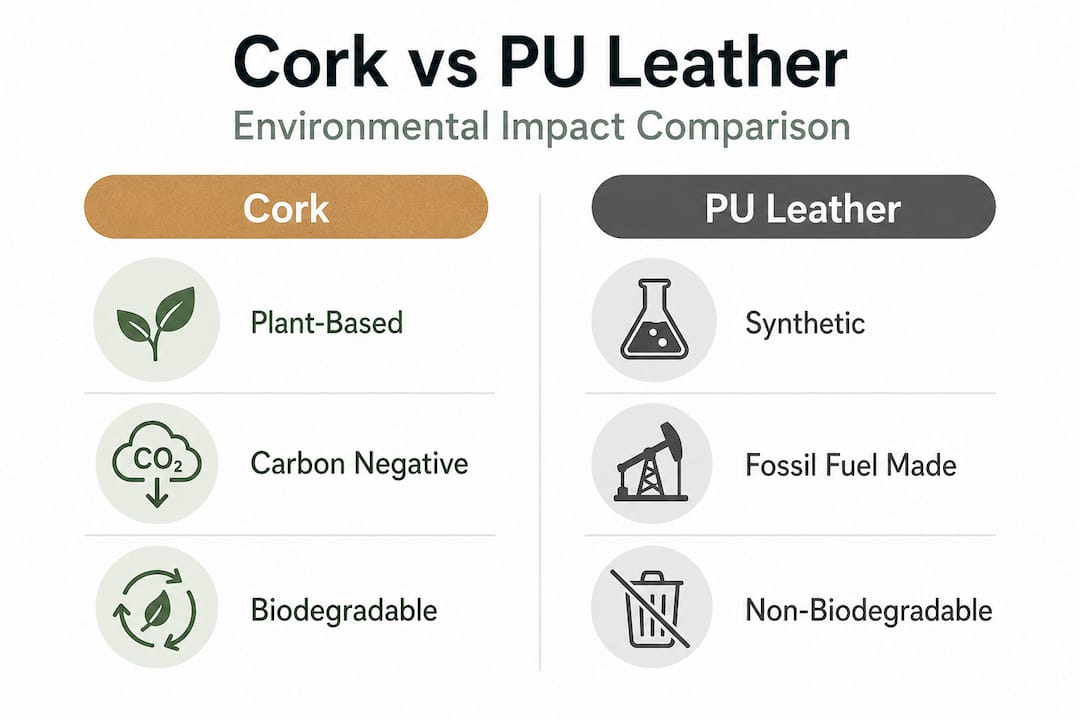
To understand cork’s eco impact in full detail, or to explore the impact of leather in comparative terms, the contrast becomes even more striking. The bottom line is simple: if your goal is to reduce your environmental footprint, cork and PU leather are not interchangeable choices.
Physical performance and daily practicality
Beyond sustainability, let’s see how these materials stand up to daily wear and what that really means for your wardrobe.
One persistent misconception is that natural materials must sacrifice performance for their eco credentials. Cork dispels this entirely. Cork leather is naturally water-resistant thanks to a natural compound called suberin (a waxy substance found in cork cell walls that repels water), and it is also lightweight, elastic, antimicrobial, and hypoallergenic, with high abrasion resistance and low permeability comparable to traditional leather.
What does that mean in practice? A cork wallet will resist light rain without needing a protective spray. A cork handbag won’t harbour the bacteria that cause unpleasant odours over time. Someone with sensitive skin can carry a cork accessory without irritation. These aren’t trivial advantages. They make cork genuinely suited to everyday life.

PU leather can present well initially. A new PU bag often has a polished, leather-like finish that feels substantial in hand. However, high-quality PU may last 5 to 10 years before peeling, while cork’s cellular structure provides better long-term resilience without synthetic binders. In other words, even the best PU leather has a structural weakness built in. The plastic coating inevitably separates from its fabric base, producing the familiar, unsightly peeling that renders bags and wallets unusable.
Cork’s key performance advantages:
- Naturally water-resistant without chemical treatments
- Hypoallergenic and safe for sensitive skin
- Antimicrobial, inhibiting bacteria and odour
- Flexible and lightweight, reducing fatigue when carrying heavier bags
- Abrasion-resistant surface that wears gracefully rather than peeling
“Cork’s cellular structure makes it one of nature’s most resilient materials. Each cubic centimetre of cork contains roughly 40 million cells, all working together to absorb pressure and spring back without damage.”
Pro Tip: When buying cork accessories, look for products that use minimal synthetic backing and natural dyes. This ensures your item stays genuinely biodegradable and retains all of cork’s natural performance properties.
For guidance on caring for cork items at home, or a broader maintenance guide for vegan accessories, the routines are refreshingly simple. A soft damp cloth is typically all you need, with no conditioning oils or specialist treatments required.
Style, ethics, and consumer perception
With practical matters covered, it’s important to look at how these choices signal personal values and affect personal style.
Cork carries a natural warmth that synthetic materials struggle to replicate. Each piece is genuinely unique: the subtle grain variations, the honeyed tones shifting from pale gold to rich amber, and the fine cellular texture all come directly from the individual tree’s bark. No two cork accessories look exactly alike, which gives them an artisanal quality that mass-produced PU simply cannot achieve.
Increasingly, cork’s role in fashion has expanded well beyond novelty. Independent designers and ethical fashion brands are incorporating cork into handbags, wallets, shoes, belts, and jewellery, drawn by both its aesthetic versatility and its storytelling power. Wearing cork makes a statement that goes beyond “I don’t use animal products.” It says you’ve thought carefully about where materials come from and where they eventually go.
This matters because the vocabulary of ethical fashion is shifting. Shoppers are beginning to distinguish between “vegan” and “sustainable,” and the differences in fashion impact between cork and conventional vegan alternatives are significant. A product can be vegan and still rely on fossil fuels, generate plastic waste, and contribute to pollution. Consumers who once felt satisfied by the vegan label are now asking harder questions.
What values different materials signal:
- Cork: renewable, biodegradable, low-impact, artisanal, long-term thinking
- PU leather: animal-free but plastic-heavy, lower upfront cost, shorter lifespan
- Traditional leather: animal-derived, durable but with significant ethical and environmental costs
Pro Tip: If you’re giving a gift to someone who identifies as both environmentally conscious and vegan, cork accessories communicate both values clearly. The harvested without felling trees process is a genuinely compelling detail that resonates with people who care about whole-system thinking.
The growing appetite for transparency in fashion means shoppers want to understand where things come from. Cork’s story, from Portugal’s ancient montado landscapes (the name given to cork oak woodland ecosystems) to a finished handbag, is one that holds up to scrutiny at every stage.
Which is right for you? Choosing based on your values
To put your new knowledge into action, let’s break down how to choose the right material for your unique priorities.
There’s no single correct answer for every shopper, but there is a logical way to work through the decision. Use this step-by-step approach:
- Identify your primary concern. Are you most motivated by reducing environmental damage, by avoiding animal products, or by finding the most durable long-term investment? Each priority points clearly toward cork.
- Consider the full lifecycle. A product that lasts two years before falling apart and goes to landfill as plastic waste is not a sustainable choice, regardless of its vegan credentials. Think about what happens at end of life.
- Assess your budget realistically. Cork accessories typically cost more than entry-level PU goods upfront, but cost significantly less per year of use when you account for longevity.
- Check the carbon story. If climate impact matters to you, the cork oaks’ CO2 sequestration of up to 14.7 tonnes per hectare per year makes cork one of the very few fashion materials that actively benefits the atmosphere during its production.
- Examine brand transparency. Trustworthy producers will tell you where their cork is sourced, how the backing is made, and what dyes or adhesives are used. Opacity on these points is a red flag.
- Consider the eco fashion impact over time. A sustainable style choice is one you’ll feel good about in five years, not just at the point of purchase.
Following these steps honestly means most environmentally motivated shoppers will find that cork satisfies their values far more completely than PU leather. The numbers, the material science, and the ethical framework all point in the same direction.
Why ‘vegan’ isn’t always better: rethinking sustainable leather choices
The fashion industry has done something clever and slightly troubling: it has trained consumers to equate “vegan” with “sustainable,” when the two are entirely separate categories. We’ve watched this confusion play out repeatedly, and it’s worth being direct about it.
PU leather being vegan is not in question. But calling it a sustainable material requires a wilful overlooking of its petrochemical origins, its microplastic shedding, and its inevitable journey to landfill. Plastic does not become environmentally acceptable because it didn’t come from an animal.
Cork’s natural resilience is consistently underestimated, particularly when shoppers compare it to cheap PU goods. Because cork costs more at the point of purchase, it’s often dismissed without consideration of what it offers over a three, five, or ten-year period. The role of design in eco fashion matters here too. Cork products designed with longevity in mind will outperform and outlast synthetic alternatives in nearly every category.
The uncomfortable truth we think the sustainable fashion movement needs to hear is this: choosing a plastic-based product because it avoids leather is not automatically a victory for the planet. Real sustainability requires looking at the whole picture, from raw material extraction through to disposal. Cork wins that assessment. PU leather does not. Holistic thinking, rather than single-issue labelling, is what separates genuinely sustainable fashion from clever marketing.
Discover sustainable cork leather alternatives
If reading this has confirmed what you suspected, that your values deserve more than a vegan label and a plastic product underneath, then cork accessories are the practical next step worth exploring.
At The Cork Store, every product in our collection is crafted from natural cork leather, offering you an alternative that is vegan, biodegradable, and genuinely kind to the planet. From cork handbags and backpacks to wallets, purses, and thoughtfully curated gift sets, each item carries the story of Portugal’s cork oak forests and the sustainable harvesting process that leaves those forests standing tall. Browse our collection to find accessories that match both your style and your standards.
Frequently asked questions
Is cork leather more durable than PU leather?
Cork leather typically offers superior resilience and abrasion resistance compared to high-quality PU, which often peels or cracks over time due to the separation of its plastic coating from the fabric base.
Is cork leather genuinely biodegradable and compostable?
Yes, cork leather is biodegradable and compostable, provided it is free from synthetic dyes or adhesive glues that would interfere with the natural decomposition process.
Does using cork leather harm cork oak trees?
No, because only the bark is stripped every 9 to 12 years, and the tree regrows completely, meaning no trees are felled during the harvesting process.
Does cork leather offer the same flexibility as traditional leather?
Cork leather is flexible, lightweight, and elastic, giving it a soft, practical quality that makes it a comfortable and functional alternative to traditional leather for everyday accessories.
What is the main environmental disadvantage of PU leather?
PU leather is a plastic product that is not biodegradable, meaning it contributes to persistent plastic pollution, microplastic contamination of waterways, and long-term landfill accumulation throughout its lifecycle.