

Avoid Cork Fakes: 3 Ways to Buy Authentic Portuguese Cork Bags
Buy from sellers who name their Portuguese workshop, show the backing material, and state their construction clearly, whether that’s a specialist retailer like Thecorkstore or a maker who ships directly from Portugal. Authentic cork bags come from the bark of the cork oak, processed in Portuguese mills, and genuine sellers prove it rather than just claiming it. Check the listing for origin details, lining and hardware specifics before you buy, and treat vague “cork look” descriptions as a warning sign.
TL;DR:
- Authentic Portuguese cork bags should have clear origin details, such as “made in Portugal,” and show grain texture and backing fabric in close-up photos.
- Genuine cork is made from bark harvested every nine years from the cork oak, laminated onto textile backing, and has natural grain variation, unlike printed vinyl or faux cork.
- Reliable sellers will provide workshop or region names, detailed construction information, and certifications like vegan approval marks, avoiding vague “cork look” claims.
- Prices vary based on size, hardware, lining quality, and craftsmanship, with structured and lined bags generally costing more, and verified provenance justifying higher prices.
- Proper care involves gentle cleaning, avoiding alcohol-based cleaners, and storage away from heat, ensuring the bag develops character rather than damage over time.
Table of Contents
- Where to buy authentic cork bags made in Portugal
- What makes Portuguese cork different from other materials
- How can you tell if a cork bag is real?
- What do Portuguese cork bags typically cost?
- How do you choose the right cork bag for your needs?
- How do you care for a cork bag so it lasts?
- Why trust this guide on Portuguese cork bags?
- Why “cork-style” products keep fooling shoppers
- Ready to shop Portuguese cork with confidence?
- Sources
Where to buy authentic cork bags made in Portugal
Three main routes exist. You can buy directly from Portuguese artisan makers, from specialist online retailers who curate Portuguese-made collections, or from branded manufacturers who sell their own cork lines at retail. A fourth, smaller route is curated marketplaces that vet origin claims before listing, though these are less common and harder to verify at scale.
Manufacturers such as MB Cork run extensive wholesale catalogues out of Portugal, with individual bag models, SKUs, and named product lines, which is a useful benchmark for what a legitimate manufacturer page looks like. If a wholesale supplier is willing to show specific product codes and construction detail, a retail seller sourcing from Portugal usually can too.
Specialist retailers sit between the factory and the customer, and this is where most shoppers outside Portugal actually buy. Thecorkstore, for example, curates handbags, backpacks, wallets, and gift sets made from Portuguese cork, with product pages that describe material composition and origin rather than just showing a photo and a price. That transparency matters more than it sounds, because cork is genuinely hard to fake convincingly at a glance, but a lot of listings dodge the question entirely.
Here’s what to look for on any product page before you commit:
- A clear “made in Portugal” statement, not just “European” or “imported”
- Close-up photos showing grain texture and the fabric backing, not just a styled hero shot
- Named lining material (cotton, polyester, or recycled fabric) and hardware type
- A workshop name, region, or production description, even a short one
- Stated lead times and a real returns policy, not just “final sale”
Retailers such as We Are Portugal explicitly market their cork handbags and wallets as vegan and made in Portugal, often pairing that claim with PETA or vegan approval marks on the listing itself. That combination, a stated origin plus a checkable certification, is the standard worth holding every seller to.
Avoid any listing that leans on the phrase “cork look” or “cork style” without ever using the word “Portugal” or naming a backing material. That phrasing usually signals a printed vinyl or polyurethane product marketed to ride the cork trend, not the real thing. If a seller can’t or won’t tell you where the material was harvested and processed, assume the worst and move on.
What makes Portuguese cork different from other materials
Cork comes from the bark of the cork oak, Quercus suber, harvested without felling the tree, and Portugal produces more of it than any other country on earth. That single fact underpins almost every sustainability claim you’ll see on a cork bag listing, and it’s worth understanding because it separates real material provenance from marketing spin.
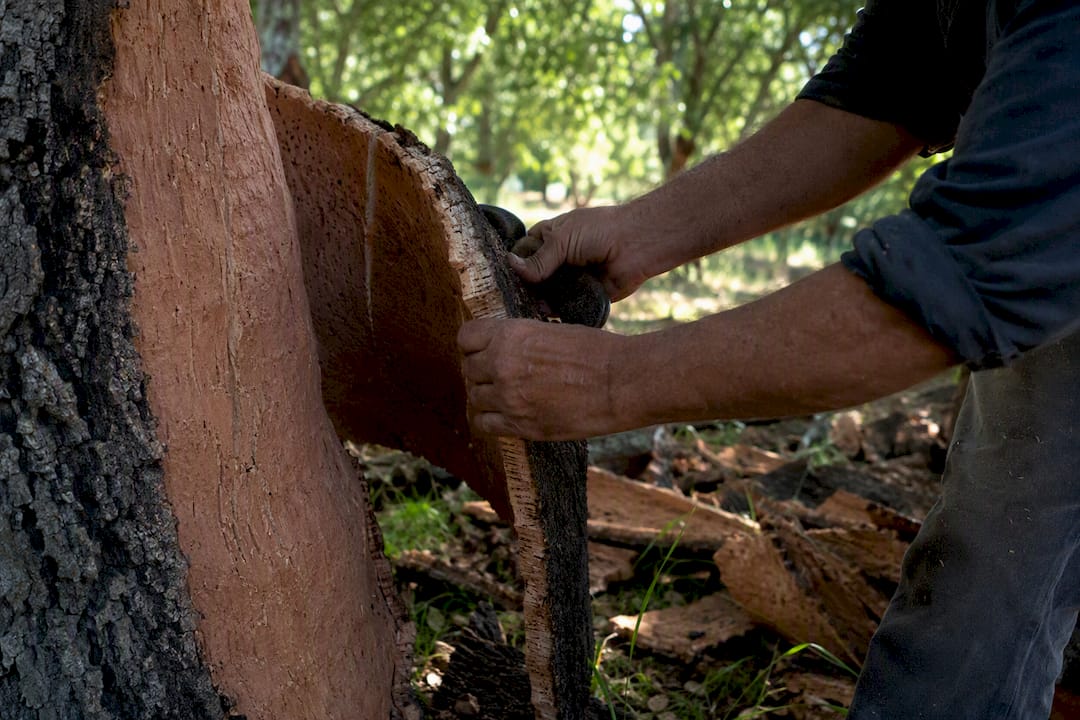
The harvesting itself only happens once every nine years per tree, and the bark regrows, which is why cork is often described as a renewable material rather than a recycled or synthetic one. What happens after harvest is where the fashion-grade material actually gets made. Raw cork bark is boiled or steamed to stabilise it, sliced into thin sheets, then laminated onto a fabric backing, usually cotton or a technical textile, because pure cork bark alone isn’t flexible or strong enough to hold stitching or bear the weight of a bag’s contents. Some sheets are left in their natural mottled pattern; others are printed with colour or texture before lamination.
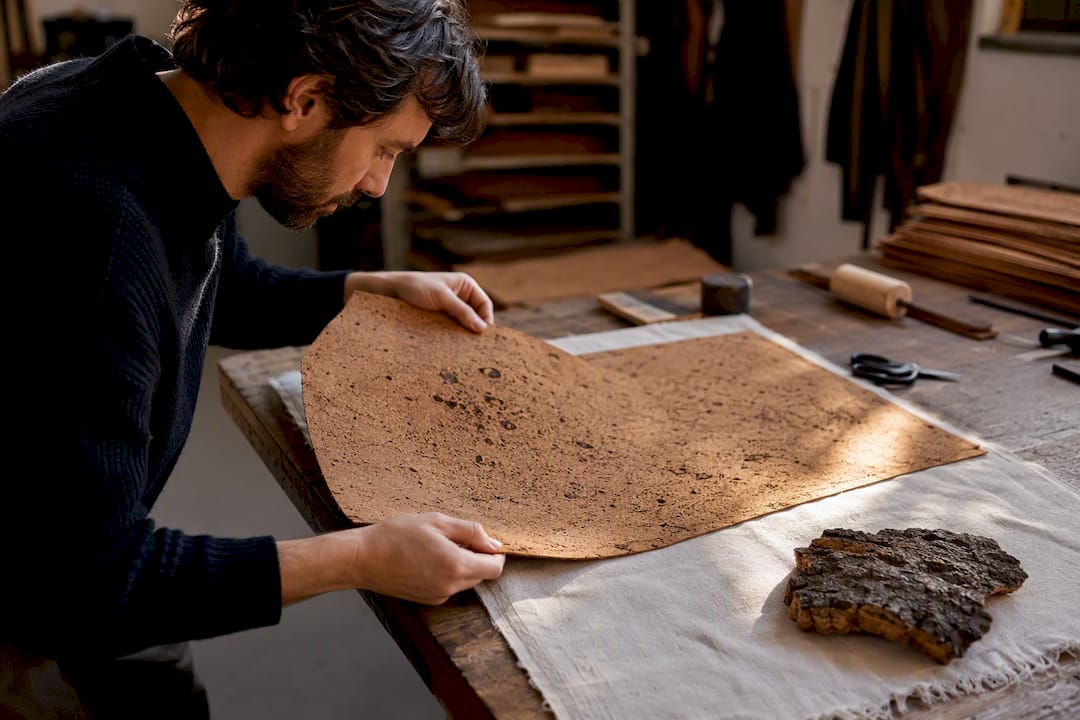
Specialist Portuguese firms have built entire businesses around getting this processing right. Corksribas has over 40 years transforming raw cork into finished material for fashion, construction, and industrial use, and that cross-sector experience is part of why Portuguese cork fabric tends to be more consistent in thickness and flex than material from newer, smaller producers elsewhere. 3DCORK is another Portuguese manufacturer that ties its production to local, renewable-energy-powered facilities, which is the kind of sustainability detail worth asking a seller to confirm rather than taking at face value.
A few things worth knowing about the finish:
- Natural cork shows visible grain variation, meaning no two bags look quite the same
- Printed cork applies colour or pattern over the cork surface, still genuine material underneath
- Backing quality determines durability far more than the visible cork layer does
- Genuine Portuguese cork fabric typically weighs and flexes differently from printed vinyl, a difference you can feel even if you can’t always see it in photos
The concentration of expertise in specialist mills and family firms is precisely why buyers trust Portuguese-made cork over cork-style alternatives from less established supply chains.
How can you tell if a cork bag is real?
Genuine cork has visible, irregular grain, a slightly warm and slightly springy feel under your fingers, and it’s never perfectly uniform. If a “cork” surface looks flawlessly smooth and repeats the same pattern block after block, you’re likely looking at a printed vinyl finish rather than laminated bark.
Run through these checks before buying, especially if you’re purchasing online and can’t handle the bag first:
- Look at the grain closely. Real cork shows natural variation and small flecks; a repeating pattern is a red flag.
- Check the backing fabric. Lift a corner or ask for a photo of the interior seam. Cork fabric is always laminated onto a textile backing, never just a raw sheet.
- Inspect the stitching. Quality construction uses reinforced seams and neat, even stitching, not glue-only joins that peel with wear.
- Assess the lining. A well-made bag has a finished interior lining, usually cotton or polyester, with clean seam allowances.
- Test the hardware. Zips and clasps should feel solid, not light or plasticky, since flimsy hardware is often the first thing to fail.
- Look for proof of origin. A “made in Portugal” statement, a workshop photo, or a certification mark such as PETA-approved vegan status all add credibility.
Pro Tip: If a seller won’t send you a close-up photo of the bag’s interior seam or backing on request, that’s a bigger warning sign than the price. Genuine makers are usually proud to show their construction.
Watch for red flags that cluster together: a strikingly low price for a “handmade” bag, no country of origin anywhere in the description, seams that are glued rather than stitched, or hardware that feels hollow. Any one of these alone might be innocent. Two or three together usually means the “cork” is decorative, not structural.
What do Portuguese cork bags typically cost?
Prices scale roughly with size, construction complexity, and finish, and buyers who understand the drivers can usually tell within seconds whether a listing is priced sensibly. Small accessories, such as cork wallets, card holders, or coin purses, generally sit at the lower end of the range. Crossbody bags and everyday totes cost more because they demand more material and more complex stitching, and structured handbags with lined interiors and metal hardware sit higher again. Larger travel and duffel bags tend to command the highest prices in the category, reflecting both the volume of material and the reinforced construction travel use demands.
Several factors push price up or down within those bands:
- Handmade labour costs more than machine-assembled construction, and genuine artisan work reflects that
- Printed or custom designs typically add a premium over natural, unprinted cork
- Lining and hardware grade matter enormously. Cotton lining and basic zips cost less than technical fabric linings and branded metal hardware
- Limited editions or artisan finishes carry the highest premiums because supply is intentionally small
Assessing value means weighing the asking price against what you can actually verify. A bag with confirmed Portuguese origin, a named lining material, solid hardware, and a real returns policy justifies a higher price than one with none of those things, even if the two look identical in photos. MB Cork’s catalogue, which ranges from printed courier crossbodies to structured totes and wallets each carrying its own model code, illustrates how much variation in construction and finish sits within what looks like one product category from the outside.
If you’re bargain hunting, accept a simpler backing and basic hardware but never compromise on stitched (not glued) seams. If you’re investing in a piece meant to last years, prioritise named linings, reinforced hardware, and a seller who documents origin clearly, since that documentation tends to correlate with better construction overall.
How do you choose the right cork bag for your needs?
Start with how you’ll actually use the bag, not how it looks in a product photo. A daily commuter bag needs a secure closure and enough structure to protect a laptop or documents. A travel bag needs generous capacity and reinforced straps built for repeated handling. An evening bag prioritises size and finish over durability, since it won’t take the daily wear a work bag does.
Work through this before you buy:
- Define the primary use. Daily carry, travel, or occasional wear each demand different priorities in size and structure.
- Check the essential specs. Confirm backing material, lining, strap length, and closure type against your actual needs.
- Ask the seller direct questions. Where is it made? What’s the backing material? What lining and hardware does it use? What are the lead times and return terms?
- Decide which trade-offs you’ll accept. A lightweight, unstructured bag suits travel; a structured bag with a firmer backing suits work use.
- Hold your non-negotiables firm. Secure, reinforced stitching and clear proof of Portuguese origin should never be optional, regardless of style or budget.
If you’re weighing multiple options at once, a simple priority order helps: durability first, provenance second, style third, price last. A beautiful bag that falls apart in six months or turns out to be printed vinyl isn’t a bargain at any price. Guides like Thecorkstore’s eco handbag guide walk through this decision process in more depth if you want a fuller framework before committing.
How do you care for a cork bag so it lasts?
Cork is more resilient than most people expect, but it isn’t indestructible, and the care routine that keeps it looking good is genuinely simple. Wipe it down with a soft, slightly damp cloth and a small amount of mild soap when it picks up dirt or marks. Never soak it, and skip abrasive cleaners or anything containing alcohol, since both can dry out and crack the surface over time.
- Blot spills immediately rather than letting them sit and soak into the backing
- Avoid submerging the bag or scrubbing hard at stains
- Store it upright or stuffed lightly with tissue to hold its shape, away from direct heat or sunlight
- Expect a light natural patina to develop with use. That’s normal ageing, not damage
- For deep stains or a torn seam, take it to a leather worker or cobbler rather than attempting a DIY fix
Pro Tip: Avoid heavy silicone-based waterproofing sprays on cork. They can clog the material’s natural texture and dull the surface. A light, cork-specific conditioner or a simple beeswax treatment works far better if you want extra weather resistance.
Handled this way, a well-made cork bag from a reputable source should hold its shape and finish for years, developing character rather than damage.
Why trust this guide on Portuguese cork bags?
This guide draws on how genuine Portuguese manufacturers and retailers actually present their products, from wholesale suppliers like MB Cork showing named SKUs and construction detail, to established firms like Corksribas, with over 40 years turning raw cork into finished material, and 3DCORK, which ties its manufacturing to Portuguese facilities and renewable energy. Those are the same provenance markers this guide asks you to look for in any listing.
Thecorkstore applies the same standard to its own collections: named materials, stated origin, and product photography that shows construction rather than just styling. If you’re comparing options, its women’s cork handbags and broader buyer’s guide to cork handbags both walk through the same checks detailed above, applied directly to real products you can inspect before buying.
Why “cork-style” products keep fooling shoppers
The biggest gap between what shoppers expect and what they actually get isn’t quality. It’s provenance. Most people assume “cork bag” is a self-explanatory category, the way “leather bag” is, when really it spans everything from genuine Portuguese laminated cork fabric to printed vinyl with a cork-effect texture stamped on top. Sellers know this ambiguity works in their favour, which is why so many listings describe a “cork look” without ever mentioning where the material actually came from.
Conventional buying advice tends to focus on style and price, and largely ignores the one question that actually protects your money: can this seller prove where the material was made? That’s a solvable problem, not a leap of faith. A workshop photo, a named backing fabric, a specific “made in Portugal” claim, these cost a seller nothing to provide if they’re telling the truth, and their absence should worry you more than an unfamiliar brand name does.
My honest read is that shoppers should stop treating certifications and origin statements as nice extras and start treating them as the baseline. Style matters, but it’s the easiest thing to fake in a photo. Provenance is what actually determines whether the bag in front of you is cork at all.
— Aaron
Ready to shop Portuguese cork with confidence?
Thecorkstore gives you what a lot of generic marketplace listings can’t: named materials, stated Portuguese origin, and construction detail on every product page, so you’re never guessing whether “cork” means real laminated bark or printed vinyl. Every piece in the collection is vegan by design, built to last with proper backing and lining rather than a decorative surface layer, and shipped with a clear returns policy if something isn’t right.
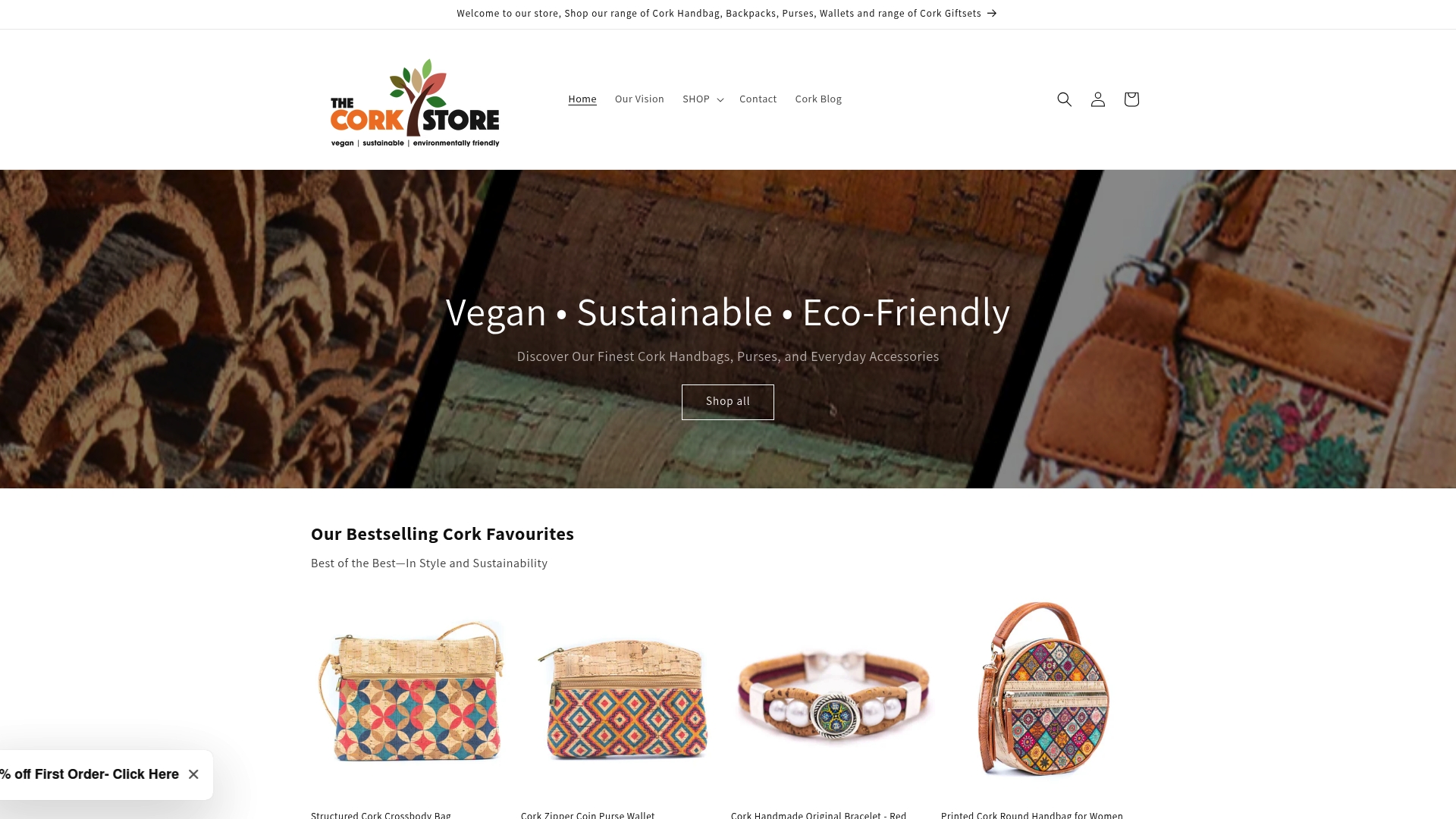
If you’re after something built for daily use and travel, the women’s cork backpacks collection is a solid place to start browsing, with styles that pair structured backing and reinforced straps against the lighter, more casual pieces covered earlier in this guide. Pair a bag with a small vegan accessory, such as a vegan watch strap, if you’re building out a fully cruelty-free wardrobe. Have a look through the current range, check the material description on any piece that catches your eye, and order with the confidence that comes from buying from a seller who shows its working.
Sources
- Cork Fabric & Bags Supplier From Portugal – MB Cork
- 3DCORK — Intelligent Nature. Engineered for your products.
- CorksRibas - Leader in Innovative and Sustainable Cork Solutions
- Vegan cork handbags, wallets and purses made in Portugal – We Are Portugal