

Cork table: buying, care and DIY ideas
A cork table is any table made mainly or entirely from cork: solid cork blocks, agglomerated (compressed) cork, or a cork veneer bonded to a substrate like MDF or plywood. Three routes suit three different buyers: a sculptural solid or agglomerated piece for a statement living room, an oiled contract-grade top for hospitality use, and a DIY cork-topped surface for anyone happy to build their own.
Sizes cluster around three formats: side tables (roughly 40 to 55cm), coffee tables (60 to 130cm), and dining tables (110 to 200cm). Stock pieces ship in days; made-to-order designer tables can take eight weeks or more.
- Designer/statement pieces: made-to-order, higher price, longer lead time
- Contract/hospitality tops: oiled cork, built for spills and re-oiling cycles
- DIY/craft tops: cheapest route, full control over finish and size
Key Takeaways
Choosing the right cork table comes down to matching construction (solid, agglomerated, or veneer) to how hard the table will actually be used, then committing to a six-monthly re-oiling routine.
| Point | Details |
|---|---|
| Construction decides durability | Solid cork suits decorative pieces; agglomerated cork suits daily-use coffee tables and dining surfaces. |
| Lead time tracks customisation | Ready-stock novelty pieces ship in days; designer and made-to-order tables can take 8 to 9 weeks or more. |
| Sealing is not optional | Hardwax oil suits home use; polyurethane suits hospitality-grade durability against spills. |
| Re-oiling protects the investment | Oiled cork tops benefit from re-oiling roughly every six months to maintain water resistance. |
| Accessories offer a lower-commitment start | Thecorkstore’s cork placemats and coasters bring the same material to any table without a bespoke order. |
Table of Contents
- What is a cork table, and which type suits you?
- Which cork tables are actually worth considering?
- How do you choose the right cork table for your space?
- How do you protect a cork table from damage?
- Can you build or resurface a cork table top yourself?
- Why does cork’s origin and production matter?
- Cork versus wood, glass and metal: the trade-offs
- When does a cork table actually make sense?
- Practical alternative: add cork accessories from Thecorkstore
- Sources
What is a cork table, and which type suits you?
Not every cork table is built the same way, and the construction method decides almost everything else, price, weight, durability, and how it should be cared for.
Solid natural cork is carved or shaped from a single block. The XLCORK giant champagne cork side table is a good example: a novelty piece made from solid cork with its weight and dimensions published on the product page. It’s decorative rather than a dining workhorse, but it shows what pure cork looks like without engineering tricks.
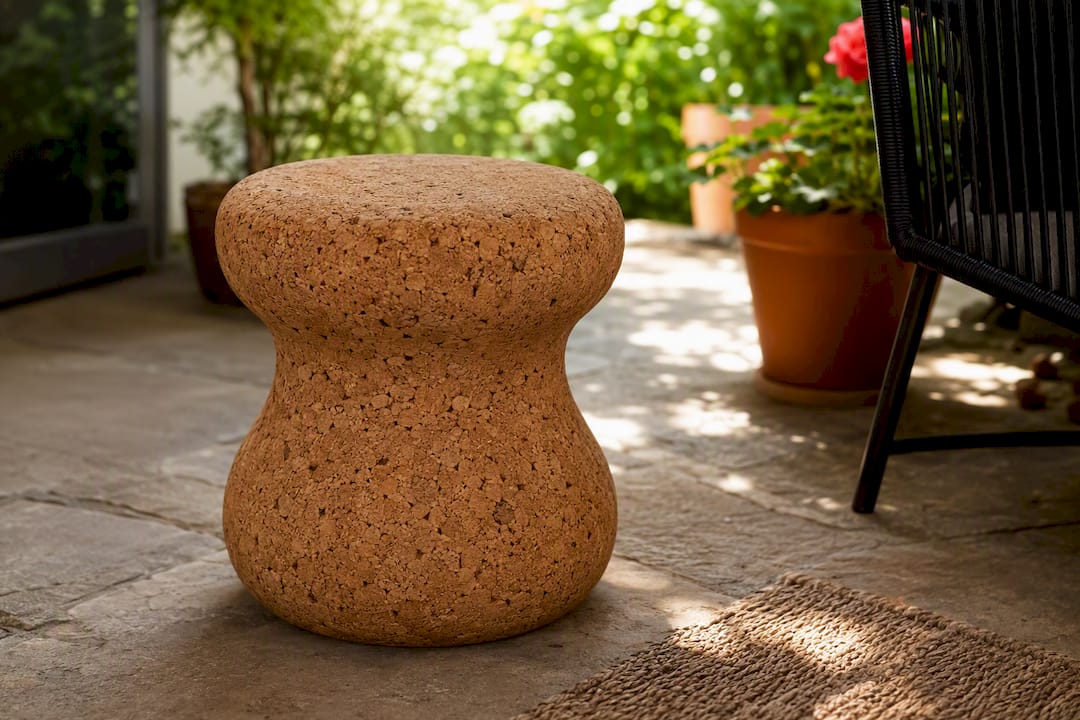
Agglomerated cork is cork granules pressed and steamed into a monolithic block, no additives needed because the tree’s own resin binds it. DAM’s MAGMA table uses this method, and makers like Babled’s Quark Cork range document the same steam-pressing process as a low-waste production technique. The result is denser, more structurally stable, and better suited to a coffee table that takes daily use.
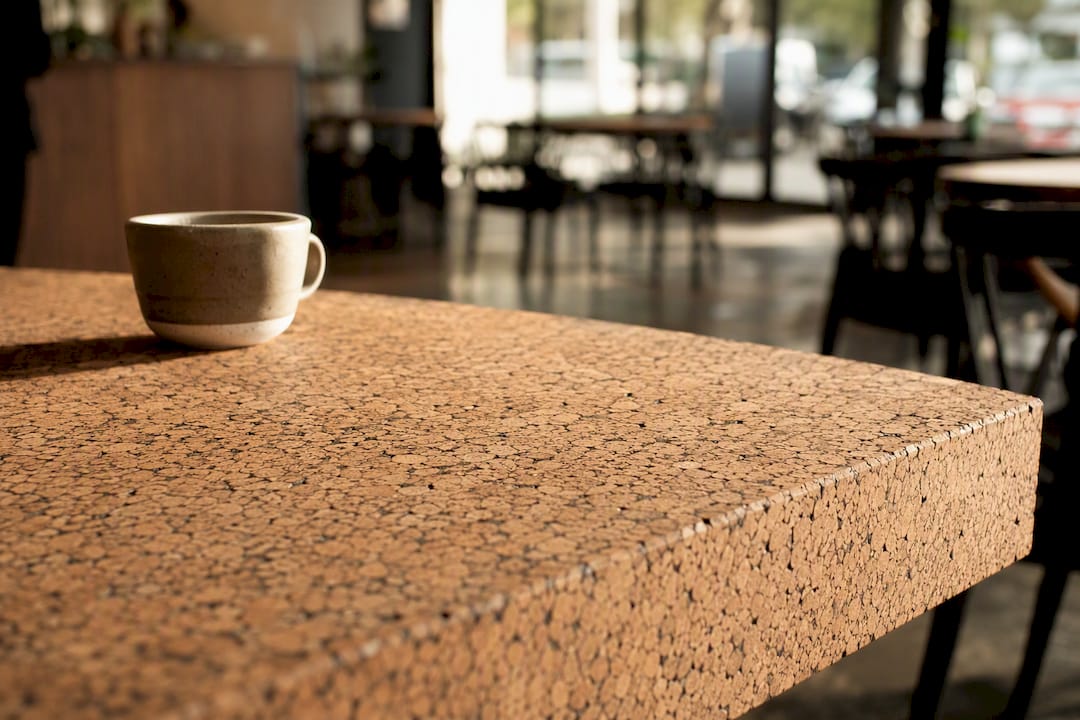
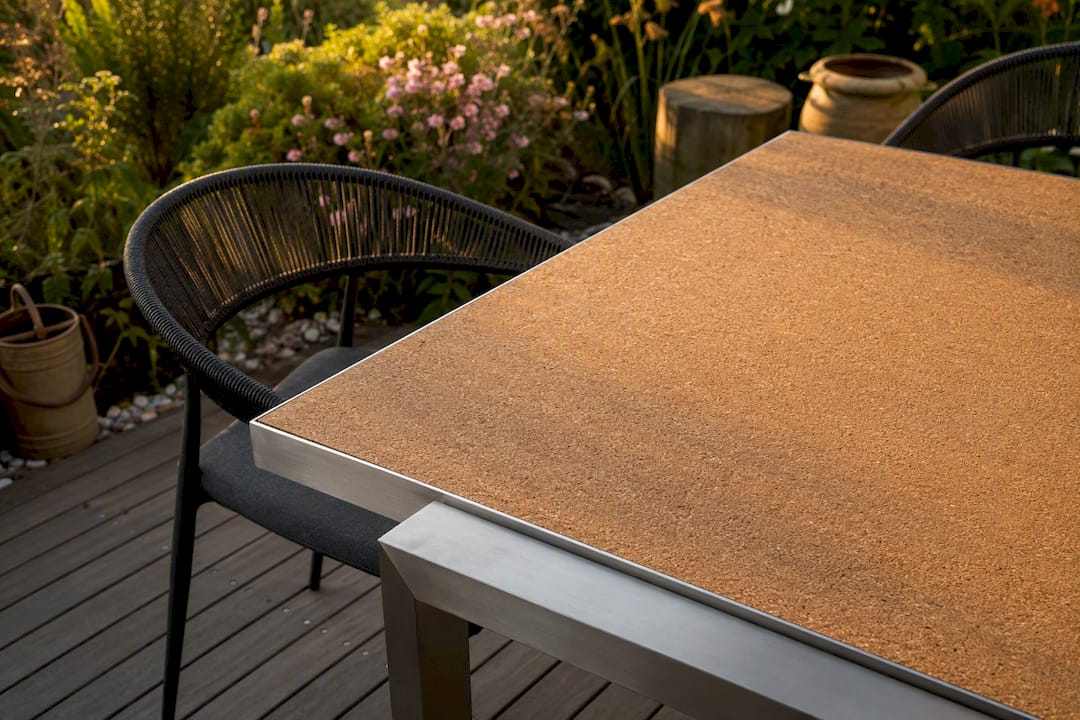
Cork veneer over a substrate pairs a thin cork layer with MDF, plywood, or a metal frame underneath. Tom Dixon’s round cork table takes this approach, combining cork with timber cores for strength that solid cork alone can’t offer at large diameters. Studio AHEAD goes further, pairing thick cork tops with stainless steel bases for a made-to-order, gallery-furniture feel.
Which cork tables are actually worth considering?
Six names come up repeatedly when you search for a genuine cork table, and they sit at very different points on price, lead time, and intended use.
Tom Dixon’s cork round table (1200mm) is the design-led entry point. It is about 1.2 meters wide and deep, and approximately 75 cm high, and its tactile, sculptural silhouette comes from mixing solid cork with an MDF or plywood core. It’s built for a dining room that wants a conversation piece, not a table that disappears into the background.
DAM’s MAGMA wide low is a monolithic agglomerated cork coffee table, available with stone top options for a contrast finish. It weighs 17kg, measures 49 x 49 x 38cm, and carries a three-year warranty with an 8 to 9 week lead time, the kind of concrete spec sheet that separates a serious maker from a listing with no detail.
Studio AHEAD’s cork table is fully made to order, pairing a stainless steel base with a thick cork top. Expect a longer wait than either of the above, since it’s presented and priced as gallery furniture rather than stock.
Kerf’s cork side table strips things back: two sheets of agglomerated cork, lightweight enough to move around a room on a whim, with no metal or timber substrate at all.
The giant champagne cork side table, sold both on XLCORK’s own site and via an ImpulsePurchase listing, is solid natural cork shaped as an oversized champagne cork. It’s a novelty rather than a daily-use table, but it ships fast and lists a fixed price, useful if you want cork furniture without a two-month wait.
| Product | Best for | Construction | Price / lead time | Durability / finish | Size / weight | Warranty / returns |
|---|---|---|---|---|---|---|
| Tom Dixon cork round table 1200mm | Designer dining, statement pieces | Cork with MDF/plywood/timber core | Premium, made to order | Sculptural, needs sealing check with seller | 1200mm x 1200mm x 75cm | Confirm with seller |
| MAGMA wide low (DAM) | High-end coffee tables, gallery pieces | Agglomerated cork monolith, stone top option | Premium, 8 to 9 week lead time | Dense, durable, re-oilable | 49 x 49 x 38cm, 17kg | 3 year warranty |
| Studio AHEAD cork table | Bespoke, made-to-order dining | Cork top on stainless steel base | Premium, long lead time | Architectural, ask about sealing | Confirm with seller | Confirm with seller |
| Kerf cork side table | Light, movable side tables | Two sheets of agglomerated cork | Mid-range, check stock | Lightweight, minimal finish | Compact, low weight | Confirm with seller |
| Giant champagne cork side table (XLCORK) | Decorative, themed interiors | Solid natural cork | Fixed retail price, fast dispatch | Decorative use, not heavy-duty | Listed on product page | Standard retail terms |
| Giant champagne cork side table (ImpulsePurchase) | Ready-to-buy novelty or gift | Solid natural cork | Fixed retail price, fast dispatch | Decorative use, not heavy-duty | As listed | Standard retail terms |
Where a listing doesn’t state warranty terms or finish type outright, ask the seller directly before ordering, especially on made-to-order pieces where a deposit is often non-refundable.
How do you choose the right cork table for your space?
Start with how the table gets used, not how it looks in a photo. A side table that holds a coffee cup and a book has very different demands from a dining table that sees hot plates, cutlery scrapes, and daily wiping down.
Match the table to its job. A coffee or side table in a low-traffic corner can handle a softer, more decorative cork like the XLCORK novelty piece. A dining table or café surface needs the density of agglomerated cork or a well-sealed veneer, the kind Inside Out Contracts supplies to restaurants precisely because oiled cork tops hold up under repeated spills.
Check the construction before you check the price. Solid cork is soft and marks more easily under sharp impact. Agglomerated cork is denser and more forgiving. Cork veneer over MDF or a metal frame adds structural strength but means the finish, not the base, does the protective work.
Before ordering, ask the seller these questions:
- Is the top solid cork, agglomerated cork, or a veneer over a substrate?
- What finish is applied, hardwax oil or polyurethane, and does it need re-oiling?
- What’s the lead time for stock versus made-to-order pieces?
- What does the warranty or return policy cover if the top marks in transit?
- Is the cork FSC-certified or otherwise traceable to source?
Price bands follow lead time fairly closely. Novelty and ready-stock pieces, like the champagne cork side tables, sit at the lower end and ship within days. Designer and made-to-order tables from Tom Dixon or Studio AHEAD sit higher and can take 8 to 9 weeks or more, DAM’s own lead time for the MAGMA table.
How do you protect a cork table from damage?
Cork is naturally water-resistant, flame-retardant and a strong sound absorber, but it isn’t waterproof out of the box. Sealing decides how it copes with daily life.
Hardwax oil suits home use and gives a matt, natural finish that’s easy to spot-repair. Polyurethane creates a harder shell, closer to what hospitality tables need to survive constant wiping and spills.
- Wipe spills promptly with a damp cloth, never an abrasive cleaner.
- Keep the table out of prolonged direct sun to prevent discolouration.
- Avoid placing very hot pans directly on the surface, since cork doesn’t conduct heat well but can still mark locally.
- Re-oil an oiled finish roughly every six months, the same cycle contract suppliers recommend for café and restaurant tables.
Pro Tip: Test any cleaning product on an unseen edge first. Cork’s surface reacts differently to solvents than wood does, and a product safe for oak can dull a hardwax oil finish.
For deeper cleaning routines, Thecorkstore’s guide on caring for cork accessories covers the same principles applied to smaller cork goods.
Can you build or resurface a cork table top yourself?
Yes, and it’s one of the more forgiving furniture projects for a confident DIYer. You’ll need cork sheets or granule underlay blocks, a contact adhesive rated for porous surfaces, a hardwax oil or polyurethane finish, and a sanding block or orbital sander.
- Measure the existing tabletop or substrate and cut cork sheets to size with a sharp utility knife.
- Sand the substrate lightly so the adhesive keys properly.
- Apply adhesive evenly and press the cork down, working from the centre outward to avoid air bubbles.
- Sand the finished surface once cured, then apply two thin coats of hardwax oil, sanding lightly between coats.
- Let the final coat cure fully before use, usually 24 to 48 hours.
Work in a ventilated space when using contact adhesive or oil finishes, and never place hot items near a surface that’s just been oiled since the finish hasn’t fully hardened yet.
Why does cork’s origin and production matter?
Most quality cork still comes from Portugal, where cork oak bark is harvested roughly every nine years without felling the tree, one of the more genuinely renewable material cycles in furniture making. FSC certification, where a maker offers it, confirms that harvesting follows sustainable forestry standards rather than just a marketing claim.
Production method matters as much as origin. Monolithic pieces like DAM’s MAGMA table or Babled’s Quark Cork range are made by steam-pressing cork granules in a mould, using the tree’s natural resin as the only binder, no synthetic glue involved. Veneer pieces bond a thinner cork layer to MDF or plywood, which lowers cost but changes how the table should be cared for and repaired.
Design writers have noted that cork’s sculptural qualities come from its natural texture, and that no two monolithic pieces are ever quite identical.
Before buying, check three things: where the cork was sourced, how long the lead time runs, and whether the maker states a warranty. DAM’s product page, for instance, states a three-year warranty alongside its weight and dimensions, exactly the kind of detail that lets you compare sellers properly. Thecorkstore’s own piece on what natural cork is covers the harvesting cycle in more depth for anyone new to the material.
Cork versus wood, glass and metal: the trade-offs
Cork brings genuine advantages a hard tabletop can’t match, but it isn’t the right fit for every room.
- Pros: lightweight compared with solid wood or stone, naturally sound-dampening, warm underfoot and to the touch, renewable, and water and heat resistant once properly sealed.
- Cons: softer than wood, glass or metal so it marks under sharp impact, needs periodic re-oiling on high-use surfaces, and can discolour with prolonged sun exposure.
When does a cork table actually make sense?
A cork table earns its place in a quiet living room, a reading nook, or a boutique café aiming for a sustainable, tactile feel. It’s less convincing for a family dining table that sees knives, hot pans, and daily scraping, wood or a sealed composite will simply shrug off more abuse there.
Practical alternative: add cork accessories from Thecorkstore
If a full cork table feels like a bigger commitment than you’re ready for, or you already own one and want to complement it, Thecorkstore gives you an easier way in: cork placemats, coasters, and small accent pieces that bring the same warm, tactile material to your table without the wait time or price tag of a bespoke commission.
Full-size cork furniture from makers like DAM or Studio AHEAD is a specialist purchase, and this article covers buying and care rather than manufacturing. But dressing a wood, glass, or existing cork table with genuine cork accessories is something you can do today. Thecorkstore’s range of cork accessories is built from the same sustainable material principles covered above, sourced with the same origin transparency buyers should expect from any cork product. Browse the current collection and pair a set of coasters or a placemat run with whatever table you already have.