

Cork table top: what DIYers and buyers need to know
TL;DR:
- A cork table top is a sustainable and warm material suitable for quiet dining rooms and home offices. Its durability and finish depend on the construction type and application, especially for contract use. Buyers should verify manufacturing details, sustainability claims, and maintenance requirements before purchasing.
A cork table top suits quiet dining rooms, home offices, and acoustic-sensitive cafés — it is lightweight, naturally warm to the touch, and one of the few genuinely renewable table materials available. For most home buyers and DIYers, it is a strong choice. For heavy-duty contract use, the finish and construction grade matter enormously, and picking the wrong type is the most common mistake.
Quick buy vs commission vs DIY comparison:
| Route | Best for | Typical lead time |
|---|---|---|
| Buy ready-made (contract supplier) | Cafés, hospitality, standard sizes | Days to 2 weeks |
| Commission bespoke | Custom shapes, showroom pieces | Several weeks |
| DIY (tiles or veneer on substrate) | Home tables, desks, budget builds | Weekend project |
Who should do what:
- DIYers and homeowners — cork tiles or veneer on a plywood substrate, sealed with hardwax oil or polyurethane, is a weekend project that costs a fraction of a ready-made top.
- Home dining buyers — a ready-made contract top from a UK supplier gives you a finished, oiled surface without the faff.
- Café and hospitality buyers — specify agglomerated or solid cork, confirm the manufacturer’s usage rating, and ask about FSC sourcing before ordering.
Table of Contents
- What types of cork table top are there, and which suits you?
- How do you apply cork tiles or veneer to a tabletop yourself?
- Which finish should you use, and how do you maintain it?
- Where should you buy a cork table top in the UK?
- Why does the material grade and manufacturing method matter?
- Key takeaways
- A practical view on cork tabletops
- Cork accessories from Thecorkstore
- Useful sources to check next
What types of cork table top are there, and which suits you?
Cork is not a single product. The construction method changes how a surface performs, how long it lasts, and whether it can be repaired.
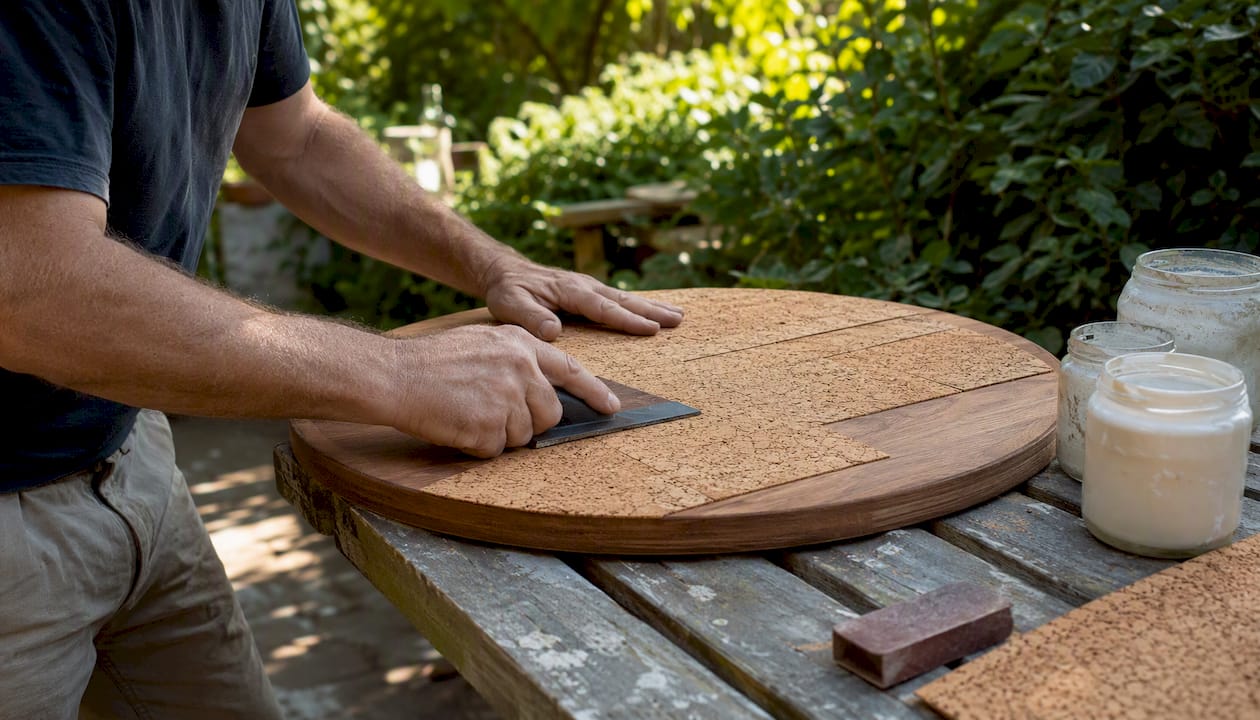
| Type | Construction | Best for | Thickness range | Outdoor rated? |
|---|---|---|---|---|
| Decorative tile / veneer | Thin cork layer on plywood or MDF substrate | Home dining, desks, light café use | ~24mm overall | No |
| Agglomerated cork (dark) | Compressed granules, natural resin binder | Contract, café, coffee tables | 50mm+ | Some variants — verify |
| Monolithic / solid cork | Steamed granules in mould, no synthetic glue | Design-led furniture, showroom | Varies by design | Rarely |
| Ready-made contract top | Agglomerated or solid, supplied finished | Hospitality, commercial | 50mm (circular Ø600–Ø1400mm) | Manufacturer-specific |
The distinction between decorative tile veneer and agglomerated cork matters more than most buyers realise. Decorative tiles are typically built on a 24mm plywood substrate with varied cork finishes — they look the part but will not withstand the same punishment as a pressed block. Dark agglomerated cork is generally more robust; lighter decorative cork is intended for indoor, light-duty use only.
Outdoor use is a specific case. Some dark agglomerated variants carry an outdoor rating, but always verify the manufacturer’s stated usage rating before placing any cork furniture outside. Never assume.
How do you apply cork tiles or veneer to a tabletop yourself?
Materials checklist:
- Cork tiles or veneer sheet (minimum 4mm tile thickness for a table surface)
- Contact adhesive or PVA wood glue (check manufacturer recommendation)
- Fine-grit sandpaper (120 and 240 grit)
- Sealant: hardwax oil, polyurethane, or lacquer
- Sharp craft knife or jigsaw, steel ruler, pencil
- Roller or brayer, clamps or weights
Steps:
- Prepare the substrate. Sand the plywood or MDF surface flat and clean off all dust. Any unevenness will telegraph through the cork.
- Cut tiles to size. Measure twice, cut once. Leave a 1–2mm expansion gap around the perimeter — cork moves slightly with humidity.
- Apply adhesive. Spread contact adhesive evenly on both the substrate and the back of the tile. Allow to become touch-dry before pressing together; once contact adhesive meets, repositioning is not possible.
- Press and roll. Use a brayer or roller to work out air bubbles from the centre outward. Apply weight or clamps and leave for the adhesive’s recommended cure time.
- Sand the surface lightly. Once fully cured, a light pass with 240-grit paper smooths any tile edges and opens the pores for sealing.
- Apply sealant. Work in a well-ventilated space. Apply two to three thin coats, sanding lightly between each. Allow full cure before use.
- Check for gaps or lifted edges. Press down any edges that have not bonded fully and re-seal if needed.
Pro Tip: Before sealing the whole surface, test your chosen finish on a scrap tile or a hidden corner. Some sealants darken cork significantly; others leave it pale. A test patch takes five minutes and saves a regrettable surprise.
Ventilation during both adhesive and sealant application is not optional. Solvent-based contact adhesives and polyurethane finishes produce fumes that accumulate quickly in enclosed spaces.
Which finish should you use, and how do you maintain it?
The finish you choose shapes how the surface ages, how easy it is to repair, and how often you need to maintain it.
| Finish | Best use case | Repairability | Re-application interval | Notes |
|---|---|---|---|---|
| Hardwax oil | Home dining, contract hospitality | High — spot repair possible | Every 6 months | Supplied oiled on contract tops; re-oil schedule recommended |
| Polyurethane | Hospitality, high-traffic surfaces | Low — full strip needed | Every 2–3 years | Durable; pairs well with solid timber frames |
| Lacquer | Decorative, lower-traffic | Low | Every 1–2 years | Brittle under impact; not ideal for café use |
| Epoxy / resin | Bar tops, very high traffic | Very low — cannot spot repair | Rarely needed | Fully waterproof but changes the tactile feel of cork |
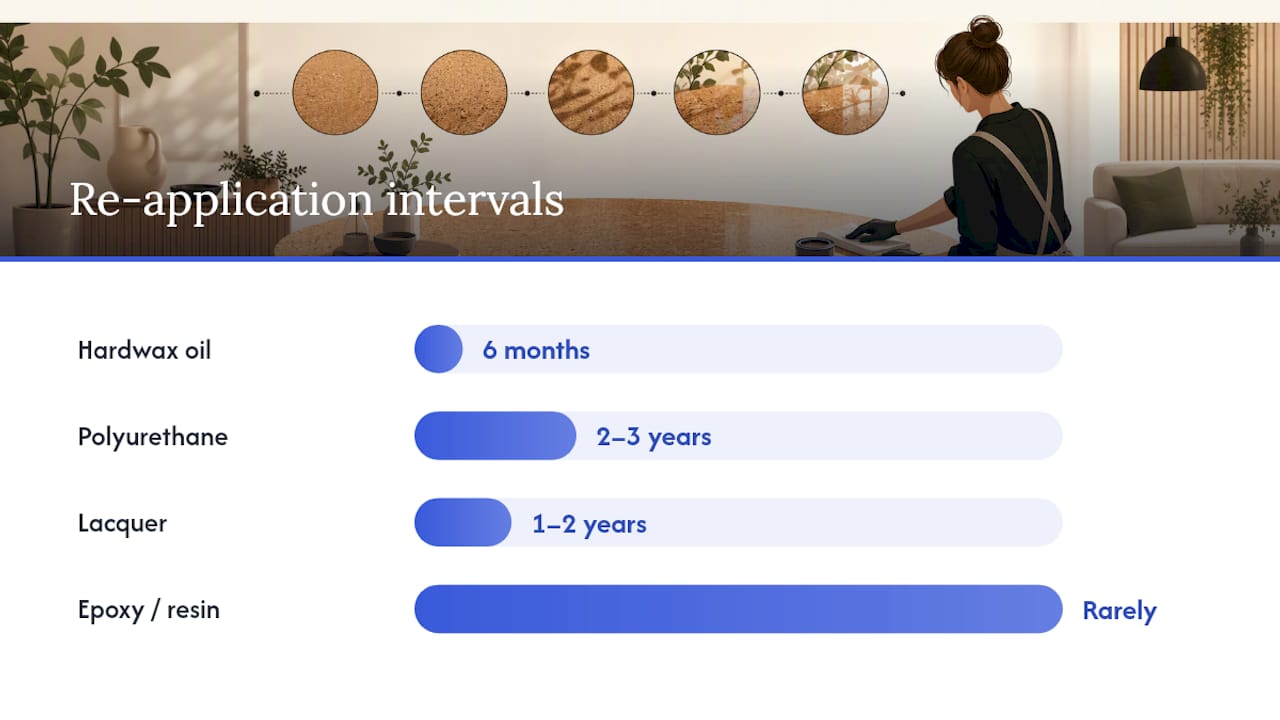
Hardwax oil is the most practical choice for most home and hospitality settings. Contract-grade cork tops are commonly supplied with a matt hardwax oil finish already applied, with a re-oiling recommendation every six months to maintain liquid resistance.
Maintenance schedule:
- Weekly: Wipe with a damp cloth; avoid soaking the surface. Dry immediately after cleaning.
- Monthly: Check for any areas where the finish looks dull or patchy — these are early signs of wear.
- Every 6 months: Re-oil hardwax-finished tops. Clean thoroughly first, allow to dry, then apply a thin coat of the same oil product.
- Annual: Inspect edges and any tile joins for lifting. Re-seal joins with a compatible sealant if needed.
Acidic spills — wine, citrus, vinegar — are the main enemy of an unsealed or lightly sealed cork surface. Clean them immediately; do not let them sit. If staining occurs despite a sealed surface, light sanding followed by re-oiling can recover most marks on hardwax-finished tops. Polyurethane and epoxy finishes do not allow this kind of spot repair.
Where should you buy a cork table top in the UK?
Ask any supplier these questions before ordering: Is the cork FSC-certified? What is the stated thickness and density? What finish is applied, and what maintenance does it require? What is the lead time, and is there a warranty?
| Product | Type / construction | Best for | Durability | Finish & maintenance | UK availability / lead time | Price band |
|---|---|---|---|---|---|---|
| InsideOutContracts cork table top | Agglomerated, contract-grade | Contract and hospitality | High — rated for commercial use | Supplied oiled; re-oil every 6 months | UK supplier; short lead time | ££–£££ |
| Etsy UK cork table tops | Tile veneer on substrate; varies by maker | Bespoke, handmade, low-run | Varies by maker and finish | Varies; confirm with seller | Varies; confirm lead time | £–££ |
| MAGMA (DAM Portugal) | Monolithic agglomerated, FSC-certified | Design-led, showroom, bespoke | Very high — monolithic construction | Manufacturer-specified; 3-year warranty | several weeks lead time | £££–££££ |
Where to look in the UK:
- Contract suppliers — such as InsideOutContracts offer standard commercial sizes — circular tops from Ø600mm to Ø1400mm at around 50mm thickness — with a finished surface ready for hospitality use. Short lead times and clear spec sheets make them the practical choice for café and restaurant buyers.
- Bespoke manufacturers — such as DAM Portugal’s MAGMA range offer monolithic agglomerated cork with FSC certification, stone inlay options, and explicit warranty and lead time information. At several weeks lead time and a multi-year warranty, this is the route for design-led projects where quality and provenance matter.
Price is driven by construction method, custom shaping, and finish. A DIY tile-on-ply build is the lowest-cost route. Ready-made contract tops sit in the mid-range. Monolithic bespoke pieces from design manufacturers sit at the top.
Why does the material grade and manufacturing method matter?
Cork’s sustainability case is strong, but it is not automatic. Cork is harvested from the bark of the cork oak without felling the tree, on a roughly nine-year cycle. That makes it one of the few genuinely renewable structural materials available. The question is what happens after harvest.
Industrial agglomerated cork is produced by pressing and steaming cork granules so the material’s own natural resins bind it into a monolithic block, with no synthetic glue required. Some producers claim near-self-sufficient energy use by burning cork biomass to power the steam expansion process. DIY tile and veneer products do not replicate this structural integrity — they are a different product category, not a cheaper version of the same thing.
Grade also matters for durability. Dark agglomerated cork is generally more robust than lighter decorative cork, which is suited only to indoor, light-duty applications. For spotting quality cork products, look for density consistency, clean edges, and a manufacturer’s stated usage rating rather than relying on appearance alone.
Questions to ask any manufacturer before buying:
- Is the cork FSC-certified, and can you provide documentation?
- What binding method is used — natural resins or synthetic adhesives?
- What is the stated usage rating (indoor/outdoor, domestic/contract)?
- What is the energy source for production?
- Is there a warranty, and what does it cover?
Key takeaways
A cork table top is a genuinely renewable, acoustically useful surface — but the construction type and finish determine whether it lasts a season or a decade.
| Point | Details |
|---|---|
| Match type to use case | Decorative tile veneer suits home and light use; agglomerated cork is the choice for contract and café settings. |
| Seal correctly from the start | Hardwax oil suits most settings and allows spot repair; polyurethane and epoxy do not. Re-oil every 6 months on commercial tops. |
| Verify sustainability claims | Ask for FSC certification and confirm whether natural or synthetic resins are used in production. |
| Commission for bespoke | MAGMA (DAM Portugal) offers monolithic FSC-certified cork with a 3-year warranty and several weeks lead time for design-led projects. |
| Thecorkstore for cork accessories | Thecorkstore offers cork accessories as a lower-commitment way to try the material before committing to a full tabletop project. |
A practical view on cork tabletops
Cork is a genuinely good material for the right application, and the right application is narrower than most buyers expect. It performs well on dining tables and desks where the surface sees moderate use and the owner is prepared to re-oil it periodically. It is less convincing as a bar top or a surface that will be scrubbed daily, unless you commit to an epoxy finish — at which point you lose the tactile warmth that made cork attractive in the first place.
The sourcing reality in the UK is that most buyers will choose between a contract supplier for a ready-made top or Etsy for something handmade. Both are legitimate routes, but they require different due diligence. A contract supplier should be able to hand you a spec sheet; an Etsy seller should be able to tell you the substrate, the tile thickness, and what sealant they used. If either cannot answer those questions, walk away.
For commercial orders, lead times are the thing most buyers underestimate. A bespoke monolithic piece from a Portuguese manufacturer is an eight-to-nine-week commitment. Plan accordingly, and get the warranty terms in writing before you pay a deposit.
Cork accessories from Thecorkstore
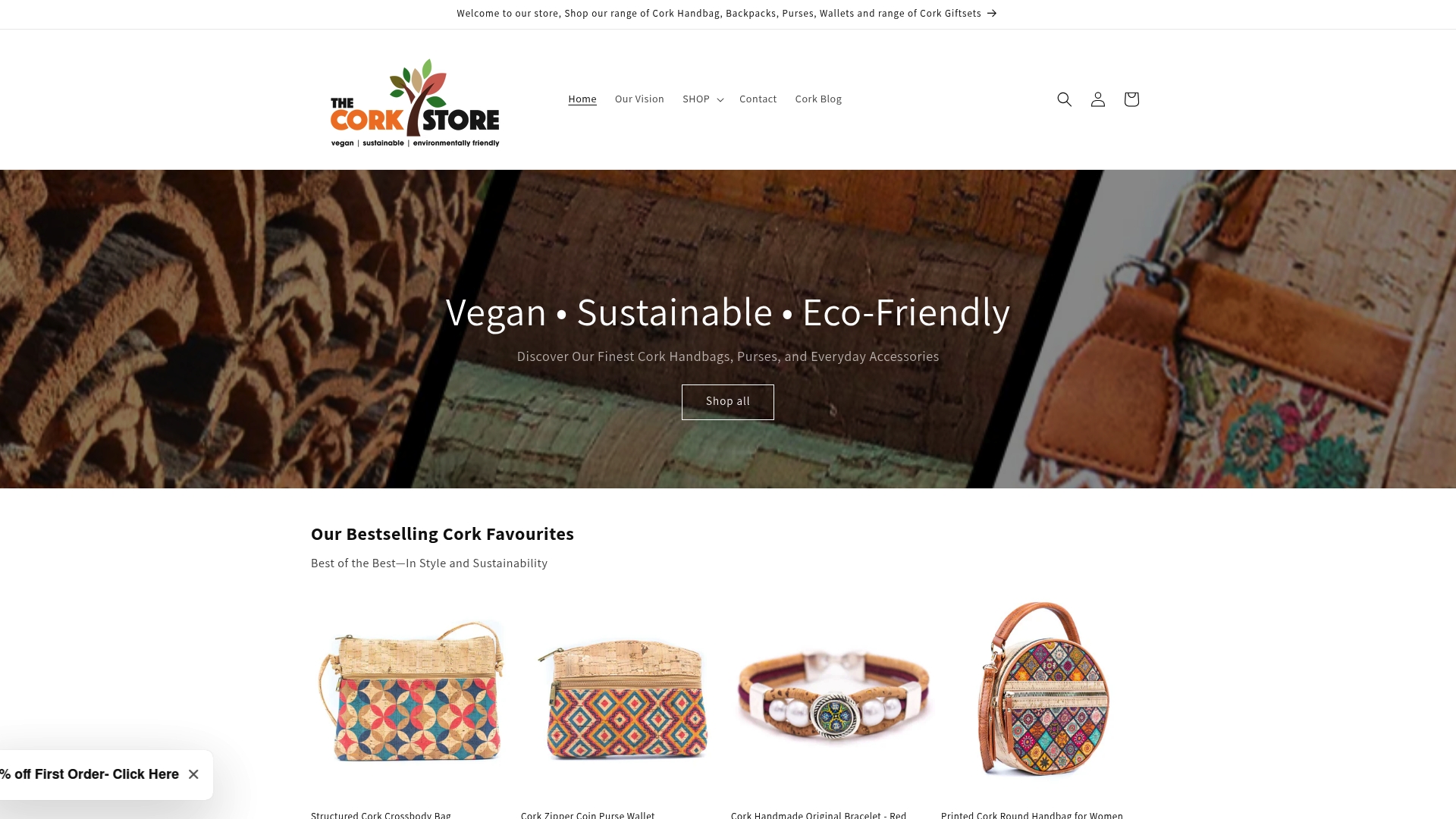
Cork table tops are a commitment — the material, the finish, the lead time. If you want to live with cork before making that call, Thecorkstore offers a range of vegan cork accessories: bags, wallets, and gift sets made from the same sustainably harvested material, at a fraction of the investment. It is a practical way to understand how cork ages, how it feels, and whether the aesthetic suits you.
Thecorkstore is an accessories retailer, not a tabletop supplier — but if you are drawn to cork for its sustainability credentials and natural texture, browse the collection at thecorkstore.co.uk to find something you can use today while you plan the bigger project.
Useful sources to check next
Before you buy or commission, verify specs and lead times directly with suppliers. Here are the key pages to consult:
- InsideOutContracts cork table top — check commercial sizes (Ø600–Ø1400mm), thickness, finish specification, and re-oiling guidance.
- MAGMA wide low by DAM Portugal — review FSC certification, lead time (several weeks), warranty (3 years), and stone inlay options.