

Eco-friendly packaging ideas for small businesses in the UK
Each of those changes is available at small-batch quantities in the UK today. Look for FSC certification on any paper or board product, OK Compost or BPI certification on anything labelled compostable, and a recycled-content label (percentage post-consumer recycled, or PCR) on any plastic component. To start without overhauling everything at once, pick one SKU, order a sample kit from a UK supplier, and run a four-week pilot before committing to a full run. That single step tells you more than any spec sheet. The UN’s explainer on plastic pollution makes clear why these choices matter beyond brand optics: single-use plastic packaging is one of the most persistent sources of environmental harm across land and ocean ecosystems.
Key takeaways
The most effective starting point for sustainable packaging is right-sizing your box and switching to FSC-certified recycled kraft, because both changes are kerbside-recyclable across the UK and reduce cost as well as environmental impact.
| Point | Details |
|---|---|
| Start with recycled kraft | FSC-certified kraft mailers and corrugated boxes are kerbside-recyclable and available at low MOQs across the UK. |
| Label disposal clearly | Print “Recycle with cardboard” or “Industrial compost only” directly on the packaging, not just on an insert. |
| Test before scaling | Run a four-week, single-SKU pilot of 50–100 units and track damage rates and customer feedback before committing to a full run. |
| Verify certifications | Request FSC, OK Compost, or BPI certificate copies from every supplier; do not accept a logo as proof. |
| Reusable mailers suit repeat buyers | Services like RePack work best for subscription or repeat-purchase brands where customers are motivated to return packaging. |
Table of Contents
- Practical environmentally friendly packaging ideas and when to use each
- How common materials compare: recyclable, compostable, biodegradable, and bio-based
- Design choices that reduce waste and improve recyclability
- End-of-life and disposal in the UK: what customers need to know
- Where to source sustainable packaging in the UK and real-world innovators to know
- Step-by-step checklist: choosing and rolling out eco packaging for a product
- How a UK cork accessories seller can apply these ideas
- Why small, honest improvements scale further than perfect solutions
- Sources
Practical environmentally friendly packaging ideas and when to use each
The list below covers 13 workable options across different product types, budgets, and volumes. Each entry notes the best use-case, a cost or scale consideration, and the key trade-offs.
1. Right-sized corrugated cardboard boxes
Best for: Any shipped product. Oversized boxes are the single biggest source of unnecessary void fill and excess weight.
- Pros: Widely kerbside-recyclable across the UK; FSC-certified options are easy to source; reduces dimensional weight charges.
- Cons: Custom sizing has a minimum order quantity (MOQ) with most suppliers; standard sizes may still leave gaps for fragile goods.
Cost note: Standard corrugated is one of the cheapest options per unit. Custom die-cut sizing costs more upfront but often saves on filler and postage over a full run.
2. 100% recycled kraft paper mailers
Best for: Apparel, accessories, flat goods, and anything that does not need rigid protection.
- Pros: Kerbside-recyclable; lighter than boxes; widely available in the UK at low MOQs.
- Cons: No padding; not suitable for fragile or moisture-sensitive items without an inner wrap.
Cost note: Among the most affordable sustainable mailer options. A good first swap for any small e-commerce seller.
3. Reusable and returnable mailers
Best for: Brands with repeat customers or subscription models where the customer posts the mailer back.
RePack runs a circular mailer service used by e-commerce brands across Europe: customers return the bag via post, it is cleaned and reused, and the brand pays per use rather than per unit. This model cuts single-use packaging waste and can reduce per-delivery material cost over time for brands with high return rates.
- Pros: Genuinely circular; strong customer loyalty signal; no single-use waste per delivery.
- Cons: Requires customer participation; logistics setup takes time; not suited to one-off or gift purchases.
4. Compostable padded mailers
Best for: Small, lightweight goods where some cushioning is needed and the customer has access to industrial composting.
- Pros: Certified options (OK Compost, BPI) break down under industrial conditions; better protection than kraft alone.
- Cons: Require industrial composting, which is not universally available in the UK; will contaminate kerbside recycling if disposed of incorrectly. Always print disposal instructions on the mailer itself.
5. Mycelium (mushroom) protective inserts
Best for: Fragile or irregularly shaped products that currently use polystyrene moulded inserts.
Mycelium packaging grows around a product mould using agricultural waste and fungal mycelium, then is dried to halt growth. The result is a rigid, lightweight insert that home-composts within weeks. Pilots in the UK have used it for electronics and cosmetics.
- Pros: Home-compostable; strong protection; made from agricultural by-products.
- Cons: Higher per-unit cost than polystyrene; lead times are longer; MOQs can be high for bespoke moulds.
6. Seaweed-based films and coatings
Best for: Food-safe inner wraps, sachets, and coating applications where a thin barrier is needed.
Notpla is a London-based company that produces seaweed-derived coatings and films used on takeaway containers and sachets. Their material biodegrades in weeks without industrial infrastructure. For small businesses, Notpla is currently more accessible through brand partnerships than direct retail, but the technology is worth tracking as availability grows.
- Pros: Biodegrades naturally; no microplastic residue; food-safe.
- Cons: Limited direct availability for small orders; not yet a drop-in replacement for all film applications.
7. Paper tape and water-activated tape
Best for: Sealing corrugated boxes where you currently use plastic parcel tape.
Water-activated tape (WAT) bonds directly to the box surface, creating a tamper-evident seal that does not need to be removed before recycling. It keeps the box mono-material and kerbside-recyclable.
- Pros: Keeps packaging recyclable; strong bond; tamper-evident.
- Cons: Requires a dispenser; slightly slower to apply than peel-and-stick tape.
8. Recyclable mono-material flexible films
Best for: Brands that need a flexible outer wrap or bag but want to keep recyclability intact.
Mono-material polyethylene (PE) films are increasingly accepted at supermarket soft-plastic drop-off points across the UK (Sainsbury’s, Tesco, and others run these schemes). Unlike multi-layer laminates, a single-polymer film can be recycled through those routes.
- Pros: Recyclable via established UK drop-off points; good moisture barrier; lightweight.
- Cons: Still a plastic; not kerbside-recyclable in most UK councils; requires customer awareness of drop-off locations.
9. Furoshiki and fabric wrapping (for gifts and retail)
Best for: Gift packaging, market stalls, pop-up retail, or any brand that wants a zero-waste unboxing moment.
Furoshiki is a Japanese wrapping technique using a square of fabric. For a small accessories brand, a branded cotton or recycled-fabric square doubles as packaging and a usable product. The customer keeps the wrap; nothing goes in the bin.
- Pros: Zero waste at point of disposal; premium feel; reusable by the customer.
- Cons: Higher per-unit cost than paper; fabric sourcing needs its own sustainability check; not suited to postal delivery without an outer mailer.
10. Seed paper and plantable labels
Best for: Thank-you cards, swing tags, and inserts that would otherwise go straight in the bin.
Seed paper is embedded with wildflower or herb seeds. The customer plants the card or tag in soil, waters it, and it grows. UK suppliers include Botanical Paperworks and several independent paper mills.
- Pros: Zero waste; memorable; supports pollinators.
- Cons: Slightly higher cost than standard card; not suitable as a primary packaging material.
11. Upcycled tissue paper and kraft filler
Best for: Inner wrapping and void fill for small, lightweight goods.
Honeycomb kraft paper is made from recycled content and replaces bubble wrap or polystyrene peanuts. It is kerbside-recyclable and provides reasonable cushioning for non-fragile items.
- Pros: Kerbside-recyclable; widely available; low cost.
- Cons: Less protective than foam for fragile goods; can tear in transit if overstretched.
12. Aluminium for endlessly recyclable containers
Best for: Cosmetics, food, and any product that needs a rigid, moisture-proof container.
Aluminium is one of the few materials that can be recycled indefinitely without quality loss, and UK kerbside collection accepts it widely.
- Pros: Infinitely recyclable; strong; moisture-proof; premium appearance.
- Cons: Higher cost than plastic; heavier, which affects postage; not suitable for all product types.
13. FSC-certified paperboard gift boxes
Best for: Retail gift packaging, accessories, and any product where presentation matters.
FSC-certified paperboard comes from responsibly managed forests and is kerbside-recyclable. For a small accessories brand, a well-designed paperboard box with a ribbon or magnetic closure replaces plastic clamshells and foam trays in one move.
- Pros: Kerbside-recyclable; widely available; strong brand presentation.
- Cons: Magnetic closures with metal components can complicate recycling; avoid laminate coatings that prevent recycling.
Pro Tip: For very small batches or one-off gifts, Furoshiki wrapping and seed paper inserts are the fastest zero-waste options to adopt with no MOQ and no supplier contract.
How common materials compare: recyclable, compostable, biodegradable, and bio-based
These four terms are not interchangeable, and confusing them is one of the most common mistakes small businesses make when switching packaging.
Recyclable means the material can be processed back into raw material through existing collection systems. In the UK, this typically means kerbside collection for cardboard, paper, glass, steel, aluminium, and some rigid plastics (check the resin code). Recyclability depends entirely on local infrastructure, not just the material itself.
Compostable means the material breaks down into organic matter under specific conditions. Home-compostable materials (certified to EN 13432 or AS 5810) break down in a garden compost heap. Industrial-compostable materials require the higher temperatures of a commercial composting facility. Many compostable films and mailers are industrial-only, and the UK’s industrial composting infrastructure is patchy. A compostable mailer placed in kerbside recycling contaminates the recycling stream.
Biodegradable has no regulated definition in UK or EU packaging law. Any material will eventually break down, so the term alone tells you nothing useful about timescale or conditions. Treat it as a marketing claim unless it is backed by a specific certification.
Bio-based describes the feedstock (plant-derived rather than fossil-derived) but says nothing about end-of-life. A bio-based plastic can still be non-recyclable and non-compostable.
Material comparison
| Material | Protection | Weight | UK end-of-life | Certification to look for |
|---|---|---|---|---|
| Recycled corrugated cardboard | Good for rigid goods | Light | Kerbside recyclable | FSC, recycled-content % |
| Recycled kraft paper | Low (no cushion) | Very light | Kerbside recyclable | FSC, PCR content |
| PCR plastic mailers | Moderate | Light | Soft-plastic drop-off | PCR % label |
| PLA/PBAT compostable films | Moderate | Light | Industrial composting only | OK Compost, BPI |
| Mycelium inserts | High (rigid mould) | Light | Home compostable | Verify with supplier |
| Seaweed films (e.g. Notpla) | Low-moderate | Very light | Biodegrades naturally | Supplier certification |
| Aluminium | High | Heavy | Kerbside recyclable | Recycled content % |
| FSC paperboard | Good for boxes | Moderate | Kerbside recyclable | FSC |
A short caution on bioplastics: PLA (polylactic acid) looks and feels like conventional plastic, which means customers and waste operatives often place it in standard recycling. It does not melt at the same temperature as PET or PE, so it contaminates those streams. Always print clear disposal instructions on any compostable packaging, and do not rely on the customer to know the difference by sight.
TIPA, a manufacturer of compostable flexible films, states that some of their certified films decompose within an industrial composting timeframe that is shorter than conventional plastics, when processed correctly. That is a meaningful improvement over conventional plastic, but only if the customer can access an industrial composting facility, which remains the exception rather than the rule across most UK postcodes.
Design choices that reduce waste and improve recyclability
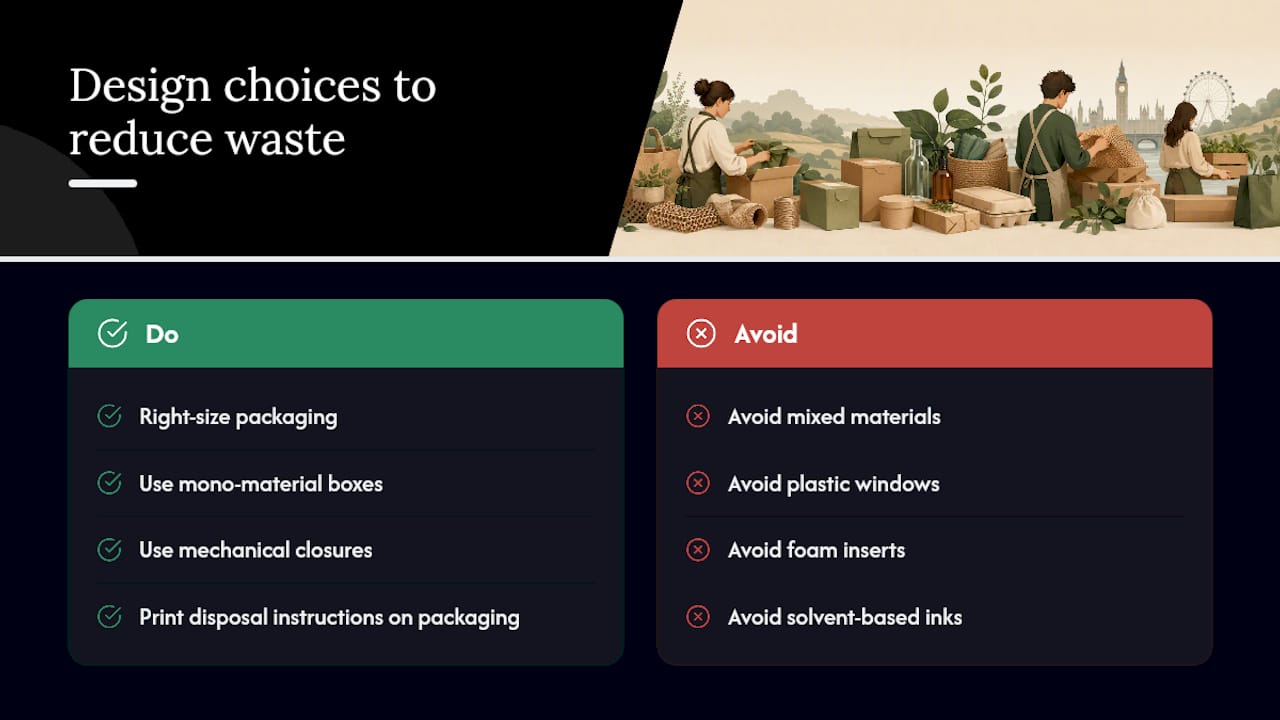
Good sustainable packaging starts at the design stage, not the supplier stage. A few rules make a significant difference.
Right-size first. The single biggest source of unnecessary material in e-commerce packaging is the gap between product and box. Measure your product dimensions and order the smallest box that fits with adequate protection. Reducing box volume also cuts dimensional weight charges, which often offsets the cost of switching to a recycled-content board.
Design for mono-material. A box made entirely of cardboard, sealed with paper tape, and printed with water-based ink is fully kerbside-recyclable. Add a plastic window, a foam insert, or a metallic laminate and you have created a mixed-material item that most UK recycling facilities cannot process. Every additional material type is a recycling barrier.
Remove unnecessary layers. Inner tissue, outer sleeve, insert card, ribbon, sticker, and foam tray: each layer adds cost, weight, and disposal complexity. Ask whether each element is doing a job the product itself cannot do. A well-designed box with a good print finish often needs nothing inside except the product.
Favour mechanical closures over adhesives. Tuck-end boxes, ribbon pulls, and magnetic closures (without metal plates glued to paper) are easier to open cleanly and keep materials separate. Mixed adhesives and heat-sealed laminates bond materials together in ways that prevent separation at the recycling plant.
Print less, or print smarter. Full-coverage print with solvent-based inks can interfere with paper recycling. Water-based or soy-based inks are widely accepted by UK paper mills. If you are printing on kraft, consider leaving large areas unprinted: it looks intentional and saves ink.
Balance barrier needs honestly. Some products genuinely need a moisture or oxygen barrier: food, cosmetics with a short shelf life, leather goods in humid transit. For those, a certified compostable laminate or a PCR plastic inner wrap may be the right call even if it complicates end-of-life. Do not remove a barrier that protects the product just to hit a sustainability metric, because a damaged product generates more waste than the packaging it came in.
Pro Tip: Print a short disposal instruction directly on the packaging, not just on an insert card that gets thrown away first. Something as simple as “Recycle with cardboard” or “Industrial compost only, check local services” on the base of a box costs nothing extra and significantly improves correct disposal rates.
Sustainability in accessory design follows the same logic: the most sustainable choice is the one that performs its function with the least material and the clearest end-of-life path.
End-of-life and disposal in the UK: what customers need to know
UK recycling infrastructure varies significantly by council, which makes blanket disposal claims on packaging risky. Here is what generally holds true and where you need to be specific.
What typically goes in kerbside recycling across most UK councils:
- Cardboard and corrugated board (flattened)
- Paper and kraft (not waxed or laminated)
- Glass bottles and jars
- Steel and aluminium tins and cans
- Rigid plastics (bottles, pots, tubs, trays) — check the resin code; acceptance varies
What generally needs a separate route:
- Flexible plastic films and bags: accepted at supermarket soft-plastic drop-off points (Tesco, Sainsbury’s, and others), not kerbside
- Compostable packaging: industrial composting only for most certified films; home composting only for specifically certified materials
- Polystyrene: not accepted kerbside in most UK councils; check local guidance
- Waxed or laminated paper: not recyclable; goes in general waste
Dos and don’ts for on-pack disposal labelling:
Do:
- Use plain language: “Recycle with cardboard” or “Soft plastic — return to store”
- Include a web address or QR code linking to your disposal guidance page
- Distinguish clearly between the outer box (recyclable) and any inner wrap (separate route)
- State “Industrial compost only” if the material requires it, and add “Check local services”
Don’t:
- Print just “compostable” without specifying the conditions required
- Use the recycling symbol on materials that are not accepted kerbside
- Assume customers know what PLA is or how to dispose of it
To check what your local council accepts, visit the council’s waste and recycling page directly, or use the Recycle Now postcode checker at recyclenow.com. If you are selling nationally, design your disposal instructions for the most restrictive scenario: assume the customer does not have access to industrial composting unless you have evidence otherwise.
Where to source sustainable packaging in the UK and real-world innovators to know
Finding the right supplier takes more than a Google search. Here is a practical map of where to look and what to ask for.
Categories of UK-relevant suppliers to explore:
- Recycled kraft mailers and corrugated boxes: Packaging suppliers such as Kite Packaging, Rajapack, and DS Smith offer recycled-content options with FSC certification at small MOQs. Request a sample pack before committing to a run.
- Compostable flexible films: Suppliers including Vegware (primarily food service) and specialist film converters offer BPI or OK Compost certified options. Vegware’s products are designed for industrial composting and are used widely in UK food service.
- Mycelium inserts: Ecovative Design (US-based but with European distribution) and smaller UK fabricators offer bespoke mycelium moulding. Lead times are longer than conventional foam; plan 6–8 weeks for a first mould.
- Reusable mailer services: RePack offers a circular mailer system where customers return packaging via post. It suits subscription brands and repeat-purchase retailers more than one-off gift sales.
- Seaweed-based coatings and films: Notpla, based in London, produces seaweed-derived coatings applied to paper and board. Their products are currently more accessible through brand partnership programmes than direct retail. Contact them directly to discuss pilot options.
- Sustainable packaging for food and beverage: If your products include food-adjacent items or you are curious how barrier packaging works in a food context, sustainable coffee packaging offers a useful parallel case study on balancing freshness requirements with eco-friendly materials.
Supplier data at a glance:
| Supplier / Innovator | Solution type | Certification | UK access |
|---|---|---|---|
| Kite Packaging | Recycled corrugated, kraft mailers | FSC, recycled content | Direct, small MOQ |
| Vegware | Compostable food-service packaging | OK Compost, BPI | Direct, UK-wide |
| Notpla | Seaweed coatings and films | Supplier-certified | Partnership / pilot |
| RePack | Reusable return mailers | Circular model | Direct, per-use pricing |
| Ecovative / UK fabricators | Mycelium inserts | Home-compostable | Via distributor |
Buying actions to take now:
- Order a trim-size sample box from at least two suppliers before choosing a format.
- Request copies of FSC, BPI, or OK Compost certificates, not just a logo on a website.
- Ask for the material’s PCR content percentage in writing.
- Confirm minimum order quantities and lead times for your first run.
- For reusable solutions, ask how the return logistics work and what the per-use cost is at your expected volume.
Spotting sustainable materials follows the same principle: certifications and material data sheets are the evidence; marketing language is not.
Step-by-step checklist: choosing and rolling out eco packaging for a product
DHL’s sustainable packaging guidance recommends auditing current packaging, redesigning for minimalism, sourcing certified materials, and piloting with logistics partners before scaling. That sequence works. Here is how to apply it at small-business scale.
-
Audit your current packaging. Weigh each component, note the material, and record what it costs per unit. Identify the heaviest, most expensive, or most wasteful element. That is your first target.
-
Set your non-negotiables. What does the packaging absolutely have to do? Protect the product in transit, maintain shelf life, meet any food-safety or cosmetic regulations? Write these down before you look at alternatives, so you do not accidentally choose a material that fails on a basic requirement.
-
Shortlist two or three material options. Use the material comparison table above to narrow down candidates that fit your protection needs, budget, and UK end-of-life options.
-
Request samples and certificates. Ask every shortlisted supplier for a physical sample and a copy of their FSC, BPI, or OK Compost certificate. Do not accept a logo on a PDF as evidence of certification.
-
Run a drop test and a moisture test. Fill a sample box with your product, seal it with paper tape, and drop it from shoulder height onto a hard floor. Repeat in a damp environment if your product is moisture-sensitive. Aesthetically attractive paper packaging can fail in wet or rough transit and generate more waste through product damage than it saves in materials.
-
Run a single-SKU pilot for four weeks. Choose your best-selling or most straightforward product. Ship 50–100 units in the new packaging and track damage rates, customer feedback, and any disposal questions that come in.
-
Gather customer feedback on disposal. Ask customers directly (via a follow-up email or an on-pack QR code) whether they knew how to dispose of the packaging. The answers will tell you whether your labelling is working.
-
Scale if the pilot meets your thresholds. Define success before you start: zero increase in damage rate, no increase in per-unit cost above your budget, and at least neutral customer feedback on the change.
Supplier questions to ask before committing:
- What is the minimum recycled or bio-based content percentage, and can you provide that in writing?
- What certifications do you hold, and can I see the current certificate?
- What are your MOQs and standard lead times for a first order?
- What disposal instructions do you recommend we print on the packaging?
- For reusable solutions: how does the return logistics work, and what is the per-use cost at 500 units per month?
Red flags to watch for:
- A supplier who cannot provide a certification copy on request.
- “Biodegradable” claims with no certification or timescale attached.
- A compostable mailer with no disposal instructions printed on it.
- Hidden costs in reusable systems (collection fees, cleaning charges) that are not disclosed upfront.
Pro Tip: When you announce a packaging change to customers, tell them what you changed, why, and exactly how to dispose of it. Shopify’s founder case studies show that transparency about packaging choices builds customer trust and loyalty far more effectively than a generic “we’re going green” message.
How a UK cork accessories seller can apply these ideas
Cork is one of the most inherently sustainable materials in fashion accessories: harvested without felling the tree, naturally regenerative, and biodegradable at end-of-life. The packaging around a cork wallet or handbag should reflect the same values.
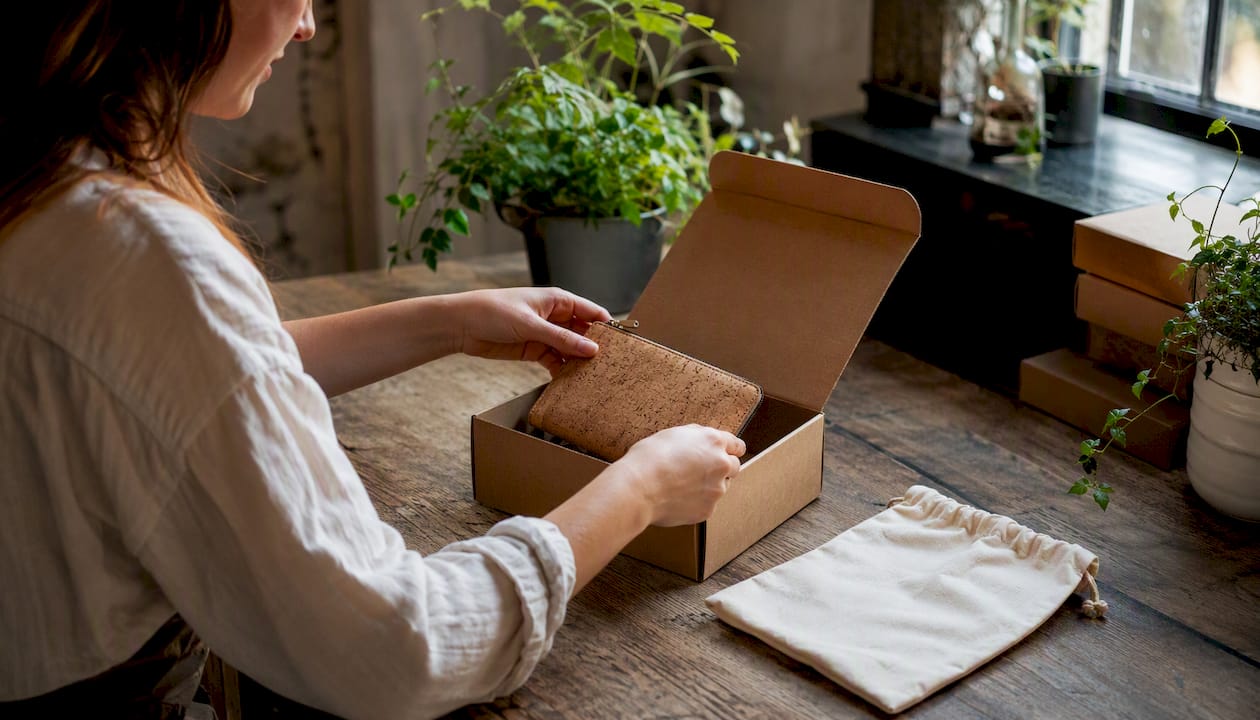
Here is a concrete pilot plan for a cork accessories seller:
Step 1: Switch the outer box. Replace any non-certified board with an FSC-certified corrugated or paperboard box, right-sized to the product. For a wallet, this typically means a small rigid box sealed with water-activated paper tape. No plastic window, no foam tray.
Both are kerbside-recyclable and provide adequate protection for a non-fragile accessory.
Step 3: Add a reusable dust bag. A small cotton or recycled-fabric dust bag inside the box serves as protective inner packaging and a usable product the customer keeps. This eliminates the need for any inner wrap entirely and adds perceived value.
Step 4: Print disposal instructions on the base of the box. “Recycle with cardboard. Remove tape first.” Two words of instruction prevent the most common disposal error.
Step 5: Pilot on one SKU. The All-Natural Cork Wallet Gift Set is a strong candidate: it is a contained, gift-oriented product where packaging presentation matters and where a fabric dust bag adds genuine value. Run 50 units, track feedback, and measure whether the change affects damage rates or customer comments.
Expected benefits: reduced box weight (lower postage band in some cases), improved brand perception among eco-conscious buyers, and a clear alignment between the product’s sustainability story and its packaging.
For a broader look at how eco packaging connects to cork accessories, Thecorkstore’s blog explores the full picture of material choices and their environmental rationale.
Browse Thecorkstore’s eco-friendly cork gift collection for products that already align with a sustainable packaging story.
Why small, honest improvements scale further than perfect solutions
The sustainable packaging conversation is dominated by the search for the perfect material: something that protects like polystyrene, costs like kraft paper, composts at home in a week, and looks beautiful on a shelf. That material does not exist yet, and waiting for it is a reason to do nothing.
What actually works is a sequence of small, honest improvements. Right-size the box. Switch to recycled kraft. Add a disposal instruction. Test a reusable mailer with your top 100 customers. Each step is reversible, measurable, and communicable. Each one also tends to reduce cost as much as it reduces impact, because excess material and excess weight are both expensive.
The business case for incremental change is stronger than it looks. Reducing packaging weight cuts dimensional weight charges. Switching from polystyrene to mycelium or kraft filler often reduces damage rates because the packaging fits the product better. Clear disposal labelling reduces customer service queries about what to do with the box. None of these are heroic moves, but they compound.
The brands that build lasting credibility on sustainability are not the ones that launched with a perfect compostable solution. They are the ones that told customers exactly what they changed, why, and what they are working on next. That transparency, more than any single material choice, is what builds loyalty.
Sources
- Sustainable Packaging: 8 Examples & Solutions for You | DHL Global
- Fsc
- Un
- RePack | Circular Tech Infrastructure