
Greenwashing in Fashion: Spot 7 Tactics, Choose Verifiable Brands
Greenwashing in fashion means making vague, exaggerated or false claims about a product’s environmental or ethical credentials to appear more sustainable than the business actually is. The United Nations warns that this practice undermines genuine climate action, and a 2026 report found that up to 60% of sustainability claims made by European fashion giants were unsubstantiated or misleading.
TL;DR:
- Treat labels such as eco and conscious as unverified unless a brand provides measurable evidence, named suppliers, or a life cycle assessment.
- Check a certification’s scope and audit process; mass balance may not trace material to a garment, and a dyeing label says nothing about labor conditions.
- A small eco collection beside an unchanged, high volume business with rapid releases does not prove that sustainability extends across the brand.
- EU testing found inaccurate fiber composition labels in 37% of clothing samples, so check material claims against independent evidence rather than product tags alone.
- Confirm certification logos with the issuing scheme, compare product claims with the brand’s materials page, and ask for supplier names or life cycle data.
Table of Contents
- What greenwashing looks like in fashion: direct and indirect forms
- Common greenwashing tactics with neutral examples
- Why greenwashing matters: consumer trust and environmental harm
- How to check a sustainability claim before you buy
- Certifications and labels: which to trust and common limitations
- How we approach transparency at The Cork Store
- The historical context and rise of greenwashing in the fashion industry
- The psychological tactics brands use to appeal to eco-conscious consumers
- The role of social media and influencer marketing in perpetuating greenwashing
- How to tell genuinely sustainable brands from greenwashers
- Practical tips for verifying brand claims yourself
- Why consumer scepticism and collective action matter
- If you want verified accessories: a short guide to shopping at The Cork Store
- FAQ
- Sources
What greenwashing looks like in fashion: direct and indirect forms
A marketing claim and a product’s actual life-cycle impact are often two different stories. A hoodie can be marketed with earthy colours and words like “conscious” while its production still involves high water use, synthetic dyes and long-haul shipping. Greenwashing takes two main shapes: direct greenwashing, where a brand itself makes the misleading statement, and indirect greenwashing, where a supplier, certifier or marketing partner makes the claim on the brand’s behalf, letting the brand distance itself if challenged.
Certain words appear again and again precisely because they carry no fixed meaning:
- “Eco-friendly”: says nothing about which impact was reduced or by how much.
- “Natural”: fibres can be natural and still farmed or processed destructively.
- “Conscious collection”: a label, not a measurable standard.
- “Responsibly sourced”: undefined without a named certifier or audit.
Common greenwashing tactics with neutral examples
Researchers and watchdogs have grouped misleading claims into recurring patterns, often called the “sins” of greenwashing. A systematic review of greenwashing in fashion documents how these patterns repeat across the industry, alongside direct, indirect and vicarious forms of the practice.
- Vague terminology: a tag reads “eco” with no definition or data behind it.
- Hidden trade-off: a garment made from recycled polyester but dyed with high-impact chemicals.
- No proof: a “cruelty-free” claim with no certificate or audit trail available.
- Irrelevance: “CFC-free” packaging, a claim true of nearly every competitor too.
- Lesser of two evils: “better” leather tanning that is still an intensive, resource-heavy process.
- False affiliations: logos resembling recognised certifications without formal accreditation.
- Fibbing: outright false statements about material content or origin.
Academic and investigative sources note that brands sometimes highlight a small capsule “eco” line while the core business model stays built on high-volume, short-lived fashion, a textbook hidden trade-off that distracts from the bigger picture.
Why greenwashing matters: consumer trust and environmental harm
Misleading claims do more than annoy careful shoppers. They redirect spending towards brands that have invested in marketing rather than in genuine supply-chain change, which starves higher-integrity producers of the sales they need to scale. At industry level, this matters because fashion’s footprint, water use, carbon emissions and overproduction, stays largely unaddressed while attention focuses on a handful of “conscious” product lines.
Greenwashing also slows collective progress. When a shopper discovers that a “sustainable” label meant almost nothing, trust in the entire category drops, including in brands that can genuinely substantiate their claims. That erosion of trust is one reason regulators have started treating unsubstantiated environmental claims as a consumer protection issue rather than just a marketing quibble.
How to check a sustainability claim before you buy
A few consistent checks catch most misleading claims before money changes hands.
- Look for specific evidence: percentages, named suppliers, or a life-cycle assessment, not just a mood word.
- Check whether a certification logo links to a named scheme with a public scope and audit process.
- Treat single-feature claims (one recycled component, one green packaging choice) as partial information, not a full sustainability story.
- Be wary of claims resting on imagery alone, green colour palettes, leaves, nature photography, with no text-based substantiation.
- Save a screenshot of the product page and claim wording; brands sometimes edit copy after scrutiny, and a saved record helps if you want to query or report it later.
Pro Tip: Open the brand’s own sustainability or materials page in a second tab before you buy. If the product listing’s claim is not repeated, explained or sourced there, treat it as unverified.
Our step-by-step guide to spotting sustainable fashion walks through this process in more detail for anyone building the habit.
Certifications and labels: which to trust and common limitations
Not all sustainability certifications measure the same thing, and the difference matters. Some schemes use a mass-balance model, where a business buys a volume of certified material but it is not physically traceable to a specific garment; others require full traceability from fibre to finished product. Input-based schemes check what went into a process; outcome-based schemes measure the actual environmental result.
- Traceable, outcome-focused schemes with public audit data tend to carry more weight than procedural labels alone.
- A certification’s scope matters: a label covering only dyeing chemicals says nothing about labour conditions or water use elsewhere in production.
- Watchdog analysis of certification schemes and voluntary initiatives has found that many focus on inputs or procedures rather than measurable outcomes, which can create a sustainability halo without real-world change.
ASA rulings reinforce this: absolute claims such as “sustainable” require life-cycle substantiation, not a single certified input, to avoid misleading shoppers.
How we approach transparency at The Cork Store
We believe shoppers should be able to see where a material came from and why it qualifies as vegan and sustainably harvested, rather than taking a mood word at face value. We list material origin and relevant credentials on our product pages rather than relying on colour palettes or single buzzwords to carry the claim, similar to browsing eco-friendly phone cases that provide verified sustainability details.
For readers who want to dig further into material checks, our guides on spotting sustainable materials and the role of transparency in fashion cover traceability questions in more depth than a product tag ever can.
The historical context and rise of greenwashing in the fashion industry
The term “greenwashing” predates fast fashion, but the industry’s adoption of it tracks closely with the rise of mass production. As consumer awareness of environmental harm grew through the 1990s and 2000s, brands under pressure to look responsible found it cheaper to adjust messaging than to rebuild supply chains. Early efforts often amounted to a single recycled-content product line sitting alongside an otherwise unchanged catalogue.
The acceleration came with fast fashion’s growth: shorter production cycles, lower prices and higher volumes created a business model that was structurally difficult to square with sustainability claims. Rather than slow down, many large retailers launched “conscious” or “eco” sub-collections that ran in parallel with core ranges built on the same high-turnover logic. A systematic review of green marketing in fashion traces how this pattern, marketing sustainability credentials while scaling production, became a recognisable industry behaviour rather than an isolated incident.
Social and regulatory pressure has since pushed the conversation further. Investigative reporting, watchdog analysis and now formal regulatory rulings have moved greenwashing from a reputational risk into a legal and consumer protection issue, which is why bodies such as the ASA and the European Commission now test and rule on specific claims rather than leaving the issue to self-regulation.

The psychological tactics brands use to appeal to eco-conscious consumers
Sustainability marketing works because it taps into a shopper’s desire to feel their choices matter. Earthy colour schemes, nature imagery and words like “mindful” or “conscious” create an emotional impression of responsibility before any factual claim is even read. This is deliberate: a feeling of alignment with one’s values is easier to generate than a verifiable supply chain.
Scarcity and exclusivity framing also appear in “conscious” capsule collections, positioning a small, limited range as the brand’s true identity while the bulk of sales continue as before. Pricing plays a role too: a modest premium on an “eco” item can signal quality and virtue simultaneously, encouraging shoppers to equate cost with credibility even when no verifiable data supports the claim.
Social proof compounds these effects. Seeing a product tagged as sustainable alongside positive reviews or follower counts can short-circuit the scrutiny a shopper might otherwise apply, especially when the claim matches what they already hope to be true about a brand they like.
The role of social media and influencer marketing in perpetuating greenwashing
Social platforms have become a primary channel for sustainability claims precisely because they reward short, visually appealing messages over detailed substantiation. A fifteen-second video showing a “sustainable” product launch rarely has room for supply-chain data, and audiences are unlikely to seek it out separately.
Influencer partnerships add another layer. A recommendation from a trusted creator can carry more persuasive weight than a brand’s own advertising, yet influencers are not always equipped, or incentivised, to verify the claims they repeat. This creates a chain where an unsubstantiated statement from a brand becomes amplified and repeated as though it were independently confirmed.
The pace of social media content also works against scrutiny. Claims move faster than fact-checking, and a misleading post can be seen by large audiences before any correction or regulatory challenge catches up. This is one reason consumer guidance increasingly recommends checking a brand’s own website and formal certifications rather than relying on social content alone as evidence of a sustainability claim.
How to tell genuinely sustainable brands from greenwashers
Certifications help, but they are not the whole picture. The strongest signal of genuine practice is a brand that can show its work at product level, naming specific suppliers, publishing measurable material percentages, and explaining how a claim was verified rather than simply asserting it.
Consistency across a brand’s full catalogue is another useful test. A business with one “eco” capsule sitting inside an otherwise unchanged, high-volume range is behaving differently to one where sustainable sourcing applies across the business. Pricing and production pace matter too: a brand selling at fast-fashion prices and release speed while claiming strong sustainability credentials deserves closer scrutiny, since those two things are difficult to reconcile.
Transparency about limitations is also telling. A brand willing to say where its supply chain still falls short is generally more credible than one claiming blanket sustainability with no caveats, since genuine sustainability work is rarely complete or perfect.
Practical tips for verifying brand claims yourself
Verification does not require specialist training, just a willingness to look past the product tag.
Start with the brand’s own sustainability or materials page and check whether the claim on the product listing is explained there in more detail. If a certification logo is shown, search the certifying body’s own website to confirm the brand is actually listed and understand what the scheme does and does not cover. Consumer guidance from watchdogs recommends asking brands directly for supplier names or life-cycle data when a page does not provide it, and reporting claims that seem unsubstantiated to the relevant advertising regulator.

Reading independent coverage, rather than only the brand’s own content, helps too. Regulatory rulings, watchdog reports and peer-reviewed research are a better check than a brand’s self-description, since they are produced independently of the sales incentive. Keeping a mental or written note of brands that have faced rulings or formal criticism also helps you build a more reliable picture over time than relying on any single purchase decision.
Why consumer scepticism and collective action matter
Checklists only work if we actually use them. Asking a brand for the evidence behind a claim, and choosing not to buy when that evidence does not exist, is a small action with real weight once enough shoppers do it consistently.
Reporting misleading claims to regulators matters too: rulings only happen when someone raises the concern.
— Aaron
If you want verified accessories: a short guide to shopping at The Cork Store
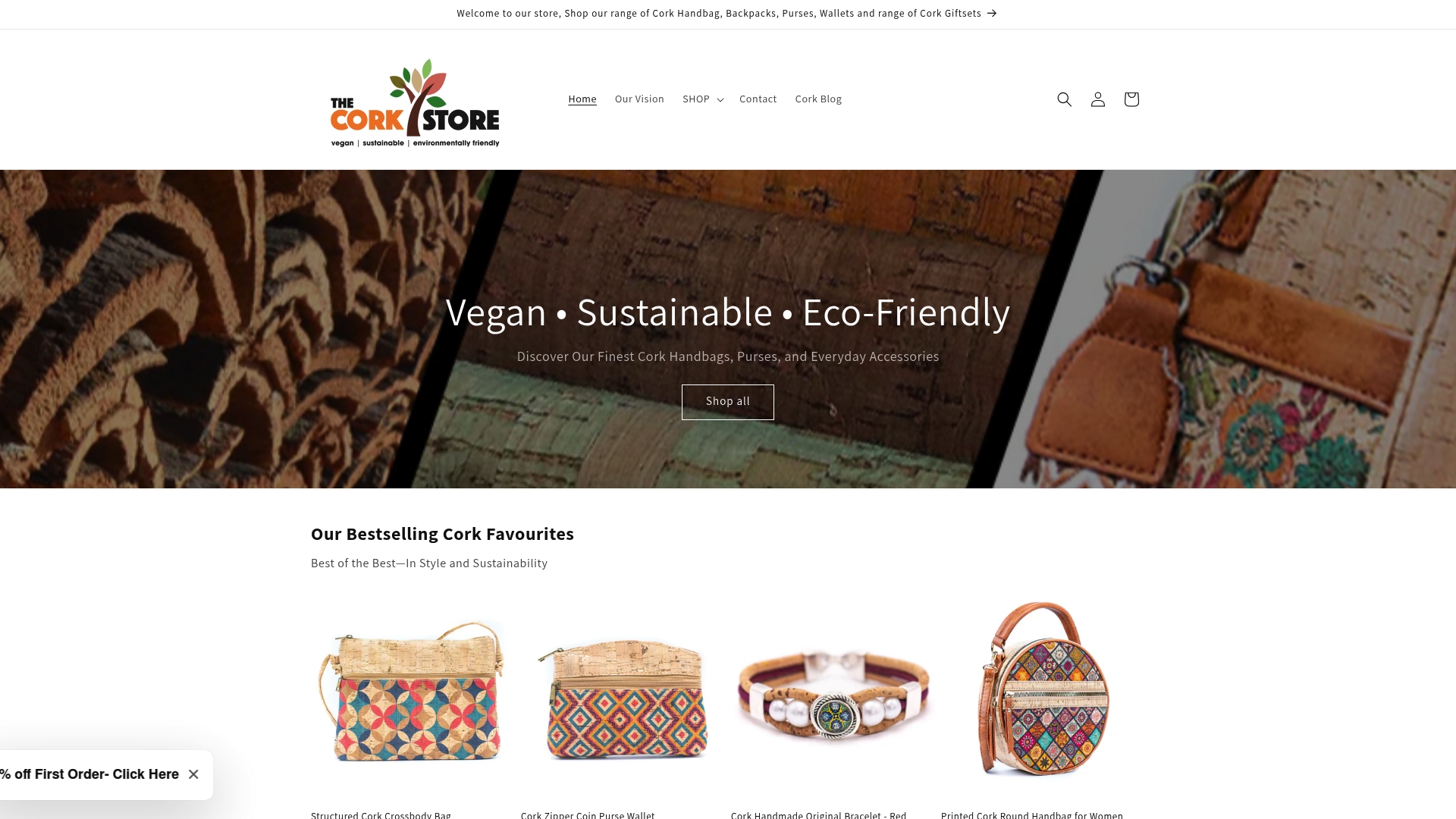
We list material origin and vegan credentials on every product page, so you can see what you are buying into before you commit, rather than relying on a tag or a colour scheme. If you are new to cork accessories, a small item like our Cork Zipper Coin Purse Wallet is a practical way to judge material quality and transparency before buying something larger.
| What to check | Where to find it at The Cork Store |
|---|---|
| Material origin | Listed on each product page |
| Vegan credentials | Stated in product descriptions |
| Entry-level option | Cork Zipper Coin Purse Wallet |
| Full range | Shop cork accessories |
Browse the full collection when you are ready to see the range of handbags, backpacks and gift sets available.
FAQ
Is H&M still accused of greenwashing?
Large fast-fashion retailers have faced repeated scrutiny over sustainability claims, and a 2026 report found that up to 60% of sustainability claims by European fashion giants were unsubstantiated or misleading. Rather than naming a single company, it is more useful to check any brand’s specific claims against the verification steps covered above.
Is Zara accused of greenwashing?
Large fashion retailers across the industry have faced criticism and regulatory scrutiny over vague or unsubstantiated sustainability claims. Instead of relying on a brand’s reputation alone, checking for specific evidence, named certifications and life-cycle data on individual products gives a more reliable answer for any retailer.
What is a famous example of greenwashing in fashion?
One widely cited pattern involves a brand launching a small “conscious” or capsule collection using recycled or organic materials while the bulk of its catalogue continues under a high-volume, short-cycle production model. Watchdog and academic sources describe this as a hidden trade-off, where one visible improvement distracts from an unchanged core business.
Which fashion brands are greenwashing?
Rather than a fixed list, regulators and researchers point to recurring tactics, vague terms, unproven claims and irrelevant comparisons, that appear across many large retailers. The ASA has ruled on specific cases where absolute claims like “sustainable” lacked the life-cycle substantiation needed to support them.
Is greenwashing illegal in fashion?
Greenwashing itself is not a single defined offence everywhere, but regulators including the ASA and the European Commission treat unsubstantiated environmental claims as misleading advertising or consumer protection breaches. EU testing found that 37% of clothing samples had inaccurate fibre composition labels, which can fall foul of labelling rules depending on the jurisdiction.
Sources
- Greenwashing – deceptive tactics behind environmental claims | United Nations
- Inaccurate clothing labels: EU testing finds systemic issue
- Unraveling green marketing and greenwashing: a systematic review in the fashion and textiles industry