
Why Cork Is Biodegradable: Complete Guide
Every year, over three hundred million tons of plastic end up in landfills while truly sustainable materials like cork quietly offer a smarter path forward. Cork’s ability to naturally decompose sets it apart from synthetic options that can persist for centuries. Learning how this unique material breaks down and supports ecosystem health helps consumers and manufacturers make better choices for the environment—without giving up on durability or design.
Table of Contents
- Defining Cork And Biodegradability
- Natural Structure Of Cork Material
- How Cork Breaks Down Naturally
- Environmental Benefits Of Cork Products
- Comparing Cork To Non-Biodegradable Alternatives
Key Takeaways
| Point | Details |
|---|---|
| Sustainability | Cork is a renewable and biodegradable material with minimal ecological impact. |
| Unique Properties | Cork’s cellular structure provides low density, elasticity, and impermeability. |
| Environmental Impact | Cork production promotes biodiversity and carbon sequestration without harming trees. |
| Comparison to Synthetics | Unlike non-biodegradable materials, cork supports ecosystem health and reduces waste. |
Defining Cork And Biodegradability
Cork is a remarkable natural material with extraordinary environmental credentials. Harvested from the bark of cork oak trees, this versatile substance represents a unique intersection of sustainability and functional design. Understanding why is cork sustainable begins with comprehending its fundamental characteristics and inherent biodegradability.
According to Wikipedia, cork is technically the phellem layer of bark tissue, primarily sourced from Quercus suber trees. Its composition is dominated by suberin, a hydrophobic substance that grants cork its distinctive properties. These include remarkable characteristics like impermeability, excellent buoyancy, natural elasticity, and impressive fire retardancy.
From an environmental perspective, biodegradation is the critical process that defines a material’s ecological impact. Wikipedia defines biodegradation as the biological breakdown of organic substances by living microorganisms into simpler compounds such as carbon dioxide, water, and biomass. For cork, this means the material can naturally decompose without leaving harmful residues, making it an exemplary sustainable resource.
Key characteristics that make cork biodegradable include:
- Entirely natural organic composition
- Derived from renewable cork oak bark
- Breaks down through microbial activity
- Returns nutrients to the ecosystem
- Minimal environmental persistence
Understanding cork’s biodegradability requires recognizing its lifecycle from living tree bark to versatile material and eventual environmental reintegration. This natural cycle positions cork as a premier choice for eco-conscious consumers seeking sustainable alternatives to synthetic materials.
Natural Structure Of Cork Material
Cork is a fascinating material with a truly unique cellular architecture that explains its exceptional properties. The Cork Production Process begins with understanding its intricate microscopic structure, which sets it apart from other natural materials.
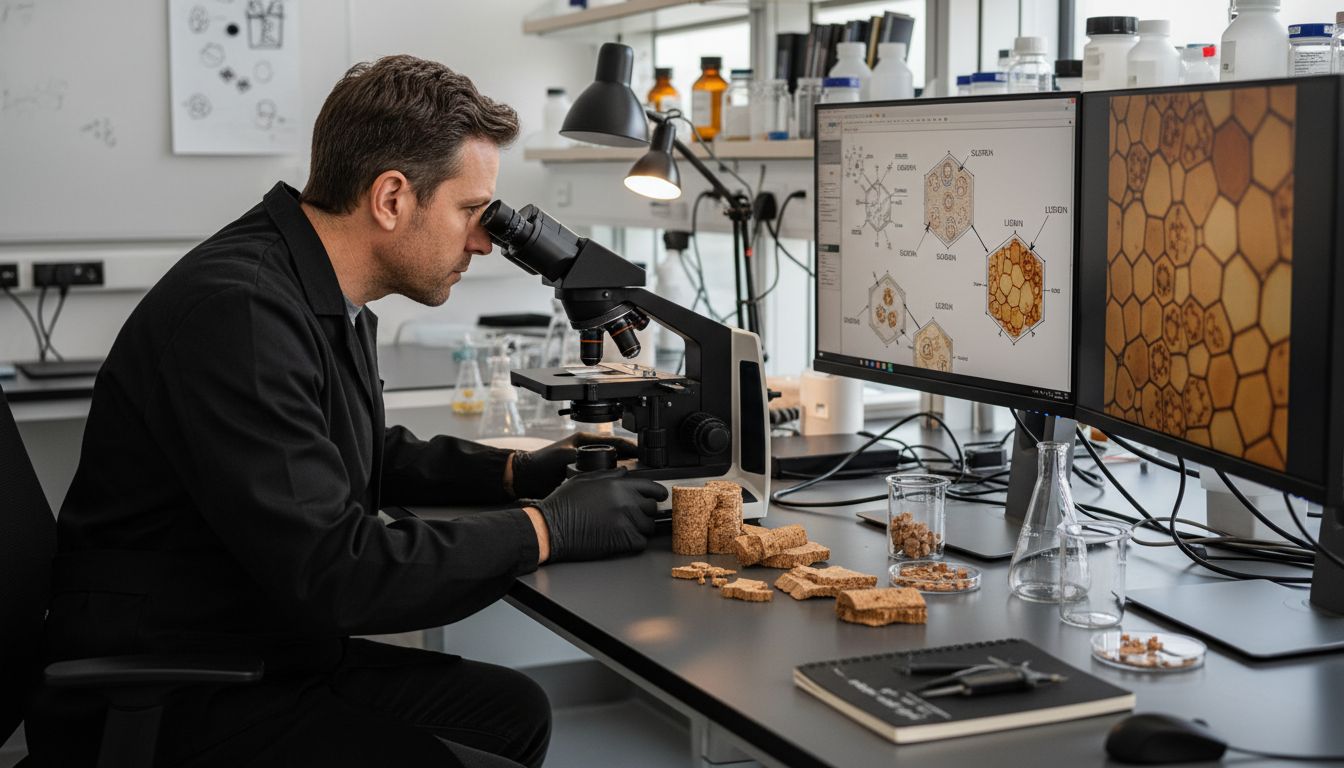
According to BioResources, cork’s cellular structure is composed of hexagonal cells filled with gas. This distinctive configuration contributes to its remarkable characteristics of low density and impressive compressibility. The cell walls themselves are primarily constructed from suberin and lignin, two substances that provide cork with its signature elasticity and durability.
Research from the Research Portal reveals additional insights into cork’s structural complexity. Specifically, studies on Quercus variabilis cork demonstrate that its cells can be pentagonal or hexagonal, with a fascinating chemical composition that includes:
- 34.8% suberin
- 19.1% lignin
- Various polysaccharides
These molecular components work together to create a material that is not just structurally unique, but also incredibly versatile. The gas-filled hexagonal cells provide cork with its characteristic lightweight nature, while the robust cell walls ensure remarkable resilience and durability. This natural design makes cork an extraordinary material that can compress, expand, and return to its original shape - a property that makes it ideal for numerous applications from fashion to construction.
How Cork Breaks Down Naturally
Understanding how cork naturally decomposes requires diving deep into its unique molecular structure. How Cork Promotes Sustainability highlights the fascinating process of its environmental breakdown, which is more nuanced than typical organic materials.
According to PubMed, cork’s biodegradation is complex and heavily influenced by its chemical composition. Specifically, the presence of suberin and lignin creates a natural resistance to microbial attack. However, under specific environmental conditions, certain microorganisms can gradually break down these robust components.
Wikipedia explains that suberin, a major cork component, is a sophisticated biopolymer forming protective barriers in plant cell walls. Its inherently hydrophobic nature makes degradation challenging, but not impossible. Specialized fungi and bacteria have evolved mechanisms to slowly decompose these complex molecular structures.
The natural breakdown of cork occurs through several key stages:
- Initial microbial colonization
- Enzymatic breakdown of complex polymers
- Gradual fragmentation of cellular structures
- Conversion into simpler organic compounds
- Eventual reintegration into the ecosystem
This methodical decomposition process ensures that cork returns to the environment without leaving harmful residues, making it an exceptional eco-friendly material. The slow, controlled breakdown allows cork to maintain its structural integrity during use while ultimately returning to nature’s circular system.
Environmental Benefits Of Cork Products
Understanding the Role of Cork in Sustainable Fashion reveals the profound environmental advantages of cork products that extend far beyond their aesthetic appeal. Cork represents a revolutionary approach to sustainable material production and consumption.
According to Research Portal, cork is a renewable and sustainable material with remarkable environmental credentials. Its applications range from construction to fashion, offering exceptional insulation properties, outstanding durability, and an impressively low environmental impact. The material actively contributes to energy efficiency and significantly reduces carbon footprints across various industries.
Wikipedia highlights the unique ecological characteristics of cork production. Unlike many other materials, cork harvesting does not require cutting down trees. Instead, only the bark is carefully removed, which regenerates naturally, allowing for repeated harvests without causing harm to the tree. This sustainable harvesting method simultaneously promotes biodiversity and enables substantial carbon sequestration.
Key environmental benefits of cork products include:
- Renewable and rapidly regenerating resource
- Minimal ecological disruption during harvesting
- Natural carbon sequestration
- Reduced waste through biodegradability
- Low energy consumption in production
- Support for forest ecosystem preservation
By choosing cork products, consumers actively participate in a more sustainable economic model. Each cork item represents a small but significant step towards reducing environmental impact and supporting ecological balance.
Comparing Cork To Non-Biodegradable Alternatives
Complete Guide to Biodegradable Fashion Materials reveals the stark differences between cork and traditional non-biodegradable materials, highlighting why eco-conscious consumers are making the switch to more sustainable options.
According to BioResources, cork offers a unique combination of properties that set it apart from synthetic materials. Its low density, exceptional elasticity, and impermeability make it a superior sustainable alternative to plastics, which are notorious for their environmental harm and non-biodegradable nature.
Wikipedia emphasizes the critical distinction between cork and synthetic alternatives. Unlike most non-biodegradable materials that persist in the environment for hundreds of years, cork can be both biodegraded and recycled. This versatility extends across multiple applications, from wine stoppers to insulation, providing eco-friendly solutions that traditional materials cannot match.
Key comparisons between cork and non-biodegradable alternatives include:
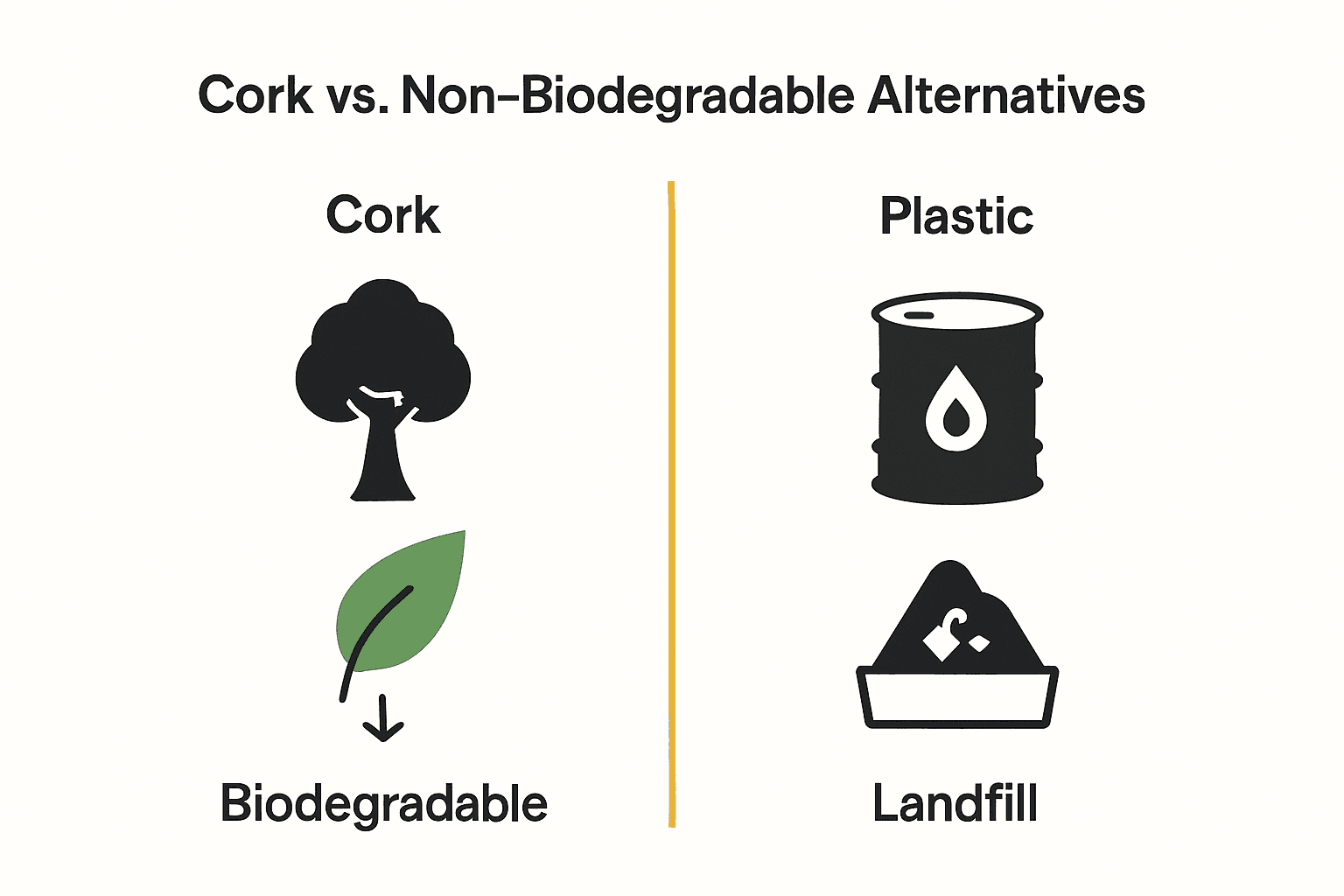
- Biodegradability: Cork breaks down naturally; synthetics do not
- Environmental impact: Cork supports ecosystem health; plastics damage it
- Resource consumption: Cork is renewable; most synthetics are petroleum-based
- Lifecycle: Cork returns to nature; synthetics accumulate in landfills
- Production energy: Cork requires minimal processing; synthetics need extensive manufacturing
The choice between cork and non-biodegradable alternatives is more than a material decision—it’s a statement about environmental responsibility and sustainable living.
 By selecting cork, consumers actively contribute to reducing global waste and supporting a circular economy.
Here’s a comparison of cork and non-biodegradable alternatives:
| Feature | Cork | Non-Biodegradable Alternatives |
|---|---|---|
| Biodegradability | Naturally breaks down | Persists for centuries |
| Environmental Impact | Supports ecosystem health | Damages environment |
| Resource Origin | Renewable tree bark | Petroleum-based |
| Lifecycle | Returns to nature | Accumulates in landfills |
| Production Energy Use | Minimal processing | High energy manufacturing |
Discover Sustainable Style With Biodegradable Cork Accessories
The article “Why Cork Is Biodegradable: Complete Guide” highlights the challenge of finding stylish accessories that align with your commitment to the environment. You want products that not only look good but also offer genuine eco-friendly benefits such as renewability, biodegradability, and minimal environmental impact. Cork’s unique cellular structure and natural composition make it an ideal choice for sustainable fashion that does not compromise on durability or style.
Explore an exclusive collection of vegan cork handbags, backpacks, wallets, purses and gift sets at The Cork Store where sustainability meets style. 
Make a meaningful impact today by choosing accessories crafted from cork’s naturally biodegradable material. Visit The Cork Store to browse eco-conscious pieces designed to reduce waste and support a healthier planet. Your next stylish and ethical purchase is just a click away.
Frequently Asked Questions
What is cork and what makes it sustainable?
Cork is a natural material harvested from the bark of cork oak trees. Its sustainability comes from its renewable nature, as harvesting only the bark allows trees to regenerate. Additionally, cork is biodegradable, breaking down naturally without harmful residues.
How does cork biodegrade?
Cork biodegrades through a process involving microbial activity. It is initially colonized by microorganisms that enzymatically break down its complex polymers, like suberin and lignin, eventually converting it into simpler organic compounds that reintegrate into the ecosystem.
What are the environmental benefits of using cork products?
Cork products are environmentally friendly as they are renewable, promote biodiversity, and contribute to carbon sequestration. Choosing cork helps reduce waste, lowers energy consumption during production, and supports forest ecosystem preservation.
How does cork compare to non-biodegradable materials?
Cork is biodegradable, breaking down naturally over time, while non-biodegradable materials, like plastics, persist in the environment for centuries. Cork’s production involves minimal energy, and it is a renewable resource, unlike many synthetic alternatives which are often petroleum-based.
Recommended
- Complete Guide to Biodegradable Fashion Materials – The Cork Store
- How Cork Promotes Sustainability: Complete Guide – The Cork Store
- Understanding Why is Cork Sustainable for Our Planet – The Cork Store
- Complete Guide to the Cork Production Process – The Cork Store
- Verschil Afbreekbaar & Recyclebaar: Complete Gids – Earth Saver Straws