

Cork cleaning guide for vegan cork accessories
For most spills on a cork bag or wallet, the right move is simple: dab the area immediately with a clean, dry cloth, then wipe gently with lukewarm water and a small amount of mild natural soap. Rinse with a clean damp cloth and leave to air dry away from direct heat. That single routine handles the majority of everyday marks without risking damage to the material.
Do right now:
- Blot, never rub. Rubbing spreads the stain and pushes it deeper into the porous surface.
- Use lukewarm water only. Hot water can swell the cork and loosen adhesives at seams.
- Keep it gentle. A soft cotton cloth or a very soft brush is all the agitation you need.
Avoid immediately:
- No solvents, nail-varnish remover, or alcohol-based sprays.
- No machine washing, even on a delicate cycle, for finished cork accessories.
- No abrasive scrubbing pads or stiff brushes.
Key takeaways
Gentle, prompt cleaning with lukewarm water and mild soap is all most cork accessories ever need, and it is the single most effective way to keep them looking good for years.
| Point | Details |
|---|---|
| Act immediately on spills | Blot with a dry cloth first; the faster you act, the less likely a stain will set permanently. |
| Mild soap and lukewarm water | This combination handles both spot cleaning and deeper cleans without risking surface damage. |
| Avoid heat and harsh chemicals | No tumble dryers, bleach, vinegar, alcohol, or abrasive tools at any stage of cleaning. |
| Store in breathable bags | Use a dust bag with airflow and stuff the shape; sealed plastic bags trap moisture. |
| Thecorkstore for care guides | Thecorkstore publishes product-specific cleaning guides alongside its vegan cork accessory range. |
Table of Contents
- How often should you clean your cork accessories?
- Cork cleaning: your step-by-step spot routine
- How to deep clean a cork bag safely
- Treating specific stains on cork accessories
- What to avoid and the most common care mistakes
- Storing and protecting your cork bags long-term
- When should you seek professional repair?
- Why gentle care is the most sustainable choice
- Thecorkstore: vegan cork accessories and care guides in one place
- Sources
How often should you clean your cork accessories?
Frequency depends almost entirely on how often you use the item. A bag you carry every day picks up far more grime than a purse you take out twice a month, so a one-size routine makes little sense.
Floor-care guidance from Green Building Supply recommends routine removal of surface grit and a weekly damp clean for high-traffic cork surfaces, a principle that translates well to accessories you use daily. For bags and wallets, a lighter touch at higher frequency beats an occasional aggressive scrub.
| Item type | Daily habit | Weekly routine | Monthly deeper care |
|---|---|---|---|
| Everyday handbag | Wipe handles with a dry cloth | Damp wipe with mild soap solution | Full spot clean; check seams |
| Occasional purse | Brush off dust before storing | Quick damp wipe if needed | Inspect for staining |
| Travel backpack | Wipe down after each trip | Damp clean straps and base | Deep clean; check zips and lining |
UK homes can be damp, particularly in autumn and winter. Store cork items in a dry spot and allow them to air out after a rainy commute before putting them away. A bag left slightly damp in a wardrobe is far more likely to develop surface discolouration than one that dries properly first.
Cork cleaning: your step-by-step spot routine
A fresh mark is always easier to shift than a dried-in one. Manufacturers confirm that the faster you act, the better your chances of a clean result with no lasting trace.
What you need:
- Soft cotton cloth or microfibre cloth
- Small soft-bristle brush (a clean toothbrush works)
- Lukewarm water
- Mild natural soap (curd soap or a gentle castile soap)
Steps:
- Blot the spill immediately with a dry cloth to lift as much liquid as possible.
- Mix a few drops of mild soap into a small bowl of lukewarm water.
- Dampen your cloth lightly in the solution. It should be barely damp, not wet.
- Wipe the affected area with gentle circular motions.
- Use the soft brush on textured or embossed cork panels, working with the grain rather than against it.
- Wipe away any soap residue with a clean cloth dampened in plain water.
- Pat dry and leave to air dry at room temperature, away from radiators or direct sunlight.
Before using any new soap or cleaning product, test it on a hidden seam or the base of the item. Cork fabric takes dye differently across finishes, and a patch test takes thirty seconds but can save a bag.
Pro Tip: On printed or patterned cork panels, use the cloth rather than the brush. Bristles can catch on surface prints and lift them if the finish is delicate.
How to deep clean a cork bag safely
Spot cleaning handles most situations. A deep clean is worth considering when a bag has accumulated general grime across the surface, when a light clean has not shifted a mark, or after heavy use on a trip. Cork fabric specialists at Korkie confirm that lukewarm water and a mild natural soap are sufficient for this level of cleaning too. There is no need for specialist products in most cases.
Start by emptying the bag completely and turning out any removable linings. Mix one teaspoon of curd soap or castile soap into 500ml of lukewarm water. Dampen a soft cloth in the solution, wring it out well, and work across the exterior in sections, using light pressure. Pay attention to handles and base corners where grime concentrates. For seams, use a barely damp soft brush and work gently along the join rather than pressing into it, since excess moisture at seams can weaken adhesives over time.
Once you have covered the whole surface, go over it again with a cloth dampened in clean plain water to remove all soap residue. Soap left on cork can attract dirt faster once it dries. Blot the surface with a dry cloth, then stuff the bag loosely with clean paper or a soft cloth to help it hold its shape while drying. Leave it upright in a well-ventilated room. Never use a tumble dryer, a hairdryer on a hot setting, or place the bag on a radiator.
Pro Tip: For cork panels with metallic or foil prints, skip the brush entirely and use only a barely damp cloth. Heat and friction are the two things most likely to lift decorative finishes.
Treating specific stains on cork accessories
Most everyday stains respond to the mild soap method above. A few need a slightly different approach, and some are genuinely difficult to shift at home without risking further damage.
| Stain type | Safe home remedy | When to stop |
|---|---|---|
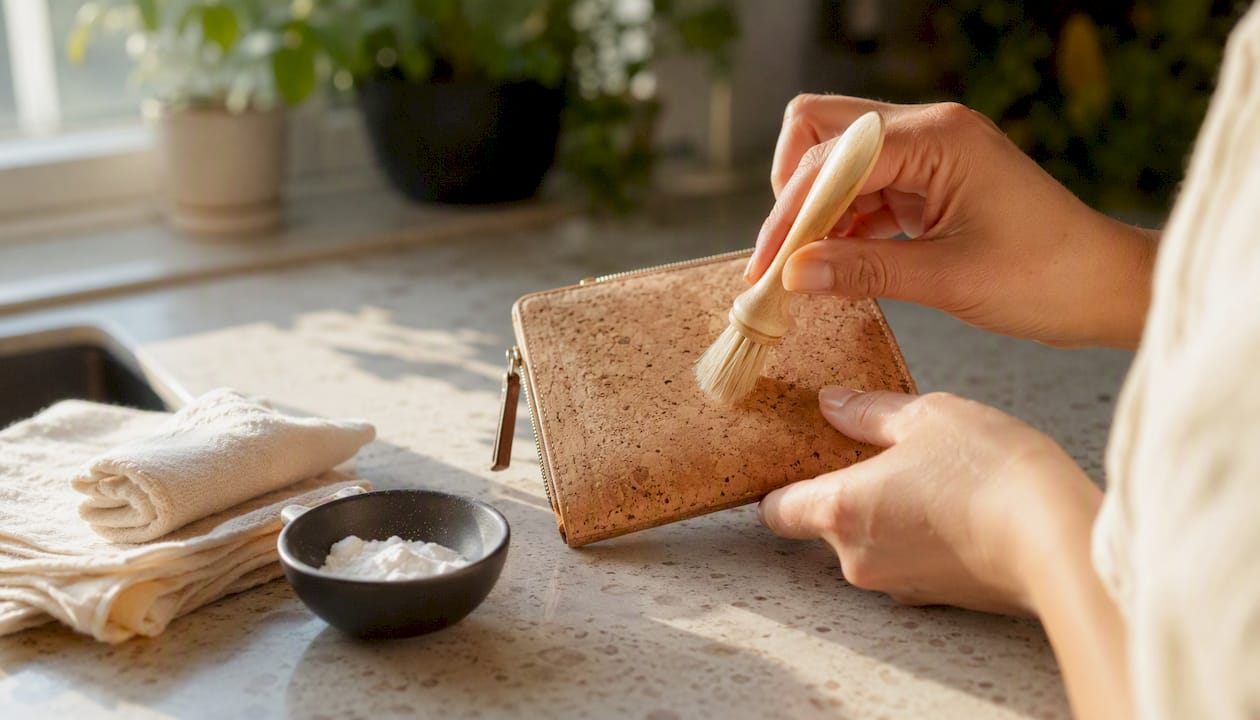
| Oil or grease | Blot immediately; apply a tiny amount of cornflour to absorb residue, leave several minutes, brush away gently, then clean with mild soap solution | If the mark persists after two attempts, stop. Repeated treatment risks surface damage. |
| Ink | Dab with a cloth barely dampened in lukewarm water and mild soap. Do not rub. | Ink that has dried into the cork is rarely fully removable at home. Seek professional advice. |
| Makeup (powder or foundation) | Brush away dry residue first with a soft brush, then use the mild soap method | Pigmented products (lipstick, eyeliner) may leave a tint. A professional cleaner has better tools. |
| Dye transfer (from clothing or bags) | Mild soap and water, applied promptly | Dye transfer is one of the hardest stains to reverse. If it has set, professional help is the realistic option. |
Check colourfastness before treating any stain: dab your cleaning cloth on an inconspicuous area first and see whether any colour lifts onto the cloth. If it does, stop and consult a specialist.
What to avoid and the most common care mistakes
Cork fabric is naturally water-resistant thanks to suberin, the waxy compound in cork cells, but it is still porous. Excess water, harsh chemicals, abrasive tools and steam can all damage surface finishes and cause swelling. The mistakes below account for most of the damage people bring to repair shops.
Do:
- Patch test any new product on a hidden area before full application.
- Air dry at room temperature every time.
- Use pH-neutral or cork-specific cleaners if you move beyond plain soap and water.
- Follow Thecorkstore’s natural cork care guidance for product-specific advice.
Don’t:
- Use bleach, vinegar, or alcohol-based cleaners. All three can strip surface finishes.
- Scrub with stiff brushes, scouring pads, or anything abrasive.
- Soak the item or hold it under running water.
- Apply conventional leather conditioners or oils. Cork does not need oiling and most leather products are not vegan-friendly.
- Use steam or high heat at any stage.
On protectants: if you want to add a layer of protection, a vegan-friendly beeswax-free balm or a cork-specific spray is the safest route. Always patch test first and apply sparingly. Cork does not usually need conditioning the way leather does.
Storing and protecting your cork bags long-term
Good storage habits extend the life of a cork accessory considerably. A few straightforward steps make a real difference, particularly through the wetter months in the UK.
- Store in a breathable dust bag, not a sealed plastic bag. Cork needs airflow to stay stable.
- Stuff the bag loosely with tissue paper or a soft cloth to hold its shape between uses.
- Keep away from direct sunlight and heat sources, both of which can fade and dry out the surface finish.
- If the item gets wet in rain, blot it dry and let it air out fully before storing.
- Pack straps separately when travelling to avoid pressure marks on the body of the bag.
- Keep cork items away from sharp objects and liquids in luggage. A small cloth pouch works well.
- For longer storage, check the item every few weeks and air it out briefly.
Thecorkstore’s storage and longevity guide covers seasonal care in more detail, including UK-specific humidity advice.
When should you seek professional repair?
Home care handles the vast majority of cleaning needs, but some situations call for a specialist. Knowing when to stop is as useful as knowing what to clean with.
Signs that a professional repairer is the better option:
- Large or set dye transfer that has not responded to two gentle attempts.
- Seam separation or delamination where the cork layer is lifting from its backing.
- Structural warping that has not resolved after careful reshaping and drying.
- Deep ink stains that have penetrated beyond the surface layer.
- Any damage to hardware or zip mechanisms that affects the bag’s function.
Leather repair shops and specialist bag repairers can often work with cork fabric, though it is worth calling ahead to confirm experience with the material. When you contact a repairer, bring photos of the damage, note the age of the item and any treatments you have already applied. That information helps them assess whether panel replacement, seam repair, or a specialist clean is the right approach. For items that are beyond practical repair, Thecorkstore’s upcycling ideas offer a sustainable alternative to disposal.
Why gentle care is the most sustainable choice
The conventional wisdom around bag care tends to default to “use a specialist product” or “clean it thoroughly.” With cork, the opposite instinct serves you better. The gentler the method, the longer the surface finish lasts, and a cork accessory that lasts five years instead of two represents a meaningful reduction in the resources needed to replace it.
Cork is already one of the most sustainable materials in fashion. The bark is harvested without felling the tree, and the material is naturally cruelty-free. Caring for it gently honours that provenance. Harsh chemicals do not just risk the finish; they can compromise the adhesives and backing materials that hold a cork accessory together, shortening its life in ways that are not always immediately visible. The mild soap and lukewarm water method recommended here is not a compromise. It is what the material actually needs, and it costs almost nothing.
Thecorkstore: vegan cork accessories and care guides in one place
Thecorkstore carries a full range of vegan cork handbags, wallets, backpacks, and gift sets, all made without animal products and built to last with proper care. What sets it apart for UK shoppers is the combination of a well-curated product range and genuinely useful care content published alongside it.

The blog covers step-by-step cork bag cleaning and accessory maintenance in detail, so you have the right guidance for whatever you buy. Whether you are looking for your first cork bag or replacing a well-loved wallet, visit Thecorkstore to browse the range and find the care guide that matches your item.
Sources
- How to Clean and Care for Cork | Bags, Flooring & More | korkie
- Cork fabrics cleaning recommendations
- How to Clean and Maintain a Cork Floor – Green Building Supply
- Is Cork Waterproof: Complete Guide for Homeowners - D and G Flooring