
Eco certifications explained: your 2026 buying guide
TL;DR:
- Eco certifications are independent labels that verify a company’s or product’s environmental claims through third-party audits. Combining product-level and business-level certifications provides the strongest evidence of genuine sustainability. Verifying the certifying body’s accreditation ensures the certification’s credibility and reduces greenwashing risk.
Eco certifications are independent, third-party validations confirming that a product or business meets defined environmental and sustainability standards. They exist to explain eco certifications in plain terms: a label you can trust because an accredited body checked the claim, not just the company making it. Schemes like OEKO-TEX Standard 100 and BPI certification cover everything from harmful chemicals in textiles to compostability in foodservice packaging. For buyers and brands alike, these labels cut through vague green claims and signal genuine environmental commitment. Understanding them is the first step to spending your money where your values are.
What are eco certifications and how do they work?

Eco certifications, also called ecolabels or sustainability certifications, are structured schemes that verify environmental claims against published standards. A certifying body audits the product, process, or organisation and awards a label only when the criteria are met. The label then signals that claim to buyers without them needing to read a technical report.
ISO classifies eco-labels into three types. Type I labels are third-party verified against accredited standards and carry the highest credibility. Type II labels are self-declared by the manufacturer, with no independent audit. Type III labels are quantitative environmental product declarations, presenting raw data rather than a pass or fail verdict.
The distinction matters because self-declared claims are the primary vehicle for greenwashing. A brand printing “eco-friendly” on packaging without third-party verification is making a Type II claim. A product carrying the EU Ecolabel or GOTS certification has been audited by an accredited body. Buyers who understand this difference are far harder to mislead.
Pro Tip: When you see a green label, search for the certifying body’s name. If you cannot find an independent organisation behind the mark, treat it as a self-declared claim.
Types of eco certifications: product-level vs company-level
Product-specific certifications focus on a single item or material. GOTS (Global Organic Textile Standard) covers organic fibres from farm to finished garment. FSC (Forest Stewardship Council) certifies responsible forestry. OEKO-TEX Standard 100 verifies that products are free from over 100 harmful substances affecting human health and the environment.
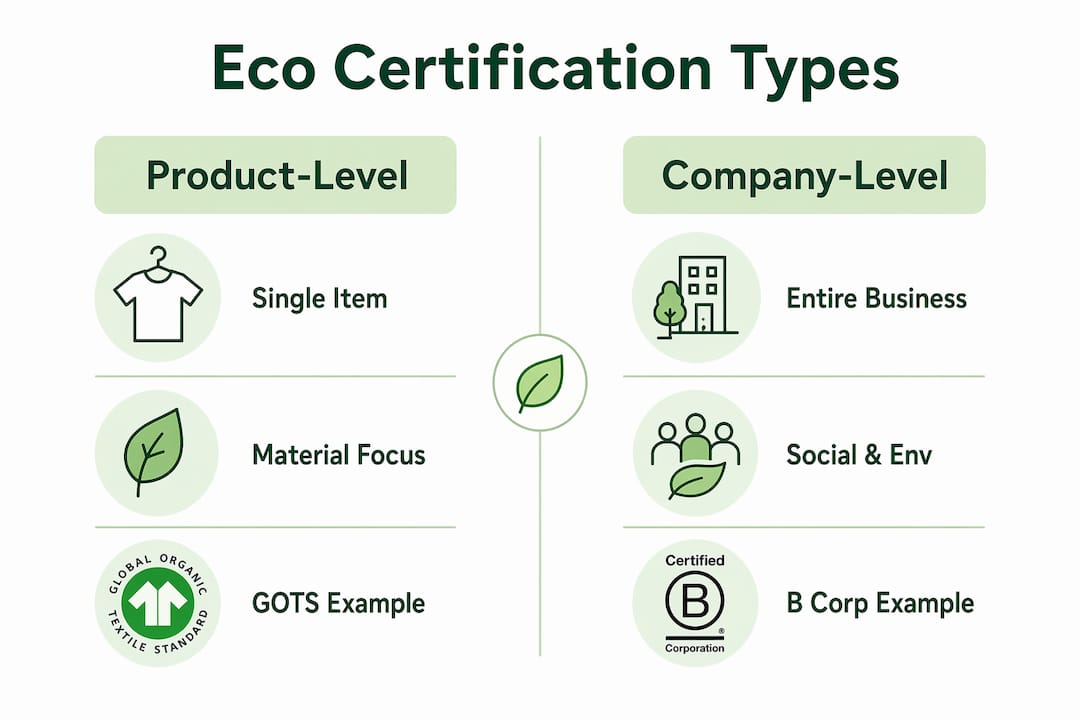
Company-level certifications assess the entire business. B Corp certification, issued by B Lab, evaluates social and environmental performance across governance, workers, community, and environment. A company can hold B Corp status while selling products that carry no product-level label, and vice versa.
Combining both types provides a more reliable sustainability signal than either alone. A brand with B Corp status and GOTS-certified products is making verifiable claims at two independent levels. That combination is far stronger evidence of genuine commitment than a single badge.
| Certification type | Scope | Example | Verified by |
|---|---|---|---|
| Type I ecolabel | Product or service | EU Ecolabel, GOTS | Independent third party |
| Type II self-declaration | Product claim | “Eco-friendly” on packaging | Manufacturer only |
| Type III declaration | Product data | Environmental Product Declaration | Programme operator |
| Company-level | Whole business | B Corp | B Lab |
| Material-specific | Single material or input | FSC, OEKO-TEX Standard 100 | Accredited auditor |
How do eco certifications benefit buyers and businesses?
Eco certifications reduce information asymmetry. Buyers cannot inspect a supply chain or test a fabric for toxins at the point of purchase. A credible certification signals verified environmental claims on their behalf, removing the need to take a brand’s word for it. That signal is especially powerful in categories where environmental impact is invisible, such as textiles, packaging, and building materials.
The business case is equally clear. An analysis of 55,753 booking transactions found that hotels with third-party audited eco-certifications experienced a 43% uplift in sales, driven by higher prices and longer stays. That figure shows certification is not just a reputational asset. It directly affects revenue.
The benefits for businesses extend beyond sales figures:
- Market access. Many retailers, procurement teams, and public sector buyers now require certifications as a condition of supply.
- Reduced greenwashing risk. A third-party audit creates a defensible record of environmental claims.
- Reputational differentiation. Certified brands stand apart in crowded markets where every competitor claims to be green.
- Operational improvement. The certification process itself often identifies inefficiencies and drives genuine environmental gains.
Diversified certification strategies amplify ESG performance and improve external reputation, particularly for small and medium-sized businesses. The benefit grows as a brand gains international presence and media attention. One certification is a starting point. Multiple aligned certifications build a credible, layered sustainability story.
What are the common challenges and misconceptions?
The biggest misconception is that all eco labels carry equal weight. A self-declared “natural” claim on a shampoo bottle and a COSMOS Organic certification from Ecocert are not comparable. One has been audited. The other has not. Treating them as equivalent is the core error that greenwashing exploits.
A second misconception concerns compostability. BPI certification confirms that a product meets ASTM D6400 or D6868 standards for industrial composting, including strict limits on PFAS chemicals. However, a certified compostable cup placed in a home compost bin or general waste will not degrade as intended. The certification is only meaningful when the correct industrial composting infrastructure exists locally.
Pro Tip: Before choosing a compostable product, check whether your local council or waste contractor operates an industrial composting facility. Without it, the certification’s environmental benefit does not reach you.
Three further pitfalls are worth knowing:
- Choosing for visibility, not fit. Selecting certifications based on brand recognition rather than operational alignment undermines their effectiveness. A certification that does not match your product type or supply chain delivers little real value.
- Trusting market context too little. In markets with lower institutional trust, buyers rely more on personal experience and peer recommendations than on formal labels. Certifications carry different weight in different countries.
- Ignoring scope limitations. A textile certification covers the fabric. It says nothing about the factory’s labour practices or the packaging used to ship the product.
How to choose and interpret eco certifications effectively
Choosing the right certification starts with clarifying your purpose. Compliance, market access, and capability building are three distinct goals, and each points to different schemes. A business exporting to Germany needs to understand the Blue Angel label. A UK fashion brand targeting ethical buyers should look at GOTS or the Soil Association’s COSMOS standard.
A practical framework for buyers and businesses:
- Define the scope. Decide whether you need product-level, material-level, or company-level verification. Do not conflate them.
- Verify the accreditation. Check that the certifying body is independent and accredited by a recognised authority such as UKAS in the UK or IAF internationally.
- Match the certification to your industry. FSC is irrelevant to a textile brand. GOTS is irrelevant to a timber merchant. Relevance is not optional.
- Align with your operations. Certifications must sit within integrated operational strategies, not alongside them as marketing add-ons. If your supply chain cannot meet the standard, the certification process will expose that gap.
- Check renewal and audit cycles. A certification awarded in 2019 and never renewed is not current evidence of compliance.
For buyers, the same logic applies in reverse. Check the certifying body, not just the logo. Look for the certification number on the product or brand website and verify it directly with the issuing organisation. Many schemes publish public databases of certified products and companies. Identifying certified eco-friendly accessories follows the same principle: the label is the starting point, not the end of the enquiry.
Understanding what makes a brand truly sustainable requires looking beyond the logo to the practices and audits that sit behind it.
Key takeaways
Eco certifications are only as reliable as the independent body that issues them. Type I third-party verified labels are the gold standard, and combining product-level and company-level certifications provides the strongest sustainability signal available.
| Point | Details |
|---|---|
| Type I labels are most credible | Only ISO Type I certifications involve independent third-party audits against published standards. |
| Compostability requires infrastructure | BPI-certified compostable products only degrade correctly in industrial composting facilities. |
| Certified businesses outperform | Hotels with audited eco-certifications recorded a 43% sales uplift versus uncertified competitors. |
| Diversify certifications strategically | Combining product-level and company-level certifications strengthens ESG performance and reputation. |
| Verify before you trust | Always check the certifying body directly. Many schemes publish public databases of certified products. |
Why I think most buyers are still asking the wrong question
Most people ask “is this product eco-certified?” when the better question is “who certified it and what did they actually check?” I have watched brands spend considerable effort acquiring a single, low-scrutiny label and then market it as proof of full environmental responsibility. That is not dishonesty in every case. Sometimes it is simply a misunderstanding of what certifications can and cannot do.
The 43% sales uplift for certified hotels is a striking number. What it actually reflects is buyer confidence, not environmental perfection. Certification builds trust. Trust drives purchasing decisions. That is the mechanism. The environmental outcome depends on whether the certification standard is genuinely rigorous and whether the business has embedded it into real operations.
My honest view is that certifications are vital but insufficient on their own. A brand holding B Corp status and GOTS-certified products, with transparent supply chain reporting, is making a far more credible claim than one with a single self-declared badge. The eco-fashion certifications worth following in 2026 are the ones backed by independent audits and renewed regularly. Everything else is a starting point for further questions, not a final answer.
Consumer education is the missing piece. Labels work best when buyers know how to read them. Until that literacy is widespread, the gap between a rigorous certification and a marketing sticker will remain invisible to most shoppers.
— Aaron
Certified and stylish: cork accessories from Thecorkstore
Thecorkstore sells vegan cork accessories that put sustainability claims into practice rather than just printing them on a label.
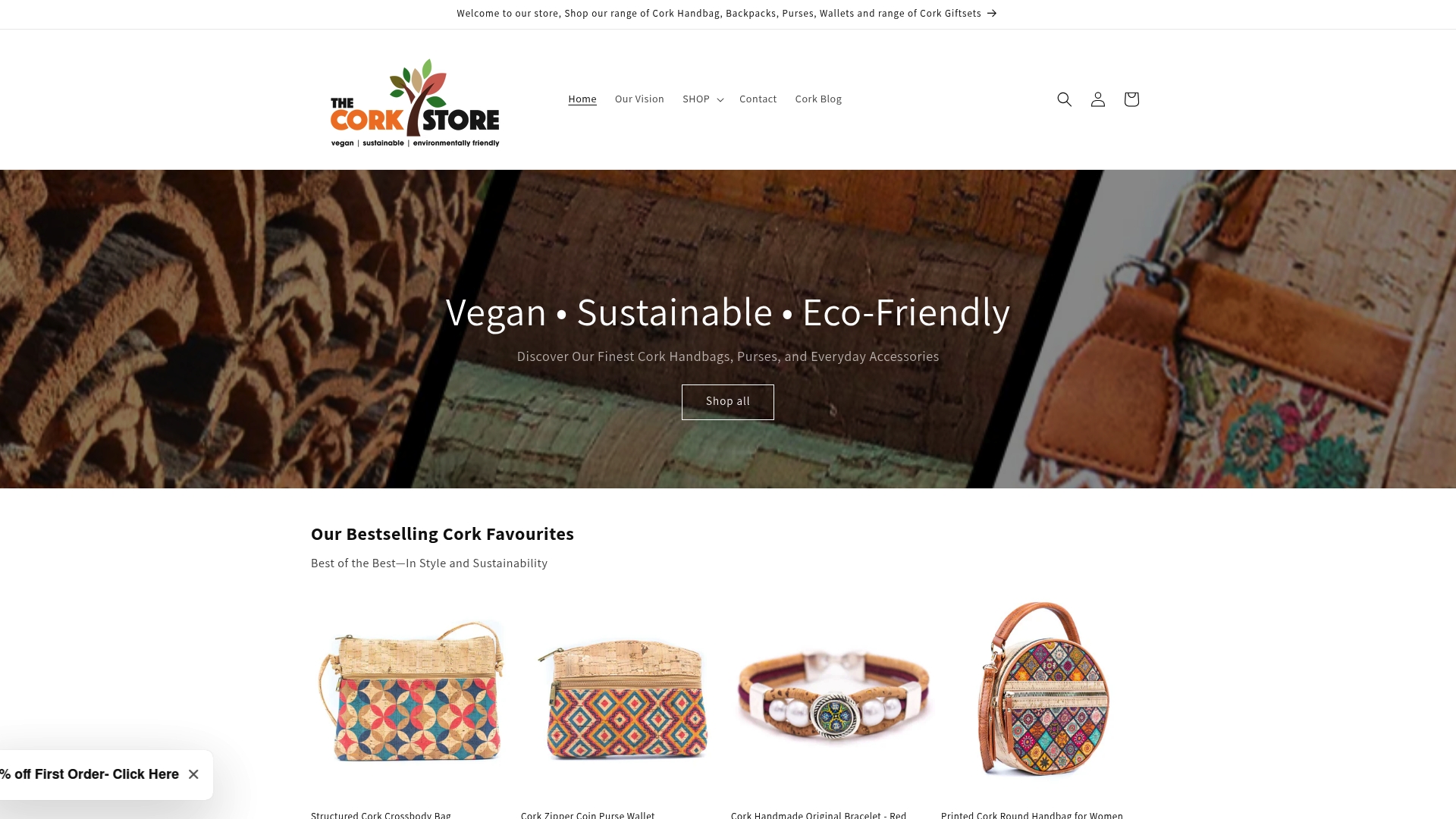
Cork is a naturally harvested material. Harvesting it does not require felling the tree, which means the forest continues to absorb carbon after every harvest. Thecorkstore’s range of eco-friendly vegan cork gifts includes handbags, wallets, backpacks, and gift sets, all made without animal products or harmful chemicals. For buyers who have read this far and want to put their understanding of eco certifications to practical use, these products are a concrete place to start. Stylish, durable, and cruelty-free, they represent the kind of purchase that aligns with genuine environmental values rather than green marketing.
FAQ
What are eco certifications in simple terms?
Eco certifications are labels awarded by independent bodies confirming that a product or business meets specific environmental standards. They differ from self-declared claims because an accredited third party has audited the evidence.
What is the difference between Type I, II, and III eco labels?
Type I labels are third-party verified and carry the highest credibility. Type II labels are self-declared by the manufacturer with no independent audit. Type III labels present quantitative environmental data without a pass or fail verdict.
Do eco certifications actually improve business performance?
An analysis of over 55,000 hotel bookings found that third-party audited eco-certifications produced a 43% sales uplift through higher prices and longer stays. The effect is strongest when the certification is independently verified and regularly renewed.
Can a compostable certification be misleading?
Yes. BPI certification confirms a product meets industrial composting standards, but the environmental benefit only occurs if local industrial composting facilities exist. Without that infrastructure, certified compostable products often end up in landfill.
How do I verify whether an eco certification is genuine?
Search for the certifying body by name and check whether it is independently accredited. Most credible schemes, including GOTS, FSC, and OEKO-TEX, publish public databases where you can verify a specific product or brand’s certification status directly.