

Fashion circular economy: a practical UK guide
A fashion circular economy is a design-driven system that eliminates waste and pollution, keeps products and materials in use at their highest value, and actively regenerates natural systems. The single most important implication: value stays in clothes longer, and far less ends up in landfill. The Ellen MacArthur Foundation and the Circular Design Standard (CDS) are the two authoritative anchors for this definition in practice.
Key takeaways
The fashion circular economy keeps value in products through design, not disposal — and the UK has credible frameworks (WRAP, CDS, Textiles 2030) to measure whether brands are delivering on that promise.
| Point | Details |
|---|---|
| Three design principles | Eliminate waste, circulate materials at highest value, and regenerate nature — these are the CDS criteria to check. |
| 26% of wardrobes unworn | WRAP research shows over a quarter of UK wardrobe items go unworn each year, making resale and repair the highest-impact consumer actions. |
| Measure displacement | Resale and rental only reduce consumption if they displace new purchases; use WRAP’s methodology to verify brand claims. |
| Mini-loops are not enough | Most current circular activity is incremental; systemic change requires aligned designers, sorters, recyclers, and policy incentives. |
| Verify before you trust | Credible circular claims reference the CDS, WRAP methodology, or equivalent third-party standards — not just brand copy. |
Table of Contents
- What does the fashion circular economy actually mean?
- Circular business models: what are your options?
- How design and material choices enable genuine circularity
- UK initiatives and standards you should know about
- UK pilots and examples that show circularity in practice
- Practical actions you can take right now
- What does the research say about circular fashion’s limits?
- How to spot greenwashing in circular fashion claims
- An eco-fashion retailer’s perspective on what actually works
- Sources
What does the fashion circular economy actually mean?
The canonical framework comes from three design-driven principles, each of which shapes how a garment is conceived before a single stitch is sewn.
- Design out waste and pollution. Waste is not an inevitable by-product; it is a design flaw. Circular fashion treats every discarded fibre, offcut, and unsold unit as evidence of a system that was not designed well enough.
- Circulate products and materials at their highest value. A garment in active use is worth more than its raw fibres. Repair, resale, and rental keep that value intact; shredding for downcycled fill does not.
- Regenerate nature. The most ambitious principle: materials and processes should leave ecosystems better, not merely less damaged.
The Circular Design Standard translates these principles into assessable product criteria: durability (how long a garment holds up under real use), repairability (whether it can be fixed without specialist tools), and aesthetic longevity (whether the design will still feel relevant in five years). These are the criteria buyers and designers can actually measure.
Scale matters here. WRAP’s consumer research found that roughly 26% of wardrobe items in the UK were not worn in the past year. That is more than a quarter of everything people own, sitting idle. The linear model — make, use, discard — is not just environmentally costly; it is economically wasteful for the people buying the clothes.
Circular business models: what are your options?
Six models dominate the conversation, and each captures value differently.
- Repair. Extends a garment’s active life by fixing damage before it becomes terminal. Low infrastructure cost for brands; high consumer trust when done well.
- Resale. Moves ownership of a used item to a new user. Platforms like Vinted and Depop have normalised peer-to-peer resale in the UK, particularly among younger buyers.
- Rental. Transfers temporary use rights rather than ownership. HURR operates a peer-to-peer fashion rental marketplace in the UK, with a focus on occasion wear that would otherwise be worn once and discarded.
- Take-back and collection. Brands or retailers collect used items at end of life for sorting, resale, or recycling. Convenience is the critical variable: WRAP’s guidance notes that accessible drop-off points drive participation, as IKEA UK’s take-back pilot demonstrated.
- Remanufacturing. Disassembles and rebuilds garments into new products at comparable quality. More capital-intensive than resale, but retains more material value than recycling.
- Upcycling. Transforms waste or low-value materials into higher-value products. Artisan-scale in most UK contexts, though some brands have built it into their core offer.
| Model | Consumer convenience | Revenue model | Key risk |
|---|---|---|---|
| Repair | Moderate (requires drop-off or postal) | Service fee or brand loyalty | Low margin without volume |
| Resale | High (app-based platforms) | Commission or listing fee | Displacement not guaranteed |
| Rental | Moderate (logistics overhead) | Subscription or per-use fee | Adds consumption if not measured |
| Take-back | Moderate (drop-off dependent) | Downstream material value | Low return rates without incentives |
| Remanufacturing | Low (brand-managed) | Premium product pricing | High capital cost |
| Upcycling | Low (brand-managed) | Premium or niche pricing | Hard to scale |
The Exeter Centre for Circular Economy’s summary of A New Textiles Economy puts a USD 500 billion opportunity on the table if the system is genuinely transformed. That figure assumes systemic alignment, not just a take-back bin in a shop doorway.
How design and material choices enable genuine circularity
Good circular outcomes are mostly decided at the design stage, long before a garment reaches a consumer. Here is a practical checklist for designers, buyers, and informed shoppers.
- Durability. Physical construction should withstand repeated washing and wear. Seam strength, colourfast dyes, and reinforced stress points are the basics.
- Repairability. Zips, buttons, and fastenings should be replaceable. Avoid fused or bonded constructions that cannot be opened without destroying the garment.
- Modularity. Where possible, design components that can be replaced independently — a detachable collar, a replaceable lining — rather than requiring the whole item to be discarded.
- Mono-materials. Mixed polymer blends are extremely difficult to recycle industrially at scale. Favouring mono-material assemblies and clear labelling (material content plus end-of-life instructions) is the practitioner standard for designing with future recycling in mind.
- Clear end-of-life labelling. A garment that cannot be identified as compostable, recyclable, or reusable at the sorting stage will default to landfill or incineration regardless of its material composition.
On materials: natural fibres such as organic cotton, linen, and wool can biodegrade under the right conditions and are generally easier to recycle than synthetic blends. The pitfall is that “natural” does not automatically mean circular — a heavily chemically treated natural fibre may be neither recyclable nor compostable. Certain chemical recycling processes can handle blended synthetics, but the technology remains limited in scale and geography across the UK.
Pro Tip: Emotional durability — designing products that people genuinely love and want to keep — reduces discard rates as effectively as technical durability. A 2025 MDPI study highlights this as a systems-level lever: if a garment has meaning to its owner, it stays in use far longer than a technically superior but emotionally neutral one. For accessories, this is especially relevant: a well-designed cork bag that ages beautifully is less likely to be discarded than a synthetic alternative that looks dated within a season.

UK initiatives and standards you should know about
Three programmes define the credible landscape for circular fashion in the UK.
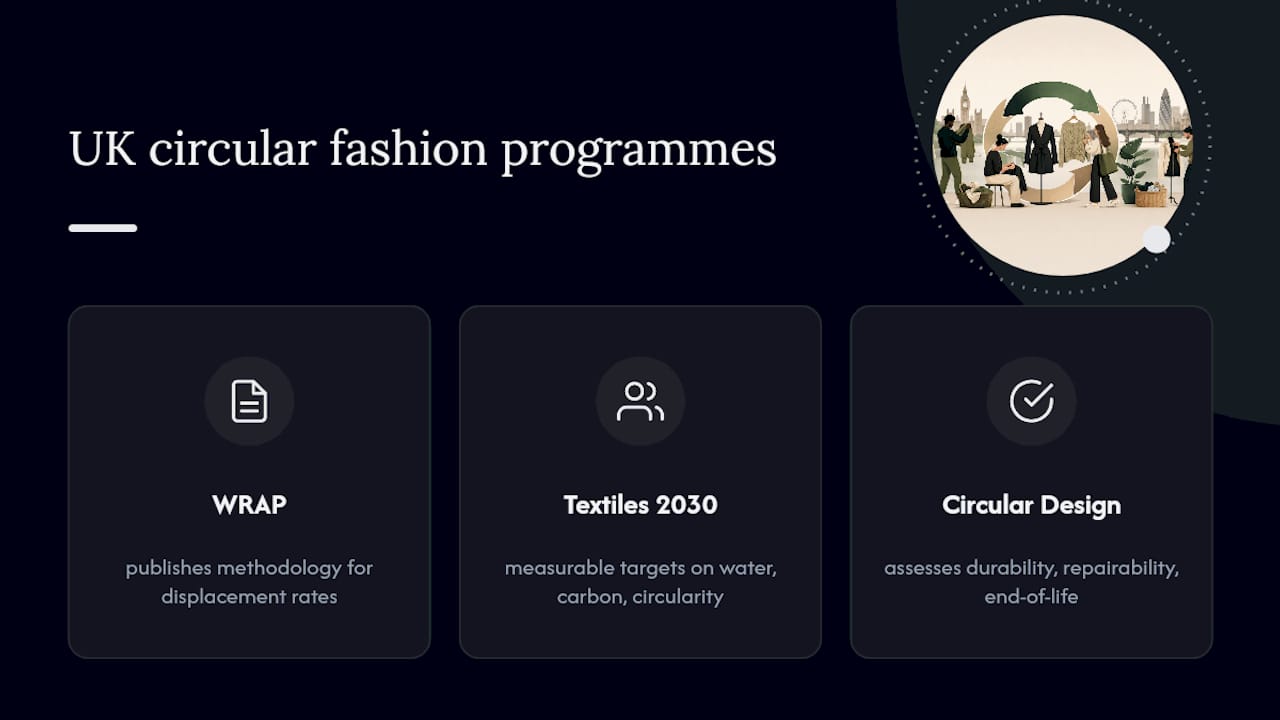
WRAP and Textiles 2030 / UK Textiles Pact are the most practically useful for businesses. WRAP (the Waste and Resources Action Programme) runs Textiles 2030, the successor to the UK Textiles Pact, which brings together brands, retailers, and manufacturers committed to measurable targets on water, carbon, and circularity. WRAP publishes methodology for measuring displacement rates — the critical question of whether a resale or rental transaction actually replaces a new purchase — and provides toolkits for launching take-back pilots. Registered signatories report progress against shared metrics, which makes their claims verifiable in a way that unilateral brand announcements are not.
The Circular Design Standard (CDS) gives businesses a structured framework for assessing individual products against circular criteria. Rather than a vague commitment to sustainability, the CDS asks specific questions about durability, repairability, and end-of-life routes. Brands that use it can point to a product-level assessment rather than a company-level aspiration.
On policy: the UK government has signalled intent to introduce extended producer responsibility (EPR) for textiles, which would require brands to contribute financially to end-of-life collection and processing infrastructure. The precise timeline and scope remain subject to consultation, but the direction of travel is clear. Brands that have already built circular infrastructure will be better positioned when EPR arrives than those starting from scratch.
UK pilots and examples that show circularity in practice
Abstract principles become credible when they are attached to real outcomes. Several UK-relevant pilots illustrate what the models above look like when they run.
- Brand take-back pilots across UK retailers have demonstrated that in-store collection points, when well-promoted and genuinely convenient, can divert meaningful volumes of textiles from landfill. WRAP’s guidance documents several such pilots and the conditions under which return rates improve.
- Peer-to-peer resale platforms — Vinted and Depop among them — have shifted the UK secondhand clothing market from charity shops to app-based transactions, reaching demographics that previously bought new by default. Mintel’s analysis links this shift to changing consumer habits and platform-driven normalisation of resale.
- HURR’s rental model focuses on high-value occasion wear, the category with the worst use-per-item ratio in most wardrobes. By enabling peer-to-peer rental rather than single-use purchase, it targets exactly the garments that circular economy logic says should never be owned outright.
- Retailer partnerships with WRAP under Textiles 2030 have produced shared measurement frameworks that allow signatories to report circularity progress consistently, rather than each brand defining its own metrics.
| Initiative type | Reported outcome | Source |
|---|---|---|
| UK take-back pilots | Textiles diverted from landfill; return rates improve with convenient drop-off | WRAP |
| Peer-to-peer resale (UK) | Growing secondhand market; younger buyer demographics shifting to resale | Mintel / industry |
| Rental (occasion wear) | Reduced single-use purchases for high-cost, low-frequency garments | HURR / industry |
| Textiles 2030 signatories | Shared measurement of carbon, water, and circularity targets | WRAP |
The Exeter Centre’s framing of a USD 500 billion systemic opportunity is worth keeping in mind when reading these pilot-scale results: the gap between what individual initiatives achieve and what full system transformation could deliver is still very large.
Practical actions you can take right now
Circular fashion does not require waiting for brands to change. Individual choices compound.
- Buy preloved first. Before purchasing new, check resale platforms. The UK secondhand market has never been more accessible or better curated.
- Rent for occasions. A dress worn once for a wedding has a terrible use-per-wear ratio. Rental platforms for occasion wear solve this directly.
- Repair before replacing. A broken zip or a worn heel does not mean a garment is finished. Local repair services and brand repair programmes are growing across the UK.
- Choose durable, simple materials. When buying new, favour mono-material garments with clear care and end-of-life labelling. Check our guide on reducing fashion waste for practical material checks.
- Use correct disposal routes. Textile banks, brand take-back schemes, and charity donation are all preferable to general waste. Composting is an option only for genuinely untreated natural fibres.
Pro Tip: When evaluating a resale or rental platform, ask whether the transaction is likely to displace a new purchase. WRAP’s displacement methodology is the UK standard for answering this question rigorously. As a consumer, a simple proxy: if you would have bought new without the platform, the transaction is displacing. If you are adding to an already-full wardrobe, it probably is not.
Garment care extends life significantly. Cold washing, line drying, and avoiding tumble drying reduce fibre degradation. For accessories, proper storage and conditioning of natural materials like cork or leather can add years to a product’s life. See Thecorkstore’s eco-friendly fashion tips for care guidance specific to sustainable accessories.
What does the research say about circular fashion’s limits?
The honest answer is that circularity, as currently practised, often falls short of its promise. A 2026 Springer review argues that most circular strategies focus on material retention — keeping fibres in use — without delivering net-positive ecological or social outcomes. Retaining a polyester garment in circulation is better than landfill, but it does not restore the ecosystem degraded to produce it.
The Taylor & Francis analysis of “mini-loop” circular practices makes a related point: most current activity is incremental. Individual brands running take-back schemes, individual platforms enabling resale — these are mini-loops that lack the holistic vision needed to close the system. Designers, sorters, recyclers, and consumers all need to be aligned, and currently they are not.
Social impacts are also underexamined. Low-margin substitution effects — where resale or repair jobs replace manufacturing jobs at lower wages — are a real risk in the transition. The MDPI study stresses that systems-level change must incorporate degrowth economics and social equity alongside technical circular measures, not treat them as secondary concerns.
What would close these gaps? Three things: measuring displacement rigorously (so brands know whether their circular models actually reduce new production), investing in sorting and recycling infrastructure (the UK currently lacks the capacity to process the volumes that circular ambitions require), and aligning policy incentives with circular outcomes rather than just circular activity.
How to spot greenwashing in circular fashion claims
Circular language is now common in brand marketing. Most of it is not backed by anything verifiable. Here is what to look for.
- Vague percentages without a methodology. “Made with recycled content” without specifying the percentage, the fibre type, or the certification is meaningless. Ask: recycled by what standard, verified by whom?
- No third-party standard. A brand that claims circularity without referencing the CDS, a WRAP methodology, or an equivalent independent framework is self-certifying. That is not evidence.
- Confusing end-of-life statements. “Recyclable” means nothing without infrastructure to recycle it. “Compostable” means nothing without industrial composting access. Check whether the claim is conditional on facilities that most UK consumers cannot access.
- Take-back schemes with no downstream transparency. Where does the collected material go? If a brand cannot tell you whether collected garments are resold, recycled, or incinerated, the scheme may be more about brand image than material recovery.
- Sustainability claims on fast-fashion volumes. A brand producing hundreds of new styles per week cannot credibly claim a circular model. Volume is the tell.
Credible evidence looks like: a CDS product assessment, a WRAP-methodology displacement analysis, clear lifecycle disclosures at product level, and third-party verification of material content claims. Our guide on how to spot sustainable fashion covers the consumer-facing version of these checks in more detail.
An eco-fashion retailer’s perspective on what actually works
The gap between circular theory and circular practice is widest at the retail level. Brands adopt the language quickly; the operational changes take much longer.
What retailers actually learn when they try to implement circular models is that logistics are the bottleneck. A take-back scheme sounds straightforward until you are managing the return flow: sorting condition, deciding what gets resold versus recycled, handling the customer communication when a returned item cannot be processed. Consumer education is the other constant challenge. Most buyers do not know what “mono-material” means, do not read care labels, and do not think about end-of-life when they are making a purchase decision.
The practical recommendation for retailers considering circular moves: start with the model that requires the least new infrastructure. For most small UK retailers, that means partnering with an existing resale platform or textile bank rather than building a proprietary take-back system. Measure displacement from the start, using WRAP’s methodology, so you know whether your circular offer is genuinely reducing new production or simply adding a new revenue stream alongside it.
Product choice matters too. Materials that are genuinely durable and easy to care for — cork, for instance, is naturally water-resistant, requires no chemical treatment, and ages well — reduce the frequency of replacement without requiring consumers to change their behaviour dramatically. Thecorkstore’s circular accessory guide explores how these material properties translate into circular design outcomes for accessories specifically.
For retailers thinking about packaging, the same circular logic applies: circular packaging choices reduce waste at the retail system level, not just at the garment level.
Sources
- Circular Fashion | Circular Economy for the Fashion Industry | Ellen MacArthur Foundation
- Circular business models for fashion and textiles | WRAP - The Waste and Resources Action Programme
- Assessing the sustainable circular fashion supply chain as a model for achieving economic growth in the global market | MDPI
- A New Textiles Economy: Redesigning fashion’s future - Exeter Centre for Circular Economy
- Circular fashion: evolving practices in a changing industry | Taylor & Francis (tandfonline)