
Before You Buy 'Cactus' Vegan Leather: 6 Checks to Avoid Greenwashing
In this article, “vegan leather from cactus” refers to cork-based vegan leather, not cactus-derived material such as Desserto. Cork fabric, made from the bark of the cork oak, gives accessories like handbags, wallets and backpacks a cruelty-free structure that resists water and wear better than many expect. The sections below walk through how it is made, how it performs and how to buy and care for it well.
TL;DR:
- Cork fabric’s strength largely depends on the textile backing and adhesive used, with woven backings providing better stress resistance.
- Natural cork’s water resistance stems from suberin, but it is not fully waterproof and can stretch more at seams when nonwoven backings are used.
- Sustainability relies on bark harvesting practices that promote forest regeneration and biodiversity, especially when certified by FSC or similar standards.
- Genuine cork products are more expensive than synthetics due to labor and slow harvest cycles, and natural variability may affect appearance.
- Verifying backing materials, adhesives, origin, and certification details is crucial to ensure both durability and true ecological credentials.
Table of Contents
- What cork-based vegan leather actually is and how it is made
- Benefits and performance for everyday accessories
- Environmental and sourcing reality: what makes cork sustainable
- How to choose a cork accessory: a practical buying checklist
- Caring for cork accessories so they last
- History and origin of cactus-based vegan leather
- How cork leather is manufactured, from bark to finished accessory
- Cork compared with other plant-based and synthetic leathers
- Where cork shows up in fashion today
- Limitations and challenges worth knowing before you buy
- An honest take on cork as a leather alternative
- Shop cork accessories at The Cork Store
- FAQ
- Sources
What cork-based vegan leather actually is and how it is made
Cork fabric starts with thin sheets of cork skin, usually 0.3 to 0.4 millimetres thick, sliced from the bark harvested off a cork oak. That skin is bonded to a textile backing, which is what turns a fragile layer of bark into something strong enough to carry keys, cards and a laptop every day. The mechanical and material studies on cork fabric confirm that tensile strength and formability come largely from the backing and adhesive, not the cork skin alone.
Manufacturers choose between a few backing types, and the choice shapes both performance and the product’s sustainability story:
- Woven textile backings, often cotton blends, give flexibility and a soft hand feel suited to purses and linings.
- Nonwoven backings are cheaper and lighter, though they can stretch more under load over time.
- Polyurethane interlayers add waterproofing and structure but reduce how fully a piece can claim to be plant-based, since they introduce a synthetic layer.
Once bonded, sheets go through finishing: natural cork grain can be left visible, dyed in solid colours, or printed with patterns, and most accessory-grade cork fabric is finished to a thickness workable for stitching and folding without cracking. The result is a material that looks and handles like a soft leather but starts from bark rather than hide. We cover more of this comparison in our piece on cork versus leather.
Benefits and performance for everyday accessories
What matters to a buyer is whether cork holds up to daily use, and the evidence is encouraging with a caveat about backing choice. Suberin, the waxy compound in cork’s cell walls, gives it natural resistance to water, microbes and abrasion, according to material research on cork, which is part of why cork fabric often performs well without heavy chemical coatings.
Some textile-reinforced cork fabrics have matched or exceeded the tensile strength of lamb leather in laboratory tests, depending on the backing used, as reported in the same cork fabric study. That is a meaningful data point for anyone assuming vegan materials are automatically weaker.
A few practical trade-offs to weigh:
- Woven-backed cork tends to perform best at stress points like straps and strap attachments.
- Nonwoven-backed cork is lighter but can show more stretch at seams under repeated load.
- Compared with PU-backed vegan leathers, cork offers better breathability and a firmer structure, though PU can edge ahead on uniform waterproofing.
Against animal leather, cork trades a small amount of stretch and moulding ability for a cruelty-free origin and a naturally water-resistant surface. We go into more of this trade-off in our comparison of cork and leather differences.
Environmental and sourcing reality: what makes cork sustainable
Cork’s sustainability case rests on how the bark is harvested, not just what it is. Cork oaks are not felled: bark is stripped from the trunk on a rotation, commonly every 9 to 14 years, allowing the tree to regenerate and continue living for well over a century, based on field research on cork oak harvesting. That same research found moderate harvest intensity can increase microhabitats that support biodiversity, though harvest intensity and local management still determine the outcome tree by tree.
That harvesting happens within montado and dehesa landscapes, the cork oak savannas of the Iberian Peninsula, which are recognised as biodiversity-rich ecosystems that depend on active management and periodic harvesting to stay healthy, per research on montado ecosystems.
Harvesting occurs on a multi-year rotation, and active management supports both biodiversity and the rural livelihoods tied to it.
Life-cycle assessment work adds a useful nuance: cork itself carries a low environmental cost as a raw material, but the footprint of a finished accessory depends heavily on what else goes into it, according to LCA-based research on cork products. A cork bag with a synthetic lining and unclear adhesives does not carry the same credentials as one disclosed as mono-material or paired with similarly sustainable components.
Before trusting a sustainability claim, check for a few things:
- FSC or equivalent chain-of-custody certification tracing the cork to a managed forest.
- A stated country or region of origin, not just “sustainably sourced” as a slogan.
- Any transparency on backing material, adhesives and energy use in production.
Market pressure from cheaper synthetic substitutes has also depressed cork prices in some regions, which the FAO’s overview of the cork industry notes can threaten the economic case for maintaining cork oak landscapes. Buying genuinely cork-based goods, rather than products vaguely labelled “cork-like,” helps support that stewardship rather than undercut it.
How to choose a cork accessory: a practical buying checklist
Most of the judgement calls happen before you add anything to a basket. Work through these checks on any product page:
- Confirm the backing material (woven, nonwoven or PU interlayer) is stated, not left vague.
- Look for a specific animal-free claim on adhesives and glues, not just on the outer cork skin.
- Check the lining fabric; a cotton or recycled lining tends to align better with a sustainable product than an unlisted synthetic.
- Verify hardware (zips, clasps, buckles) is metal or another non-animal material, with no unlisted leather trims.
- Ask for origin or certification details, such as FSC chain-of-custody, if they are not already on the page.
- Look closely at seam and strap-attachment photos; tight folds and multi-layer seams are where weaker backings show stress first.
Pro Tip: If a listing says “vegan leather” without naming the base material, ask the seller directly what it is made from before buying.
Red flags worth walking away from include “cork-like” wording that avoids naming cork outright, no mention of what the lining or adhesive is, and animal-derived trims tucked into an otherwise vegan listing. For a deeper verification routine, our buying checklist for vegan cork bags walks through five checks in more detail.
As for which shape to choose: a crossbody or purse suits light daily carry and benefits most from a soft woven backing, while a backpack carrying heavier loads needs reinforced straps and stitching at every attachment point.
Caring for cork accessories so they last
Cork rewards simple care and punishes harsh chemicals. Wipe it down with a soft, damp cloth and a little mild soap; solvents and bleach-based cleaners strip the natural suberin layer that gives cork its water resistance.
- Clean with a damp cloth and mild soap, never a solvent-based cleaner.
- Store away from direct sunlight and extreme dryness, ideally somewhere ventilated.
- Condition occasionally with a product designed for plant-based leathers to keep the surface supple.
- Check stitching and strap tension periodically, especially at folded corners where stress concentrates.
Pro Tip: Keep your receipt and any care card that came with the piece; a reputable seller can usually advise on or arrange a repair for loose stitching before it becomes a tear.
Our guide to cork wallet benefits covers more on how small accessories hold up with this kind of routine care.
History and origin of cactus-based vegan leather
Cork’s own history as a material runs back centuries, long before “vegan leather” was a marketing term. Cork harvesting for bottle stoppers, flooring and insulation developed as a traditional industry across the Mediterranean, particularly in the montado and dehesa landscapes of the Iberian Peninsula, where cork oaks have been managed on long rotations for generations.
The idea of using cork specifically as a leather alternative for bags and accessories is more recent, emerging alongside the broader push for cruelty-free fashion from the late 20th century onward. As demand for animal-free materials grew, cork’s natural water resistance and tactile similarity to leather made it an obvious candidate, and small producers began bonding cork skin to textile backings to create a workable fabric rather than a rigid board.
That shift mattered because cork had mostly been known as a rigid or semi-rigid material, think stoppers, tiles, noticeboards, not something flexible enough for a handbag or wallet. Refining the slicing and bonding process to produce a soft, pliable sheet was what turned cork from a construction material into a genuine leather alternative.
Today, cork-based accessories sit within a wider category of plant-based leathers that also includes materials derived from pineapple leaves, apple pulp and mushroom mycelium, each developed to answer the same basic demand: a durable, animal-free material with a lower environmental footprint than conventional hide tanning. Cork’s advantage within that group is its long industrial history and the existing cork oak landscapes that supply it, rather than needing entirely new agricultural supply chains built from scratch.
How cork leather is manufactured, from bark to finished accessory
The process begins at harvest, when skilled workers strip bark from the trunk of a mature cork oak by hand, using a technique passed down through generations to avoid damaging the tree’s regenerative layer. That bark then dries and cures before being processed into sheets.

From there, thin cork skins, typically 0.3 to 0.4 millimetres, are sliced and prepared for bonding, as detailed in the cork fabric research referenced earlier. The cork skin alone is too delicate for daily use, so it is laminated onto a textile backing, woven or nonwoven, using an adhesive layer. This bonding stage is where most of the fabric’s final strength, flexibility and durability get determined.

After lamination, the combined sheet goes through finishing: trimming to size, sometimes dyeing or printing to add colour or pattern, and a final check for consistency in thickness and surface texture. Because cork is a natural material with visible grain and occasional small voids, manufacturers typically grade sheets for appearance before cutting pattern pieces, reserving the most even sections for visible panels on a bag or wallet.
The finished rolls or sheets then go to accessory makers, who cut, stitch and assemble them into handbags, wallets, backpacks and similar items, pairing the cork fabric with linings, hardware and structural reinforcement at stress points like straps and corners. The entire sequence, from stripped bark to a finished product, typically spans months rather than days, partly because cork itself needs time to dry and cure properly before it can be sliced and bonded.
Cork compared with other plant-based and synthetic leathers
Cork sits alongside several other materials marketed as vegan leather, each with a different base and a different performance profile. Pineapple-leaf leather (often known by the brand name Piñatex) uses fibres extracted from pineapple leaf waste, bonded into a nonwoven mat that is then coated, giving a flexible material often used in footwear and smaller accessories. Mushroom-based leathers use mycelium, the root structure of fungi, grown into sheets and then tanned and finished in a process that shares some steps with traditional leather tanning.
Synthetic vegan leathers, typically polyurethane-based, remain the most common alternative on the market because they are cheap to produce in large volumes and can be moulded into a wide range of textures and finishes. Their downside is that they are petroleum-derived and do not biodegrade the way plant-based options can.
Against this group, cork’s distinguishing features are its natural water and microbial resistance, inherited from suberin, and its long-established sourcing infrastructure through managed cork oak forests. Pineapple and mushroom leathers are newer to scale and still developing consistent supply chains, while PU leathers offer the most uniform finish but the weakest environmental credentials. None of these materials is strictly superior across every measure. Pineapple leather tends to be lighter, mushroom leather often has the softest hand feel, and cork generally offers the best balance of structure and water resistance for structured accessories like handbags and wallets, as our comparison of sustainable vegan leathers explores further.
Where cork shows up in fashion today
Cork has moved well beyond flooring and stoppers into a genuine accessory category. Handbags, wallets, purses, crossbody bags, backpacks and even bracelets are now commonly made from cork fabric, often paired with cotton linings and metal hardware to keep the entire piece animal-free.
The trend has grown alongside wider demand for cruelty-free fashion, with cork increasingly marketed not as a novelty but as a genuine leather alternative suited to daily use rather than occasional wear, exemplified by unique canvas tote bag designs that combine activism and eco-friendliness. Gift sets pairing a cork wallet with a matching purse or bracelet have also become a popular way to introduce the material to someone new to vegan accessories, since a smaller item is a lower-commitment way to test how cork looks and feels in hand.
Designers have also leaned into cork’s natural grain rather than disguising it, treating the visible texture as a feature rather than a flaw, which has helped position cork accessories as a design choice rather than purely an ethical substitute. Our piece on why cork handbags are gaining ground looks at several of the practical reasons driving that shift. Expect to keep seeing cork applied to travel bags and duffel-style pieces too, where its light weight and water resistance are genuinely useful rather than just aesthetic.
Limitations and challenges worth knowing before you buy
Cork is not without trade-offs, and an honest buying decision accounts for them. Scalability is one: cork oak bark grows slowly, on a 9 to 14 year harvest rotation according to the cork oak field research cited earlier, which limits how quickly supply can expand to meet a sudden surge in demand.
Cost is another factor. Genuine cork fabric, properly backed and finished, tends to sit above basic PU leather in price because of the labour involved in harvesting and the slower production cycle, though it often compares reasonably with mid-range animal leather.
Colour and texture variability is inherent to the material. Because cork is a natural product with visible grain, no two sheets look identical, and some buyers accustomed to the uniform surface of synthetic leather may find that inconsistency unexpected rather than charming. Dyeing can even out colour but will not fully remove the natural variation in grain and texture.
Finally, as covered earlier, not every “cork leather” product is equally sustainable. A cork skin bonded with a PU interlayer and an unlisted synthetic lining dilutes the environmental case considerably, which is why checking backing and lining details matters as much as confirming the outer material is cork at all.
An honest take on cork as a leather alternative
Cork gets oversold in one direction and underrated in another. The marketing often implies it is simply “better” than animal leather across the board, when the honest picture is that performance depends heavily on backing choice, and a poorly backed cork fabric will underperform a well-tanned leather at stress points. What cork genuinely delivers, reliably, is a cruelty-free material with natural water resistance and a sourcing story tied to a centuries-old, regenerative forestry practice, which is a real and distinct advantage over most synthetic alternatives.
The bigger blind spot among shoppers is treating “vegan” as a complete answer. A cork bag with an unlisted PU interlayer and a synthetic lining is still mostly plastic underneath the surface. Reading past the headline material is where the real decision happens, and it is worth the extra two minutes on a product page. We write about cork’s practical trade-offs rather than its marketing because a shopper who understands the backing and lining makes a better purchase than one who buys on the word “vegan” alone.
— Aaron
Shop cork accessories at The Cork Store
We offer a range of cork handbags, wallets, purses, crossbody bags and backpacks that highlight backing and sourcing details to promote transparency.
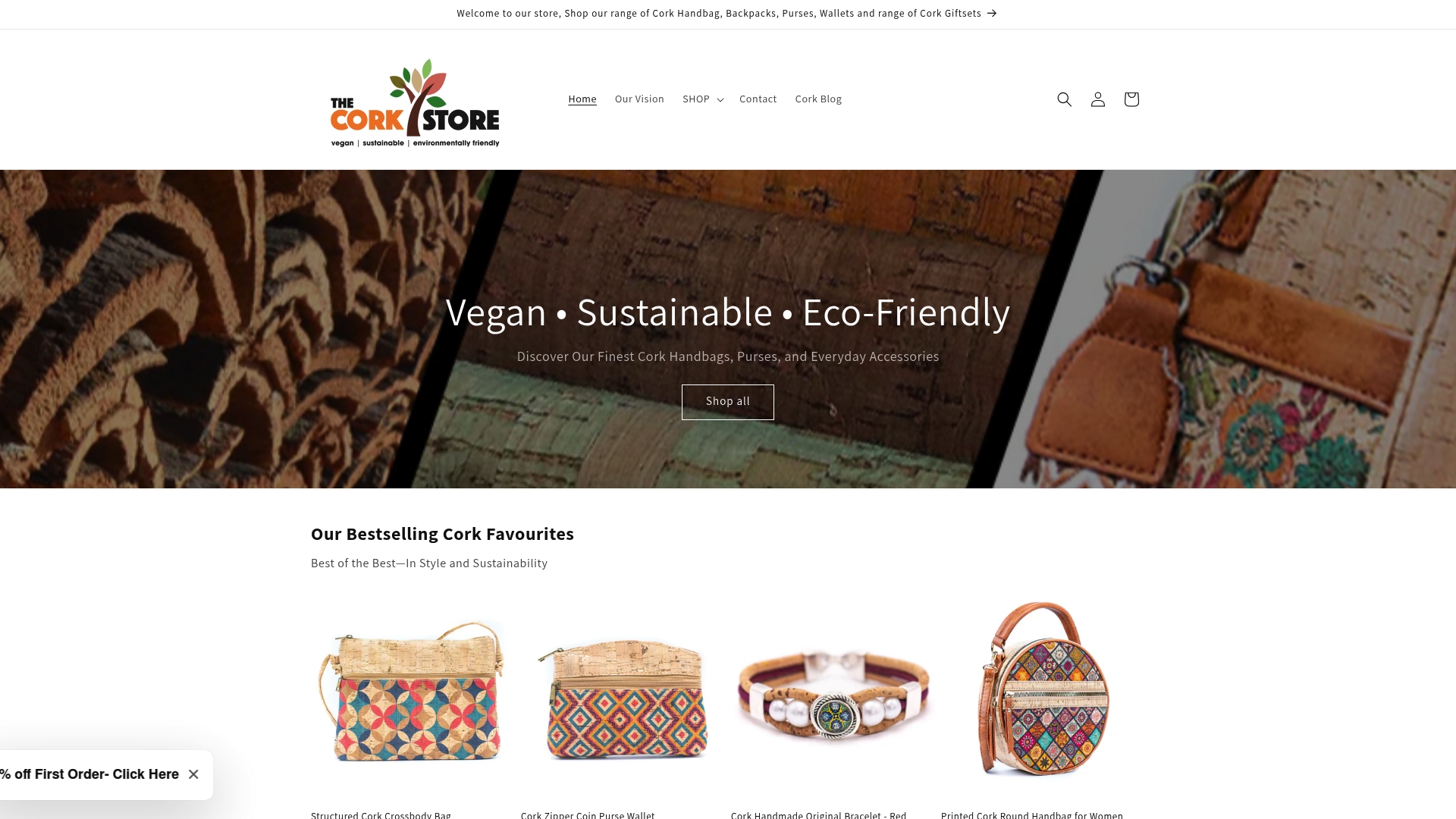
When browsing, look for the same things we have flagged throughout: a named backing material, animal-free adhesives and a clear statement of origin. A few starting points:
- Our wallets and purses range includes compact styles like the coin and card purse for everyday carry.
- Our cork backpacks collection covers both structured rucksacks and a lighter drawstring gym bag style.
- Our gift sets, including the all-natural cork wallet gift set, pair pieces together for a lower-risk way to try the material.
Browse the full range at The Cork Store and check each product page for backing, lining and origin details before you buy.
FAQ
Is cactus leather the same as cork leather?
No, this article covers cork-based vegan leather, made from the bark of the cork oak, rather than cactus-derived materials like Desserto. The two are different plant-based leathers with different sourcing and production methods.
How durable is cork compared with animal leather?
Durability depends heavily on the backing used; some textile-reinforced cork fabrics have matched or exceeded the tensile strength of lamb leather in laboratory testing. A well-backed cork accessory can hold up to daily use comparably to a mid-range leather piece.
Is cork leather waterproof?
Cork is naturally water-resistant rather than fully waterproof, thanks to suberin in its cell structure, as noted in material research on cork. It handles light rain and spills well but should not be treated as fully submersible.
How do I check if a cork product is genuinely sustainable?
Look for named certification such as FSC chain-of-custody, a clear statement of origin, and disclosed backing and lining materials rather than vague “eco-friendly” wording. The LCA-based research on cork products confirms that a finished accessory’s footprint depends on more than the cork itself.
What should I do if a cork accessory starts showing wear?
Check stitching tension and strap attachment points first, since these are the most common stress areas. A reputable seller can often advise on a repair, and keeping your receipt or care card makes that process easier.
Sources
- Mechanical, sound absorption and thermal properties of cork fabric
- Arch In Green — cork materials overview
- Effect of bark harvest intensity on the formation of cavities and other microhabitats in cork oaks (Quercus suber)
- Eco-efficient value creation of cork products: an LCA-based method for design intervention