
Avoid Fake Cork: Ask for FSC or PEFC When Buying Portuguese Cork
Portugal is the main global source of authentic, eco-friendly cork goods, and its makers produce nearly everything the material lends itself to: handbags and wallets, homewares, promotional items and the traditional stoppers the industry built its name on. If you want the real thing, look for a stated Portuguese origin alongside FSC or PEFC certification, or a supplier who can show clear traceability back to the forest.
TL;DR:
- Genuine Portuguese cork is identifiable by its natural, grainy texture, lightweight feel, and gentle flexibility, and should be accompanied by FSC or PEFC certification and traceability details.
- Most cork production in Portugal centers on industrial-grade cork for stoppers, with smaller workshops producing consumer goods like handbags, homewares, and gifts, often crafted from reconstituted cork fabric.
- Selecting authentic cork requires asking sellers for origin, certification, material composition, and proof of sustainable harvesting, especially to avoid fake or low-quality products.
- Portugal’s cork industry supports rural employment and sustainability, harvesting bark every nine years without felling trees, and certification ensures adherence to responsible forest management standards.
- Buyers should prefer sourcing from brands and retailers that disclose processing details and certifications, with large exporters like Corticeira Amorim representing industry standards and practices.
Table of Contents
- Popular cork products made in Portugal
- What makes Portuguese cork different
- How to spot genuine Portuguese cork before you buy
- Where to buy or source Portuguese cork products
- Sustainability, forest management and certification
- Traditional and modern manufacturing techniques
- Cultural significance and history of cork production in Portugal
- Major Portuguese cork producing regions and their specialties
- How to care for cork products so they last
- Economic impact of the cork industry in Portugal
- Why we recommend Portuguese-made cork for buyers
- The Cork Store: verified, vegan cork accessories
- Sources
- FAQ
Popular cork products made in Portugal
Once you know Portugal is the place to look, the next question is what to actually buy. Portuguese workshops turn cork into a genuinely wide catalogue of goods, from fashion staples to industrial materials, and each category has its own quality markers.
- Fashion accessories: handbags, crossbody bags, wallets and backpacks, usually finished with a printed or natural cork surface bonded to a fabric backing, chosen for being lightweight and hard wearing.
- Small accessories and gifts: coin purses, bracelets, notebooks and mouse mats, which sit at accessible price points and work well as presents thanks to cork’s texture and novelty.
- Home and lifestyle items: coasters, hot pads, placemats, insulation panels and flooring, prized for heat resistance and a soft, quiet underfoot feel.
- Promotional corporate items: branded umbrellas, tote bags and notebooks, popular with companies wanting a sustainable giveaway that still feels premium.
Beyond consumer goods, cork stoppers and other industrial cork products remain the sector’s biggest driver by volume and export value, a point worth remembering when you read about the industry’s scale: most of that scale is still built on wine closures, not handbags.
What makes Portuguese cork different
Cork’s appeal starts with the material itself. It compresses without cracking, resists water, conducts heat and sound poorly (a genuine advantage in flooring and insulation), and rarely triggers allergic reactions, which is why it turns up in products aimed at sensitive skin. Properly finished cork also ages well, holding its shape and colour over years of use.
Portugal’s advantage is scale and concentration of expertise. The country is the largest global exporter of cork and a leading industrial hub for finished cork products, which means more processing units, more accumulated know-how in grading and finishing, and more consistency batch to batch than smaller producing regions can offer.
Portugal exports more cork than any other country, according to Corticeira Amorim’s sustainability reporting, a scale advantage that underpins the country’s reputation for consistent grading and finishing.
Manufacturers have also invested in quality technologies originally built for stoppers, such as detection systems that screen for compounds affecting taste and smell, which speaks to an industry culture obsessed with consistency even where it is not strictly needed for a handbag. That distinction matters for buyers: raw cork planks and a finished cork accessory are not the same product. Selection, stabilisation and the backing material used all determine whether the final item lasts.
How to spot genuine Portuguese cork before you buy
A little hands-on testing goes a long way, and so does ask the right questions.
- Check the texture. Real cork has a slightly grainy, matte surface with visible natural variation, not a uniform printed pattern.
- Check the weight. Cork accessories feel notably lighter than an equivalent leather or synthetic item of the same size.
- Check the flex. Genuine cork springs back gently when pressed and does not crack at folds or seams.
- Ask for documentation. Request the stated country of origin, the producer or factory name, and details on material composition and finish.
- Ask about certification. FSC and PEFC labels, alongside chain-of-custody documentation, indicate the cork was sourced from managed forests and tracked through processing.
Pro Tip: Ask the seller directly whether the product is vegan-certified, what warranty applies, and whether they offer a sample before a wholesale order: a supplier confident in their sourcing will answer all three without hesitation.
If a listing is vague about origin or shows a suspiciously low price for a “handmade Portuguese” item, treat that as a warning sign rather than a bargain.
Where to buy or source Portuguese cork products
Retail buyers have three reasonable routes: brand websites that publish their own sourcing information, specialist eco-fashion retailers who curate cork goods alongside other vegan materials, and marketplaces where seller reviews and stated origin claims can be checked before ordering.
- For retail buyers: favour sellers who name their factory or producer and publish certification details rather than a generic “eco-friendly” tagline.
- For wholesale buyers: look for suppliers who offer samples, quote clear minimum order quantities, and can produce traceability paperwork on request.
- On price and timing: small-run or artisanal cork goods cost more than mass-produced items, and international orders should build in realistic shipping and customs lead times.
- On verification: guides covering how to spot authentic cork in Lisbon and how to avoid cork fakes are useful starting points, before committing to an order.
Sustainability, forest management and certification
Cork’s environmental case rests on one simple fact: harvesting the bark does not require felling the tree. Cork oaks are stripped every nine years or so and can live for well over a century, which is part of why Portugal’s cork landscapes, known locally as montado, have remained productive for generations rather than being cleared for other uses.
Certification is how buyers verify that this good practice is actually being followed. The FSC Portugal forest management standard sets out how Portuguese forest management schemes are assessed, and PEFC operates a comparable chain-of-custody system: both labels tell you the cork can be traced back through processing to a forest managed against defined environmental criteria.

That kind of market reporting is worth knowing about because supply and pricing shift year to year with harvest conditions. Sustainability-minded buyers should ask suppliers not just for a certification logo but for evidence of community benefit and chain transparency, since the label alone does not tell the whole story of who benefits along the way.
Traditional and modern manufacturing techniques
Cork product making in Portugal blends genuinely old craft with modern industrial process. The traditional core remains: bark is stripped by hand using a specialised axe, a skill passed between generations of harvesters, then air-dried and boiled to soften it and improve elasticity before grading.
From there, processing stages such as stabilisation, boiling, sorting and grading determine what the cork is fit for. Higher-grade sheets with fewer natural flaws go toward stoppers and premium goods, while other grades are ground down and reconstituted into cork fabric, the rolled sheet material used for handbags, wallets and similar accessories.

Reconstituted cork fabric is where modern manufacturing shows itself most clearly. Cork granules are bonded, under heat and pressure, to a backing fabric, usually cotton or a similar textile, producing thin, flexible sheets that can be cut and stitched much like leather. This is why a cork handbag can be both structurally sound and remarkably light. Quality control technology, originally developed for detecting compounds that would spoil a wine’s taste in stopper production, reflects an industry-wide culture of precision that has filtered through to other product lines even where the same specific checks are not required.
The result is a sector that has not abandoned artisan skill for automation, but layered industrial consistency on top of it, so a handbag bought today benefits from decades of process refinement built for a completely different product.
Cultural significance and history of cork production in Portugal
Cork has shaped parts of rural Portugal for centuries, particularly in the southern regions where cork oak woodland, the montado, has long supported a mixed way of life combining forestry, grazing and agriculture on the same land. Harvesting cork became a skilled, respected trade passed down within families, with the timing and technique of stripping bark treated as specialist knowledge rather than casual labour.
The industry grew into a major export sector as demand for wine stoppers expanded internationally, and Portuguese firms built processing capacity that eventually made the country the dominant force in global cork supply. That history still shapes how the material is regarded domestically: cork is not treated as a novelty but as a longstanding national industry with its own regional identities, festivals and craft traditions tied to the harvest calendar.
For consumers outside Portugal, this context matters because it explains why “Portuguese cork” carries weight as a provenance claim rather than just a marketing phrase. It signals a supply chain rooted in generations of harvesting practice and an industrial base built specifically around getting the most from this one material, which is part of why buyers are right to look for that provenance explicitly rather than accept “cork” as a generic descriptor.
Major Portuguese cork producing regions and their specialties
Cork oak forest is concentrated in the south and centre of Portugal, and different regions have developed slightly different specialities within the industry.
The Alentejo region holds the largest share of Portugal’s cork oak woodland and is generally regarded as the heartland of raw cork production, supplying much of the bark that feeds processing plants elsewhere in the country. Coastal and central areas around towns with strong industrial cork processing traditions have historically concentrated on stopper manufacturing and export logistics, given their proximity to ports. Smaller workshops producing fashion accessories and homewares tend to cluster near these processing hubs, allowing them to source finished cork fabric without long supply chains.
This regional spread means a “Portuguese cork” claim can cover quite different parts of the production chain, from raw bark harvested in Alentejo to a handbag stitched in a workshop hundreds of kilometres away. Neither is more or less authentic than the other, but it is worth understanding that the country’s cork identity is built on this whole chain rather than one single production centre.
How to care for cork products so they last
Cork is naturally durable, but a little care keeps accessories looking sharp for years. Wipe cork bags and wallets with a soft, slightly damp cloth rather than soaking them, and let them air dry away from direct heat, since radiators and direct sun can dry out the surface and cause cracking over time.

Avoid harsh chemical cleaners: mild soap and water is usually enough for everyday marks. For homewares such as coasters or placemats, a quick wipe after use prevents staining, and cork’s natural water resistance means most spills lift off without soaking in.
Store cork accessories somewhere with reasonable airflow rather than sealed in plastic, which can trap moisture. Because cork is naturally flexible, it tolerates being folded gently far better than some synthetic alternatives, but repeated sharp creasing in the same spot will eventually weaken any material, cork included. With basic care, a well-made cork accessory should hold its shape and finish for years of regular use.
Economic impact of the cork industry in Portugal
Cork is not a niche craft sector in Portugal, it is a substantial export industry. Portugal is the world’s largest cork exporter, and the sector’s biggest single product line by value remains the natural cork stopper used across the global wine trade.
That stopper business has shown sustained strength over time: APCOR’s yearbook data noted continuing strong export growth for cork stoppers, underlining how export-oriented the wider cork sector is. More recent market reporting shows the picture is not simply “growth every year”. The 2025 harvesting campaign restored industrial stock levels after a modest production dip compared with the prior year, alongside price adjustments across different cork grades, a reminder that this is a real agricultural commodity subject to harvest cycles rather than a factory output that scales up on demand.
Beyond the balance sheet, the industry supports rural employment in the cork oak regions, from harvesters working the traditional stripping trade through to processing plant staff and the workshops turning cork fabric into finished goods. For buyers, this economic weight is part of the sustainability argument: choosing genuine Portuguese cork supports an established rural economy built around a material that does not require clearing forest to produce.
Why we recommend Portuguese-made cork for buyers
Working with cork suppliers day to day, the most common issue we see is not fake cork outright, it is vague labelling: a product marketed as “cork” with no stated country of origin, no mention of the backing fabric, and no certification trail. Genuine Portuguese cork feels distinct once you have handled a few pieces, but documentation is what actually protects a buyer before the item arrives.
At The Cork Store, we ask suppliers for stated origin, material composition and finishing details before listing a product, and we favour partners who can show certification or clear traceability rather than a general sustainability claim. If you take one thing from this guide, make it this: always ask a seller where the cork was processed, not just where the tree grew.
— Aaron
The Cork Store: verified, vegan cork accessories
If you would rather skip the research and buy from a curated source of vegan cork handbags, wallets, backpacks and gift sets with attention to origin and material details, consider browsing The Cork Store.
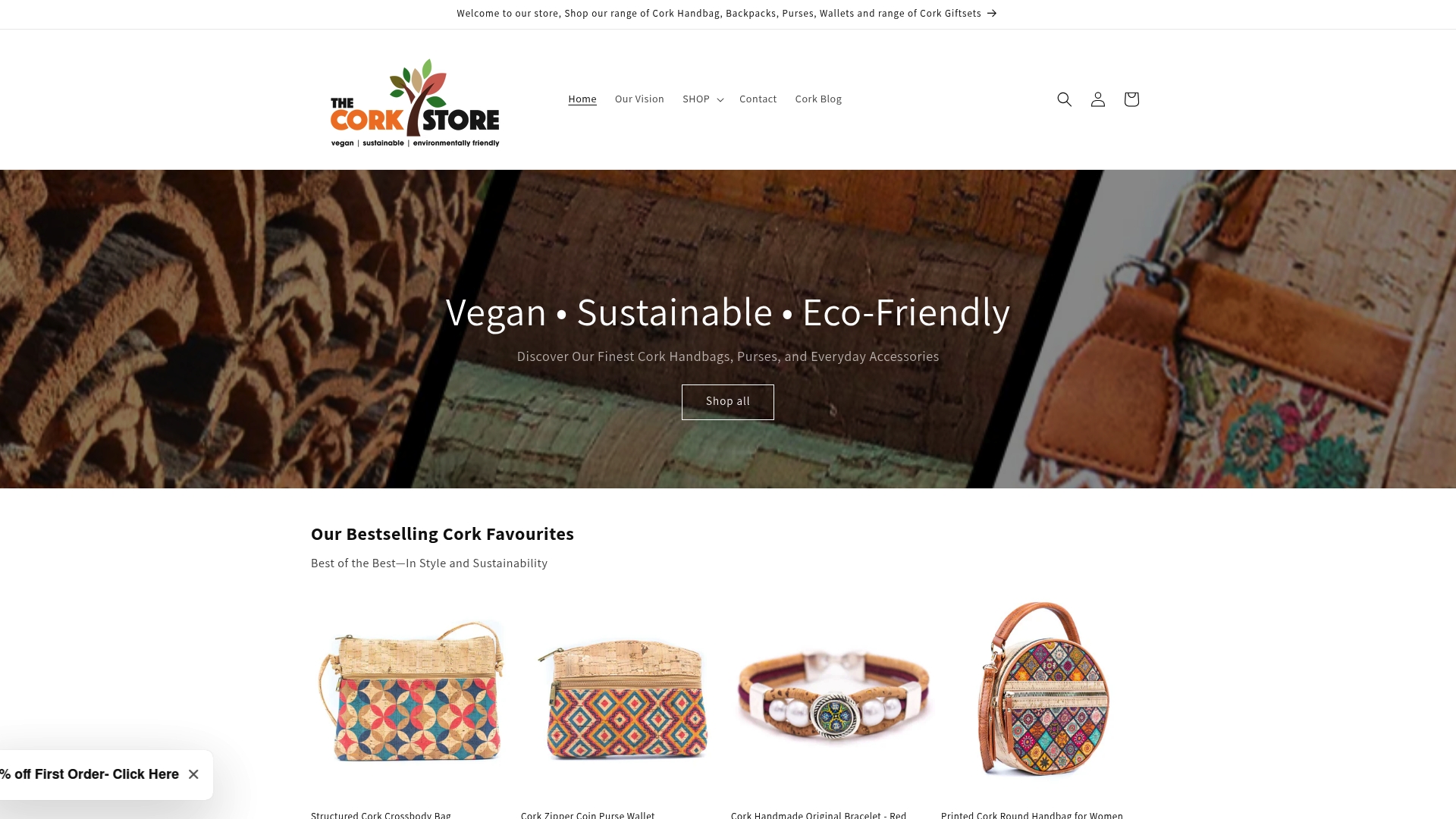
Different buyers tend to want different starting points:
- Gift buyers often start with the Women’s Gift Sets or a smaller present such as the Cork Zipper Coin Purse Wallet.
- Everyday users looking for a practical, lightweight wallet tend to go for something like the Marine Cork Wallet or the compact Cork Small Coin and Card Purse.
- Retailers exploring wholesale should contact us directly through the site for sample and minimum order details.
Browse the full range on the main shop page to see current handbags, backpacks and accessories.
Sources
- Sustainable by nature (Corticeira Amorim report, 2026)
- FILCORK 2025 cork harvesting campaign press release
- FSC Portugal forest management standard (FSC PRT standard document)
FAQ
Where is the best place to buy cork products in Portugal?
The most reliable route is a retailer or brand that states the product’s origin, factory or producer name, and material composition rather than a generic “eco-friendly” label. Specialist cork and vegan-fashion retailers, along with brands that publish sourcing and certification details online, are generally more trustworthy than unbranded marketplace listings.
Who is a famous Portuguese cork manufacturer?
Corticeira Amorim is widely recognised as the world’s largest cork processing group, with a long history in the sector and extensive production and distribution operations. Its scale has made it a reference point for cork processing standards across the industry.
Is there a cork factory in Portugal?
Yes, Portugal has numerous cork processing plants concentrated mainly in the country’s southern and central regions, close to the cork oak forests that supply raw bark. These facilities range from large industrial operations producing stoppers to smaller workshops turning cork fabric into fashion accessories and homewares.
Is Portugal the biggest producer of cork?
Yes, Portugal is the world’s largest exporter of cork, supported by extensive cork oak woodland and a concentrated processing industry. This scale is why “Portuguese cork” is treated as a meaningful provenance claim rather than just a marketing term.