
Eco Minded Buyers: 50–60% of Global Cork Is Portuguese, Spot Real Cork
Portuguese cork is the bark of the Quercus suber oak, stripped by hand roughly every nine years without harming the tree, and Portugal produces 50 to 60% of the world’s supply from around 730,000 hectares of forest. It is renewable, biodegradable and naturally waterproof, which is why it turns up everywhere from wine stoppers to vegan handbags. For anyone buying accessories, flooring or insulation, cork offers a rare combination of durability and genuinely low environmental cost.
TL;DR:
- Genuine Portuguese cork is lightweight, flexible, and shows irregular pore patterns, while synthetic or bonded materials tend to be heavier, stiffer, and uniform.
- Properly harvested cork trees can be stripped every nine years without damage, which may enhance their ability to sequester carbon during bark regrowth.
- The most reliable way to verify authentic cork is to check its smell, grain, weight, flexibility, and ask sellers about its origin and backing materials.
- Portugal produces over half of the world’s cork, supporting a sustainable, biodiverse landscape called the montado, which benefits from managed harvesting practices.
- Care for cork products by avoiding soaking, using mild cleaners, and resealing flooring extends their lifespan and maintains their environmental benefits.
Table of Contents
- What makes cork behave the way it does?
- How is cork harvested and what is the montado?
- Is cork actually a sustainable material?
- What is Portuguese cork actually used for?
- How do you tell genuine Portuguese cork from a cheap imitation?
- Why does Portugal dominate the global cork trade?
- How do you look after cork bags, flooring and fabric?
- What sustainable style actually asks of buyers
- Where to find genuine Portuguese cork accessories
- Sources
What makes cork behave the way it does?
Cork’s properties come from biology, not manufacturing. Quercus suber grows almost exclusively in the western Mediterranean, with Portugal’s warm, dry summers and cool, wet winters producing some of the thickest, highest-grade bark anywhere. The tree evolved this bark as a defence against wildfire and drought, and that same defence mechanism is what makes cork so useful commercially.
Cut cork open under a microscope and you find millions of tiny air-filled cells packed with a waxy compound called suberin. That structure is what gives cork its signature feel and function, and it explains a lot about why the material ends up in such different products:
- Impermeability: suberin repels water and gas, which is why cork has sealed wine bottles for centuries.
- Compressibility: the air pockets let cork compress under pressure and spring back, ideal for stoppers and cushioned soles.
- Insulation: trapped air makes cork a poor conductor of heat and sound, which is why it lines walls, floors and even aircraft.
- Low density: cork is remarkably light relative to its strength, useful in bags and accessories that need to feel weightless.
These aren’t marketing claims. The cellular structure and suberin content) are what physically produce impermeability, elasticity and thermal performance, and every downstream product, from a bag to a floor tile, is really just an application of one of those four properties.
How is cork harvested and what is the montado?
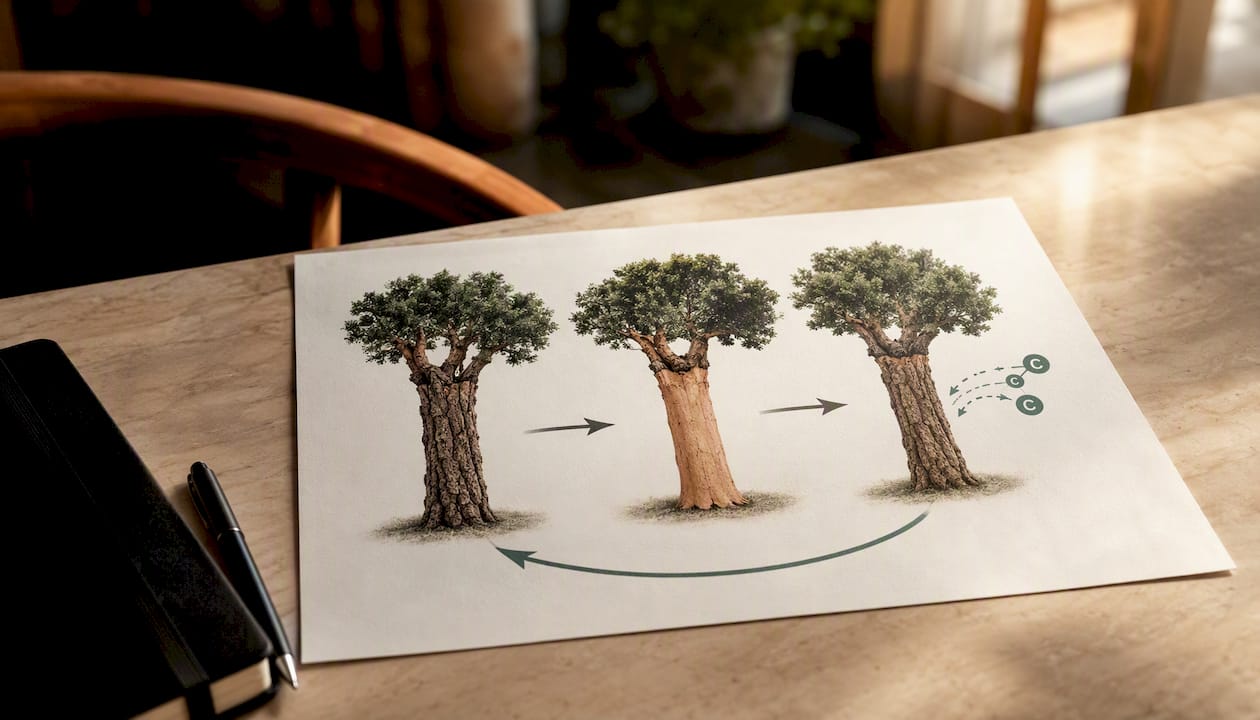
Cork is stripped from the tree by hand using a specialised axe, and the process happens without felling or seriously damaging the oak. Harvesters work in summer, when the bark separates most cleanly from the trunk, and a single tree can be harvested dozens of times across a lifespan that often exceeds 200 years.
The cycle runs in three broad stages:
- Growth phase: after stripping, the tree needs roughly nine years to regrow bark to a workable thickness, which is why Portuguese law mandates that minimum interval between harvests.
- Harvest: skilled workers strip the bark in large, curved sheets, a job that still relies on manual expertise rather than machinery.
- Processing: the raw bark is stacked, air-dried for months, then boiled and flattened before being graded by thickness and quality for stoppers, flooring or fabric production.
That nine-year rhythm is not a farming quirk, it is the natural minimum for cork to regenerate to a usable thickness, and it is enforced precisely because stripping too early damages both the tree and the resulting product.
Portugal manages a very large area of cork oak forest, more than any other country, and the Forbes reporting on Portugal’s cork economy frames this as a genuine billion-dollar ecological asset rather than a niche agricultural product.
These forests grow as part of the montado, a mixed-use landscape where cork oaks share ground with grazing livestock, cereal crops and cork oak’s cousin, the holm oak. The montado is not a plantation in the industrial sense. It is a low-intensity agroforestry system that has supported rural Portuguese communities for generations, and VisitPortugal’s own account of cork production treats the montado as inseparable from the material’s cultural identity, not just its supply chain.
Is cork actually a sustainable material?
Cork’s environmental case rests on something counterintuitive: harvesting the bark does not damage the forest, it arguably improves its carbon performance. When a cork oak is stripped, the tree responds by regrowing bark faster than it otherwise would, and that regrowth phase pulls in more carbon dioxide than an unharvested tree of the same age.
That mechanism is well documented by Amorim Cork’s material research, which links managed harvesting directly to increased CO2 uptake during regrowth. It means a working cork forest can outperform an untouched one on carbon capture, provided harvesting stays on that nine-year rotation and doesn’t strip trees too aggressively.
Cork oak forests across the Mediterranean are estimated to sequester a significant amount of CO2 annually, and the montado’s role in that goes beyond the trees themselves. The mixed grazing and cropping system supports unusually high biodiversity for a working landscape, including species that have all but disappeared from more intensively farmed regions.
Compared with the alternatives it typically replaces, cork’s circularity case is straightforward:
- Cork biodegrades naturally, unlike PVC-based synthetic leathers or plastic laminates.
- Offcuts and dust from processing are commonly reused in composite cork products rather than discarded.
- Cork requires no tanning chemicals, dyes or petroleum inputs the way most faux leathers do.
- A cork tree can be harvested for well over a century, so one plant generates decades of raw material without replanting.
Industry bodies including Corticeira Amorim have made public commitments around zero-waste processing and circular product design, treating cork as a genuine bioeconomy material rather than a rustic alternative to plastic.
Pro Tip: If sustainability is your main buying driver, look past the word “eco” on a product label and check whether the material is described as cork fabric or a cork veneer over synthetic backing. The two age very differently, and only one biodegrades.
What is Portuguese cork actually used for?
Cork’s oldest job is still its biggest: sealing wine bottles, a use that depends entirely on the impermeability suberin provides. But the material’s versatility has pushed it well beyond the wine trade over the past two decades.
Traditional and industrial uses include:
- Wine and spirit closures, still the largest single application by volume.
- Building insulation, where cork’s thermal and acoustic properties reduce heating costs and noise transfer.
- Flooring, prized for being warm underfoot, naturally antimicrobial and resilient to repeated compression.
- Acoustic panelling, used in studios and concert venues for the same cellular structure that muffles sound elsewhere.
- Aerospace insulation, a less obvious use, but one that trades on cork’s lightness and heat resistance.
The fashion and accessories side is newer but growing fast. Cork fabric, sometimes called cork leather, is a thin sheet of cork laminated onto a textile backing, giving it the flexibility needed for bags, wallets and wearable accessories. Genuine cork fabric is water resistant, hypoallergenic and biodegradable in a way that most plastic-based vegan leathers simply are not, which is why it has become a serious alternative for buyers avoiding both animal leather and PVC. Thecorkstore’s own range of Portuguese cork products sits in this category, built from that same laminated cork fabric rather than a coated veneer.
How do you tell genuine Portuguese cork from a cheap imitation?
Not everything sold as “cork” holds up to scrutiny, and the giveaways are physical, not just written on a label. A few checks take seconds and save you from buying a heavy synthetic composite dressed up as the real thing.
- Check the flex. Genuine cork fabric bends and creases like fabric. If a bag or wallet feels stiff or cracks along a fold, it is likely a thick cork veneer bonded to a rigid synthetic base.
- Weigh it in your hand. Real cork is noticeably light for its size. Anything unusually heavy has synthetic backing doing most of the structural work.
- Smell it. Cork has a faint, warm, woody smell. A strong chemical or plastic odour suggests a coated or laminated substitute.
- Look at the grain. Authentic cork shows irregular, natural pore patterns. A perfectly uniform, printed-looking texture is a red flag.
- Read the product description carefully. Terms like “cork fabric” or “natural cork” should describe the actual outer material, not just a decorative trim, and honest listings will usually name Portugal as the source.
The distinction between genuine cork fabric and cork veneer over synthetic substrates matters most for daily-use items like bags and wallets, where flexibility and breathability affect how the product ages. For flooring, the trade-offs shift: thickness and wear-layer quality matter more than flexibility, and typically command a higher price for genuine solid cork over cork-look laminate.
Pro Tip: Ask the seller directly where the cork is sourced and whether the backing is fabric or synthetic. A retailer confident in its supply chain will answer both questions without hesitation. Thecorkstore’s guide on how to spot quality cork products covers these checks in more depth for anyone shopping specifically for accessories.
Why does Portugal dominate the global cork trade?
Portugal’s dominance isn’t accidental geography, it is decades of managed forestry combined with a processing industry built specifically around cork. With 50 to 60% or more of world production coming from its 730,000 hectares of cork oak forest, the country supports an entire supply chain of harvesters, driers, graders and exporters, many of them family businesses operating in the same regions for generations.
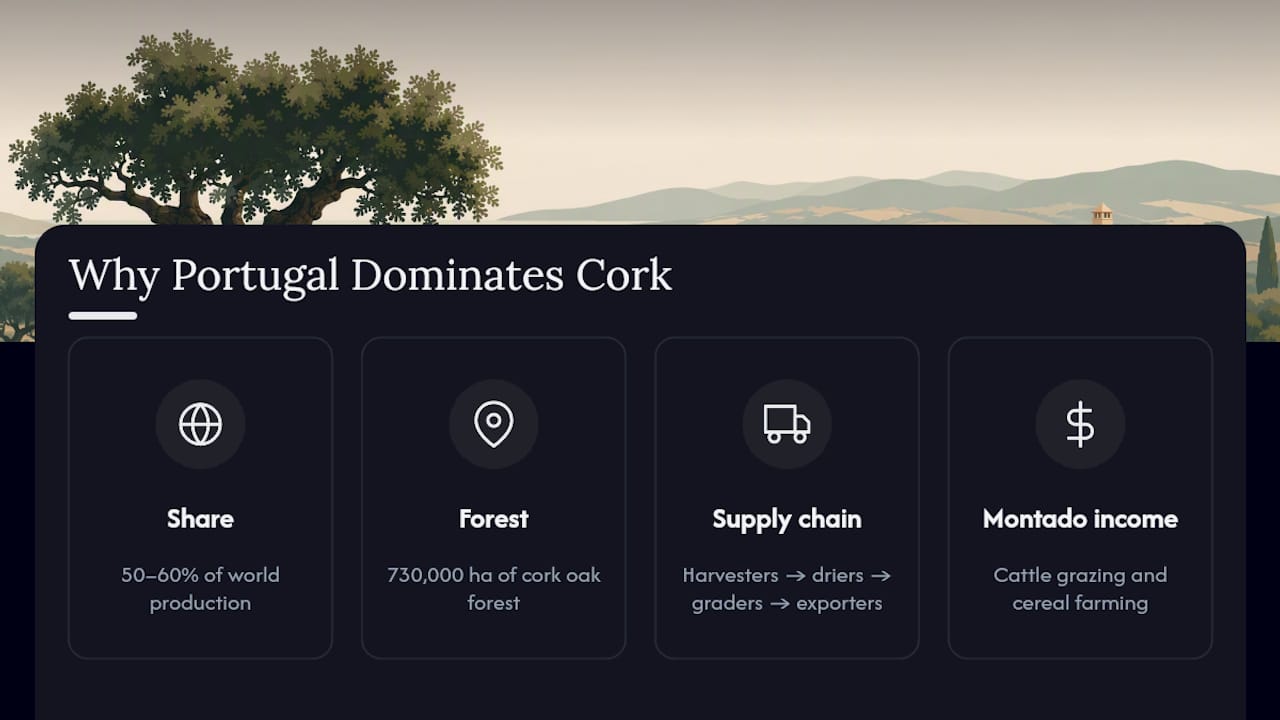
Cork remains one of Portugal’s most significant export categories, and rural communities in the Alentejo region depend heavily on the montado for income beyond just cork, including cattle grazing and cereal farming on the same land. That diversification is part of why the industry has proven resilient even as wine closure demand has fluctuated against synthetic and screw-cap alternatives.
How do you look after cork bags, flooring and fabric?
Cork is more forgiving than most people expect, but it isn’t indestructible. A little basic care extends the life of any cork product significantly.
- Wipe, don’t soak. A damp cloth removes most dirt from cork bags and fabric; avoid submerging cork in water.
- Skip harsh chemicals. Mild soap is enough; solvents and bleach can dry out or discolour the surface.
- Treat stains quickly. Blot rather than rub, and let cork air-dry away from direct heat.
- Reseal cork flooring periodically. A fresh coat of sealant every few years keeps floors resistant to moisture and scuffing.
- Store bags upright and stuffed to help them hold their shape between uses.
Cork accessories cared for this way commonly last for years of regular use, since the material’s natural resilience does most of the work.
What sustainable style actually asks of buyers
Cork’s sustainability story is compelling on paper, but it only holds up if buyers ask harder questions than “is it eco-friendly?” The real test is whether a product uses genuine cork fabric with biodegradable backing, or a thin cork veneer glued to plastic that will outlive the cork by centuries in landfill. That distinction rarely makes it into marketing copy.
My honest recommendation: buy fewer cork pieces, but buy ones where the seller can explain the backing material without hesitation. A well-made cork bag or wallet, cared for properly, will outlast several seasons of fast-fashion alternatives, and that longevity is where the environmental benefit actually gets realised, not just in the raw material’s biodegradability. Anyone starting out should read a practical guide to spotting quality before spending money, not after.
— Aaron
Where to find genuine Portuguese cork accessories
Some retailers offer cork fabric sourced from Portugal, built into handbags, backpacks, wallets, purses and gift sets designed as genuine cruelty-free alternatives to animal leather, not a compromise on style to get there.
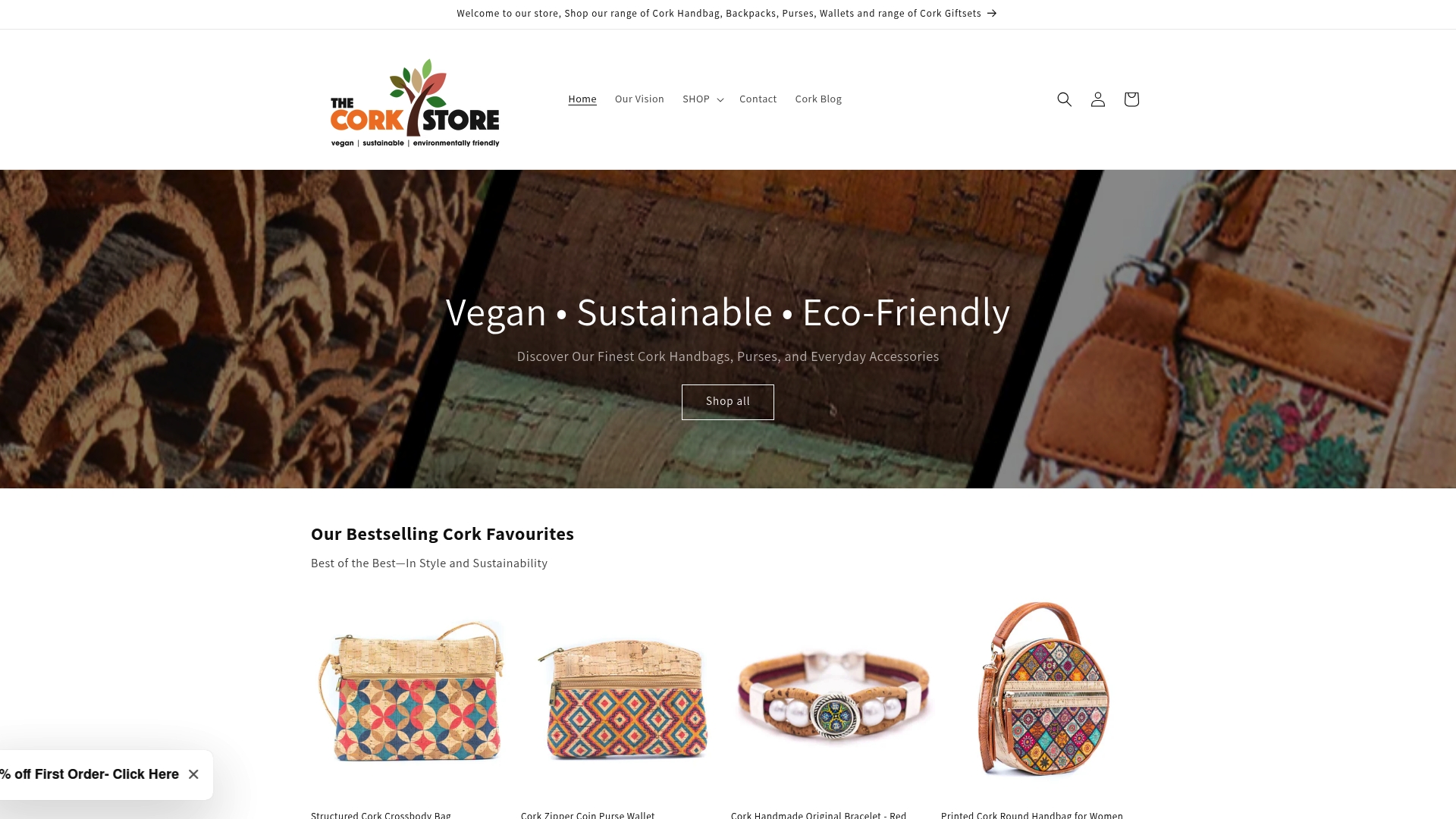
The range covers everyday essentials through to gift sets, each listed with clear product descriptions and images so you know exactly what you’re buying before it arrives. If you’ve read this far and want to put the buying checks into practice, browse the current collection of cork accessories and see how the material feels against the checklist above. It is the most direct way to judge genuine cork fabric for yourself.
Sources
- How Portugal’s cork forests became a billion‑dollar eco marvel — Forbes
- Find out all about Cork | Amorim Cork
- The cork — VisitPortugal