
6 Checks Before Buying From a Cork Shop Online for Sustainable Goods
Buy cork accessories and homeware from a specialist shop rather than a general marketplace, and check that the product page states material type, origin, care instructions and clear photos before you order. Specialist shops typically provide sourcing details and care guidance for cork handbags, wallets and gift sets within their listings. Expect shipping times and a returns policy to be spelled out too.
TL;DR:
- Confirm product details like dimensions, cork material type, and finish, and review care instructions and shipping estimates before making a purchase.
- Natural cork retains full elasticity and grain, making it ideal for flooring and crafts, while agglomerated cork provides control over thickness for insulation and accessories.
- Check for clear provenance information, ideally from Portugal or Spain, and look for certification or lifecycle details rather than vague eco claims.
- Wipe cork accessories with a damp cloth, avoid harsh chemicals, and store them upright and away from sunlight to maintain their condition over time.
- Buying from a specialist cork shop ensures transparency about material type and harvest practices, reducing buyer regret and improving long-term satisfaction.
Table of Contents
- What cork shops sell: main product categories
- Types of cork material and what they mean for quality
- Sustainability and origin: what to trust on a product page
- How to buy cork online: checks before you click “buy”
- Care and maintenance for cork goods
- Why buying from a specialist cork shop matters
- Shop cork accessories at The Cork Store
- FAQ
- Sources
What cork shops sell: main product categories
Most cork shops split their catalogue into a handful of clear groups, so knowing what you want before you browse saves time. Fashion accessories dominate the consumer end: handbags, wallets, crossbody bags, backpacks and gift sets built around cork’s texture and lightness. Home and craft buyers look for coasters, placemats, flat sheets, rolls and loose granules for DIY projects or insulation experiments. A smaller segment covers building and industrial cork, including flooring, wall tiles, underlayment and the traditional wine stopper, though these typically sit outside most fashion-focused retailers’ range.
A well-built product page tells you the dimensions, weight, the form of cork used and what it is meant for, whether that is a daily tote or a craft sheet for a school project. When you are browsing a specialist site, use the category filters rather than a general search bar: cork shops tend to group by use (bags, wallets, gifts) rather than by material grade, so filtering by category first narrows things down faster than hunting by keyword.
- Fashion accessories: handbags, wallets, crossbody bags, backpacks, bracelets and curated gift sets.
- Home and craft: coasters, placemats, flat sheets, rolls and granules for insulation or DIY.
- Building and industrial: flooring, wall tiles, underlayment and stoppers, typically sold by specialist trade suppliers rather than fashion retailers.
Types of cork material and what they mean for quality
Not all cork is the same, and the form used affects how a product performs. Natural cork is cut directly from the bark in sheets and keeps the material’s full elasticity and grain, making it a popular option for those seeking eco-friendly and stylish flooring area rugs. Agglomerated cork is made from granules bonded with a binder, which gives manufacturers more control over thickness and finish but depends on the quality of that bonding. Expanded cork, produced through a steam process, is denser and used mostly for insulation boards rather than accessories. Cork fabric, sometimes marketed as a leather alternative, bonds a thin cork veneer to a fabric backing, which is what gives cork bags their flexibility and light weight.
Each form performs best in a different role. Agglomerated and expanded cork forms are produced from granules and binders or steam bonding, and their mechanical properties suit insulation, flooring and energy-absorbing applications, while thinner cork fabric suits bags and wallets that need to fold and flex daily. On a product page, look for mentions of thickness, the finish applied to the surface, what backing material is used, and whether a binder is named.
- Natural cork: full sheets with visible grain, used in flooring and some craft products.
- Agglomerated cork: granules bonded with a binder, common in flooring and structured accessory panels.
- Cork fabric or “cork leather”: a thin cork veneer backed with fabric, used for bags, wallets and bracelets.
Pro Tip: Run a finger along the seams and edges in the product photos: a well-finished cork accessory has tidy, bound edges and an even surface, while a cheaply made one often shows visible glue lines or a patchy, inconsistent texture.
Sustainability and origin: what to trust on a product page
Cork comes from the bark of the cork oak, harvested without felling the tree, mostly across Mediterranean woodlands in Portugal and Spain. Portuguese cork oak agroforestry systems supply a large share of the world’s commercial cork, and the same research notes that “reproduction cork”, taken from later debarkings once a tree matures, yields higher-quality material than the first harvest. That distinction is worth looking for on a product page, since it signals the supplier understands their own supply chain rather than repeating a generic eco tagline.
A credible listing names the country of origin, describes the harvest practise in plain terms, and references any certification or lifecycle information rather than leaning on the word “eco” alone. Vague claims with no provenance, no named region and no mention of how the bark was harvested are a weak signal, however polished the photography.
- Look for a stated country of origin, ideally Portugal or Spain.
- Check for a plain description of bark-harvesting practise, not just the word “sustainable”.
- Prefer listings that reference certification or lifecycle information over generic green language.
Cork oak bark regrows after each harvest, and the material itself is naturally recyclable and biodegradable, which is part of why cork’s cellular structure also makes it low density, elastic and impermeable to liquids, properties that matter as much for a handbag as for a wine stopper.
How to buy cork online: checks before you click “buy”
Buying cork accessories online carries the usual sizing and fit risk of any fashion purchase, plus a few cork-specific points worth checking first.
- Confirm the exact dimensions and weight listed, and look for a photo showing the item at scale or worn by a model.
- Check the material and finish described, including edge binding and any interior lining, alongside explicit care instructions.
- Review the shipping zones and delivery estimate, noting that items produced in Portugal can carry longer lead times to some destinations.
- Read the returns and warranty policy before ordering, particularly for gift sets bought ahead of an occasion.
- Look for a secure checkout, transparent pricing with no hidden fees at the final step, and visible customer service contact details.
- Scan recent customer reviews for comments on sizing, colour accuracy and durability over time.
Cork’s own material chemistry backs up some of these checks. Suberin and lignin in cork’s cell walls give it low permeability and natural elasticity, which is why a well-made cork bag holds its shape and resists everyday knocks better than a poorly bonded one. A listing that explains even briefly why the material behaves the way it does is usually written by someone who understands the product, not just someone writing copy.
Care and maintenance for cork goods

Cork accessories need little upkeep, but a few habits keep them looking new for longer. Wipe the surface gently with a damp, soft cloth after use and let it air dry within 48 hours rather than leaving it damp, since trapped moisture is the main cause of mildew on natural materials. Avoid harsh chemicals, solvents and machine washing, all of which can strip the surface finish or loosen bonded layers.
For stains, treat them promptly with a mild soap solution rather than scrubbing, and reach for a specialist cleaner only when a stain persists, following the cork cleaning guide for the right approach. Store bags and wallets upright or lightly stuffed with tissue to avoid creasing, in a dry spot away from direct sunlight. The Cork Store’s care guide for cork accessories and its maintenance guide for cork bags both go into more detail for buyers who want a longer routine.
- Wipe clean with a damp cloth and air dry within 48 hours.
- Avoid harsh chemicals, solvents and machine washing.
- Treat stains early with mild soap, and use a specialist cleaner only if needed.
- Store upright, lightly stuffed, away from direct sunlight and damp.
Why buying from a specialist cork shop matters
A general marketplace listing rarely tells you which type of cork you are getting or how the bark was harvested, and that gap is where most buyer regret starts. A specialist shop’s narrower catalogue makes it easier to compare similar bags side by side and to find a care guide written for the exact material you bought, rather than a generic leather-care page that does not apply. That focus, more than any marketing language, is what separates a trustworthy cork shop from one that is simply reselling whatever is cheapest.
— Aaron
Shop cork accessories at The Cork Store
Some retailers sell women’s cork handbags, wallets, crossbody bags, backpacks, bracelets, travel bags and curated gift sets, each listing material form, finish and care notes to help buyers compare options properly.
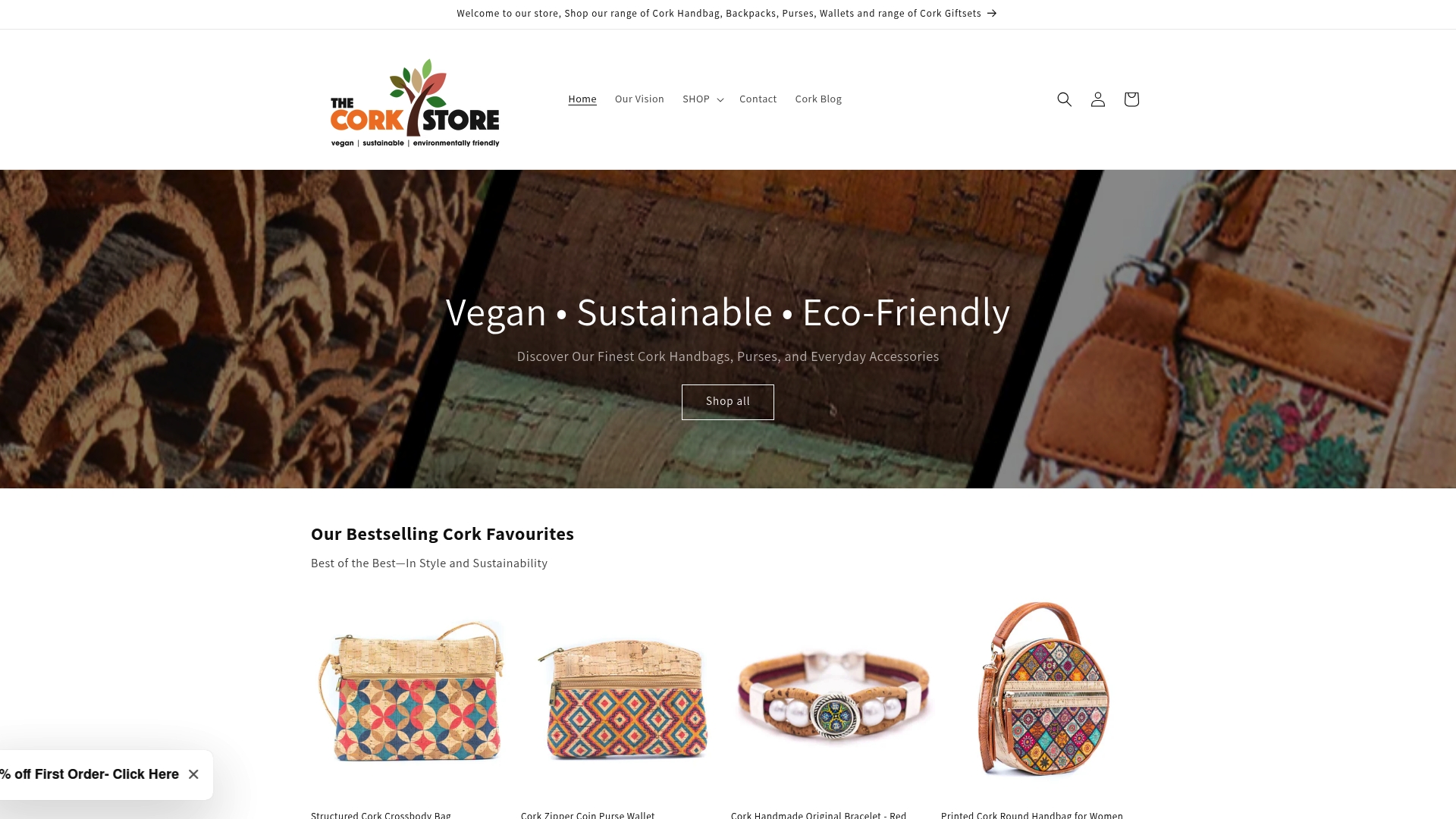
Browse the full range of cork handbags, wallets and accessories to see current categories, or go straight to a bestseller like the Marine Cork Wallet or the Cork Drawstring Backpack if you already know what you want. Gift shoppers can check the Women’s Gift Sets collection or the All-Natural Cork Wallet Gift Set for a ready-made option. Orders from specialist sites usually provide care guides and customer support to assist buyers before and after purchase.
FAQ
What is the difference between natural and agglomerated cork?
Natural cork is cut directly from bark sheets and keeps its full grain and elasticity, while agglomerated cork is made from granules bonded with a binder, giving manufacturers more control over thickness. Natural cork suits flooring and craft sheets, and agglomerated forms are common in insulation boards and some structured accessory panels.
Is cork actually a sustainable material?
Cork is harvested from the bark of the cork oak without felling the tree, and the bark regrows for future harvests, which is part of why it is considered a renewable material. Portuguese cork oak woodlands supply much of the world’s commercial cork, and provenance and harvest stage both affect the quality of the finished product.
How do I care for a cork handbag or wallet?
Wipe the surface with a damp, soft cloth and let it air dry within 48 hours, avoiding harsh chemicals or machine washing. The Cork Store’s cork accessory care guide covers stain removal and storage in more depth.
Why is cork used for bags instead of leather?
Cork’s closed-cell structure makes it naturally lightweight, elastic and impermeable to liquids, which suits a bag that needs to flex daily without cracking. It is also produced without animal materials, which appeals to buyers looking for a vegan leather alternative.
What should I check before buying cork products online?
Confirm the exact dimensions, material form and finish, and check that care instructions, shipping estimates and the returns policy are all clearly stated. Reading recent customer reviews for comments on sizing and durability also helps avoid a mismatched purchase.
Sources
- Cork structure, properties and applications — Arnold Arboretum/Harvard
- The compressive behaviour and crashworthiness of cork: a review — PMC
- Rationale of cork properties — BioResources review (Pereira)
- Life-cycle assessment of typical Portuguese cork oak woodlands — ScienceDirect