
The role of cruelty-free certification explained
TL;DR:
- Cruelty-free certification verifies that no animal testing occurs at any development stage and requires independent audits. Only 15% of brands meet such rigorous standards, making certified labels a trustworthy indicator of ethical production. Consumers should verify certification status directly through official databases to avoid misleading claims.
Cruelty-free certification is defined as a verified assurance that no animal testing occurred at any stage of a product’s development, from raw ingredient sourcing through to finished goods. The role of cruelty-free certification extends far beyond a logo on a label. It represents a documented, audited commitment to ethical production. Only 15% of global cosmetic brands meet recognised, robust cruelty-free standards. That figure reveals just how much weight a genuine certification carries when you are trying to make an informed purchase. Organisations such as Cruelty Free International and the Leaping Bunny Programme set the benchmarks that separate credible certification from marketing noise.
What does the role of cruelty-free certification actually involve?
Certification is not a single tick-box exercise. It is a structured process that verifies every link in a product’s supply chain. The certification process typically takes 2–6 weeks, primarily because of the detailed collection of supplier declarations for each individual ingredient. That timeline reflects the depth of documentation required, not administrative delay.
The process follows a clear sequence:
- Application and product listing. The brand submits a full catalogue of products and every ingredient used, including raw materials sourced from third-party suppliers.
- Supplier declarations. Each supplier must confirm in writing that no animal testing was conducted on the ingredients they provide, at any point in the production chain.
- Ingredient cut-off date review. Certifiers establish a fixed date after which no new animal testing is permitted. Any ingredient tested after that date disqualifies the product.
- Supply chain audit. Robust certifications mandate supplier-level verification and traceability across the full ingredient supply chain, not just final product testing. For high-risk products, this can include on-site reviews.
- Ongoing monitoring. Certification is not permanent. Brands must renew and demonstrate continued compliance, often annually.
The distinction between attestation-based and fully audited certifications matters enormously here. Some programmes accept a CEO questionnaire as sufficient proof. High-grade certifications, by contrast, require independent third-party audits and verified supplier documentation. Active supply-chain monitoring is the hallmark of the most rigorous certifications, as noted by beauty ratings manager Becca Willcox.
Pro Tip: When evaluating a certification, ask whether the programme conducts independent audits or relies solely on brand self-reporting. If the answer is the latter, treat the claim with caution.

Why does cruelty-free certification matter to consumers and advocates?
Consumer trust is the central issue. Without consistent global standards, the term “cruelty-free” is frequently used as a marketing tool rather than a solid ethical indicator. That ambiguity leaves consumers with no reliable way to distinguish genuine commitment from a well-designed logo.
Certification resolves that problem by converting moral intent into consistent buying behaviour. Research confirms that cruelty-free certification acts as a key lever converting consumer moral intent into consistent purchasing when paired with transparent corporate social responsibility and fair pricing. The practical implication is clear: a label alone does not change behaviour, but a verified label backed by transparent practices does.
The importance of cruelty-free labels also extends to identity. Many consumers who choose certified products do so as an expression of personal values, not simply as a product preference. Certification gives that expression a factual foundation. Without it, the purchase risks being built on a claim the brand cannot substantiate.
The consumer case for certification rests on several connected points:
- Verified assurance. Certification confirms that no animal testing occurred, rather than simply asserting it.
- Supply chain visibility. Certified products come with documented ingredient trails, not just finished-product declarations.
- Protection from misleading claims. 78% of beauty brands lack any form of third-party cruelty-free certification, relying instead on self-declared claims. Certification filters out that noise.
- Advocacy leverage. Certified purchasing data gives animal welfare organisations concrete evidence of market demand for cruelty-free product standards.
“Cruelty-free consumption combines multiple signals: logos, influencer advocacy, CSR messaging, and fair pricing. Together, these transform altruism into a purchase decision. Certification is the anchor that makes those signals credible.”
Understanding why cruelty-free matters at a structural level helps consumers move beyond surface-level label reading and make genuinely informed choices.
How do cruelty-free certifications differ from one another?
Not all cruelty-free certifications carry equal weight. The differences between programmes are significant, and understanding them is part of becoming a confident ethical consumer.
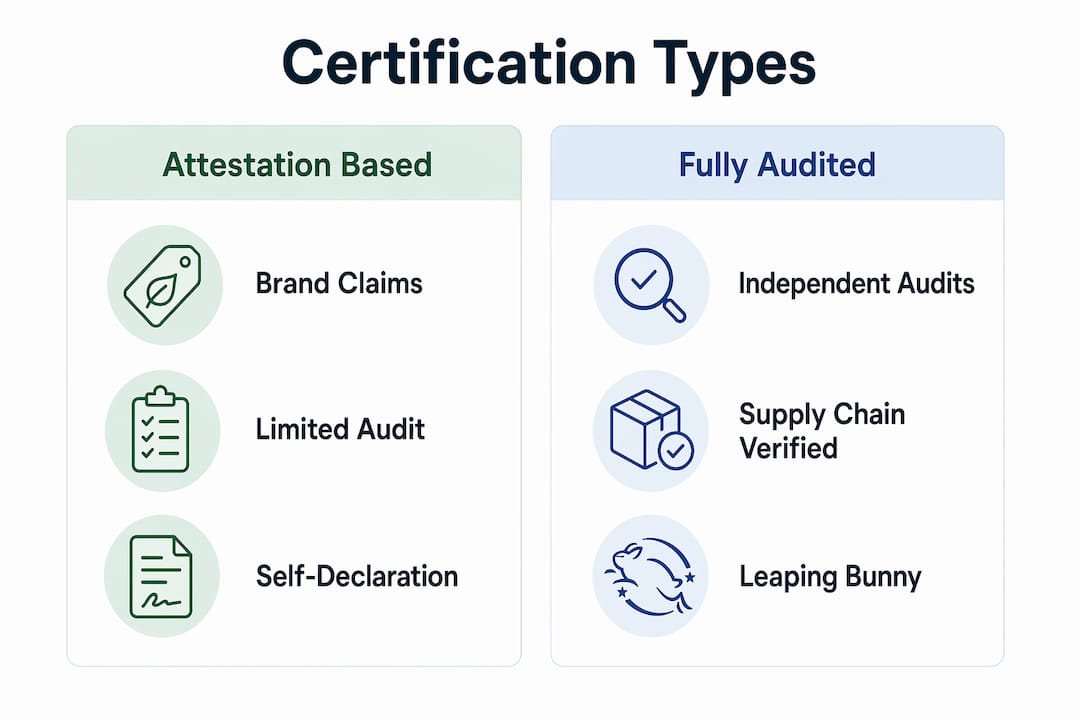
| Certification | Verification method | Supply chain audit | Vegan guarantee |
|---|---|---|---|
| Leaping Bunny | Independent third-party audit | Yes, full supply chain | No |
| PETA Beauty Without Bunnies | Brand attestation | Limited | No |
| V-Label (cruelty-free tier) | Third-party review | Partial | No |
| Vegan Society trademark | Third-party audit | Yes | Yes |
The table above shows a critical pattern: cruelty-free certification and vegan certification are not the same thing. Cruelty-free does not guarantee vegan. A product may contain animal-derived ingredients such as beeswax or lanolin and still pass cruelty-free standards, provided those ingredients were not tested on animals. Consumers who require both assurances need to look for dual certification.
The risk of self-declared claims is equally significant. A brand that prints “not tested on animals” on its packaging without third-party verification carries no enforceable accountability. Dr Paul Locke of the Johns Hopkins University Toxicology Policy Lab emphasises that consumer confusion stems directly from the absence of uniform global standards. He identifies the adoption of New Approach Methodologies (NAMs), which are non-animal testing techniques validated by science, as a critical step toward meaningful progress.
Pro Tip: Check a brand’s certification status directly on the certifying body’s official website rather than relying on the brand’s own marketing materials. Leaping Bunny, for example, maintains a publicly searchable database of approved brands.
For a practical breakdown of what certified cruelty-free means in the accessories sector specifically, the cruelty-free accessories guide from Thecorkstore covers the key distinctions clearly.
How does certification shape brand reputation and ethical retail?
Certification carries direct commercial consequences for brands. European retailers demand cruelty-free certification as part of procurement filtering, requiring robust supply-chain verification before listing a product. That means certification is no longer optional for brands that want access to ethical retail channels.
The business case for certification includes several concrete benefits:
- Retailer access. Certified brands meet procurement requirements that uncertified brands cannot satisfy, opening doors to ethical retail partnerships.
- Brand loyalty. Consumers who buy on ethical grounds tend to repeat purchase from brands they trust. Certification provides the verified foundation that loyalty requires.
- Market differentiation. In a market where 78% of brands rely on self-declaration, third-party certification is a genuine point of difference.
- Reduced reputational risk. Brands with documented supply-chain compliance are far less exposed to the reputational damage that follows a credible animal testing allegation.
The challenges are real too. Documentation-heavy certification processes place a significant administrative burden on smaller brands. Gathering supplier declarations across a complex ingredient list, particularly for products with many raw material sources, requires dedicated resource. That cost is part of why so few brands achieve robust certification. It is also why the certification, when achieved, carries genuine credibility.
Sustainable fashion brands that commit to certification, including those producing ethical cork accessories and recycled materials, demonstrate that ethical production and commercial viability are not in conflict. The impact of cruelty-free practices on brand reputation is cumulative. Each certified product strengthens the brand’s position in a market that is paying closer attention to supply-chain ethics.
Key takeaways
Cruelty-free certification is the single most reliable tool consumers have for distinguishing verified ethical products from unsubstantiated marketing claims.
| Point | Details |
|---|---|
| Certification depth varies significantly | Leaping Bunny requires independent audits; some programmes accept only brand attestations. |
| Only 15% of brands meet robust standards | The majority of brands rely on self-declared claims with no third-party verification. |
| Cruelty-free does not mean vegan | Products can pass cruelty-free standards while still containing animal-derived ingredients. |
| Certification takes 2–6 weeks | The timeline reflects the complexity of supplier declarations, not administrative slowness. |
| Retailers use certification as a filter | European retailers require certified supply-chain verification as part of procurement decisions. |
Why I think the certification gap is the real story
The statistic that stays with me is this: only 15% of global cosmetic brands meet recognised cruelty-free standards. That is not a niche problem. That is the mainstream market operating almost entirely on unverified claims.
What I find most telling is how rarely that fact appears in consumer-facing marketing. Brands invest heavily in the language of ethics while avoiding the accountability that genuine certification demands. The documentation burden is real, but it is also the point. Rigour is what makes the label meaningful.
My honest view is that consumers are not the problem here. The confusion around cruelty-free versus vegan, or between attestation and audit, exists because the industry has not been required to be clear. Stronger global standards, and wider adoption of New Approach Methodologies as alternatives to animal testing, would change that. Until then, the most useful thing any consumer can do is go directly to the certifying body’s database and verify the claim themselves. Do not take the packaging at face value.
For accessories specifically, the ethical fashion guide from Thecorkstore is one of the clearer resources I have come across for understanding what certification actually means in practice.
— Aaron
Thecorkstore’s cruelty-free commitment
Thecorkstore is built on the principle that style and ethical production are not a trade-off. Every cork accessory in the collection, from handbags and backpacks to wallets and gift sets, is made without animal products and without animal testing. Cork itself is harvested without harming the tree, making it one of the few materials that is genuinely cruelty-free at the source. If you are looking for accessories that reflect your values without compromising on quality, explore the full range at Thecorkstore and shop with the confidence that comes from knowing exactly what you are buying.
FAQ
What is cruelty-free certification?
Cruelty-free certification is a verified assurance from an independent third party that no animal testing occurred during a product’s development or ingredient sourcing. It is distinct from a brand’s own self-declared claim.
Is cruelty-free the same as vegan?
No. Cruelty-free means no animal testing was conducted, but the product may still contain animal-derived ingredients such as beeswax or lanolin. Vegan certification confirms no animal-derived ingredients are present.
How long does the cruelty-free certification process take?
The process typically takes 2–6 weeks, primarily because of the detailed supplier declarations required for each ingredient across the full supply chain.
Which cruelty-free certification is the most rigorous?
Leaping Bunny is widely regarded as the most rigorous, requiring independent third-party audits and full supply-chain verification rather than relying on brand attestations alone.
How can I verify a brand’s cruelty-free certification?
Check the certifying body’s official database directly. Leaping Bunny maintains a publicly searchable list of approved brands, which is more reliable than a brand’s own packaging or website claims.