
What is sustainable innovation: a practical guide
TL;DR:
- Sustainable innovation develops products and services that reduce environmental harm while creating economic and social value. It requires integrating life cycle thinking and circular economy principles from the earliest design decisions. Success depends on managing all innovation dimensions within the CORE framework from concept to environment.
Sustainable innovation is defined as the systematic development of new products, services, or business models that reduce environmental harm while creating economic and social value. It goes beyond adding a green label to an existing product. True sustainable innovation embeds life cycle thinking and circular economy principles from the very first design decision, moving deliberately away from the linear “take-make-waste” model that has defined industrial production for over a century. Frameworks such as the UN Sustainable Development Goals and the EU Chemicals Strategy for Sustainability now give organisations a concrete reference point for measuring whether their efforts genuinely qualify. For professionals and individuals alike, understanding what sustainable innovation actually means, and what it demands in practice, is the first step toward making it work.
What is sustainable innovation and why does it matter now?
Sustainable innovation is a structural process, not a marketing afterthought. Embedding sustainability proactively in new product development boosts credibility, stakeholder engagement, and long-term market success far more than superficially adding green features at the end of a project.
The importance of sustainable innovation has grown sharply as regulatory pressure and consumer expectations converge. The EU Chemicals Strategy for Sustainability, for instance, requires manufacturers to assess chemical safety across the full product life cycle, not just at the point of sale. That kind of regulatory shift forces businesses to rethink design from the ground up.
Circular economy principles sit at the heart of this shift. Rather than extracting raw materials, using them once, and discarding them, circular thinking asks designers to plan for reuse, repair, and recovery before a product is even manufactured. Cork, for example, is harvested from the bark of cork oak trees without felling them, making it a naturally circular material. Thecorkstore builds its entire product range around this principle, offering accessories that are both functional and genuinely low-impact.
The triple bottom line concept, covering environmental, social, and economic outcomes, gives organisations a practical lens for evaluating whether their innovations deliver real value or simply shift harm elsewhere. Sustainable innovation that positively impacts all three dimensions is the standard worth aiming for.
What are practical examples of sustainable innovation transforming industries?
Real-world applications of sustainable innovation show just how far the concept reaches across sectors. Two examples stand out for their measurable impact and transferability.
Nano-coatings on solar panels
Nano-coatings applied to solar panel surfaces increase energy output by 4% while reducing cleaning water use by 55%. One specific nano-coating reduced cleaning frequency for 11-year-old panels by 56%. That combination of energy gain and resource saving illustrates how a single material innovation can deliver benefits across multiple environmental dimensions simultaneously.
Chemical recycling in textiles
Chemical recycling techniques now allow manufacturers to produce performance wear using 100% textile waste by breaking down fabric at the molecular level. The process produces polyester yarn that is indistinguishable from virgin material, reducing reliance on petroleum-derived fibres. This closes the loop on textile waste, a problem that has long resisted conventional mechanical recycling.
| Innovation type | Environmental benefit | Efficiency gain |
|---|---|---|
| Nano-coatings on solar panels | Reduced water consumption | 4% energy output increase, 55% less water used |
| Chemical textile recycling | Diverts fabric from landfill | 100% waste-derived yarn, no virgin petroleum needed |
| Cork harvesting | Zero tree felling required | Bark regenerates every 9 years, carbon stored in tree |
Sustainable product design in retail follows the same logic. Learning to recognise eco-friendly accessories requires understanding material sourcing, production processes, and end-of-life options, not just surface-level claims.
Pro Tip: When evaluating any product’s sustainability credentials, ask three questions: Where does the raw material come from? What happens to it at end of life? And does the production process create new environmental problems while solving old ones?
How is sustainable innovation multidimensional and what frameworks help manage it?
Sustainable innovation does not sit neatly in one department. Research identifies four dimensions through which sustainability orientation shapes innovation outcomes: product, process, organisational, and marketing. Each dimension plays a distinct role, and neglecting any one of them weakens the overall effort.
The CORE framework offers a practical structure for managing this complexity. CORE stands for Conceptualisation, Orchestration, Realisation, and Environment. These four interdependent domains map directly onto the stages of new product development, from early ideation through to market launch and post-market review.
| CORE domain | Role in sustainable innovation |
|---|---|
| Conceptualisation | Defines sustainability goals and frames the problem space |
| Orchestration | Coordinates cross-functional teams and external partners |
| Realisation | Translates concepts into manufacturable, viable products |
| Environment | Assesses regulatory, market, and ecological context throughout |
Balancing these domains is where most organisations struggle. A product team might excel at Conceptualisation, producing ambitious sustainability targets, but then hand off to an engineering team that has no visibility of those targets. The result is a product that misses its environmental goals despite genuine intent.
Sustainable outdoor product design faces the same challenge. Understanding why sustainable outdoor furniture requires integrated design thinking, not just material swaps, illustrates how the CORE logic applies across very different product categories.
Pro Tip: Map your organisation’s current innovation process against the four CORE domains before starting any sustainability-focused project. Gaps in Orchestration are the most common cause of well-intentioned projects that underdeliver on environmental targets.
What challenges and common pitfalls arise when implementing sustainable innovation?
Sustainable innovation fails more often from process failures than from lack of ambition. Knowing the most common pitfalls helps professionals avoid them before they become costly.
- Siloed development. When engineering, supply chain, and marketing teams work in isolation, sustainability goals set at the concept stage rarely survive contact with production constraints. Cross-functional orchestration from ideation to market is the structural fix.
- Regrettable substitutions. Replacing one problematic material with another that creates a different environmental or health problem is a well-documented failure mode. Integrating life cycle thinking and health assessments early in the design process prevents this.
- The “too-much-of-a-good-thing” effect. Research shows an inverted U-shaped relationship between sustainability focus and performance outcomes. Excessive emphasis on sustainability, without balancing commercial and functional viability, produces diminishing returns and resource inefficiencies.
- Late-stage greenwashing. Adding sustainability claims after a product is designed, rather than building them in from the start, produces weak outcomes and exposes organisations to reputational and regulatory risk.
- Ignoring the end-of-life stage. Products designed without a clear recovery or reuse pathway undermine circular economy goals regardless of how sustainably they were manufactured.
The common thread across all five pitfalls is timing. Sustainability considerations introduced late in the development process are almost always compromised by decisions already locked in at earlier stages.
How to implement sustainable innovation effectively
Effective implementation of sustainable innovation follows a clear sequence. Skipping steps, particularly the early ones, is the most reliable way to produce results that disappoint.
- Embed sustainability in new product development from day one. Define environmental and social targets at the concept stage, before any design decisions are made. This is the single most impactful step.
- Build cross-functional teams from the start. Bring engineering, supply chain, marketing, and sustainability specialists together at ideation, not after a prototype already exists.
- Apply life cycle thinking throughout. Assess environmental and health impacts at every stage, from raw material extraction through to end-of-life disposal or recovery.
- Use collaborative knowledge absorption. Diverse stakeholder engagement and iterative learning, covering acquisition, assimilation, transformation, and exploitation of knowledge, drives better outcomes than internal-only development.
- Balance sustainability with functional and commercial viability. A product that is environmentally excellent but commercially unviable does not scale. Both dimensions must be managed together.
- Measure against the triple bottom line. Track environmental, social, and economic outcomes throughout the project, not just at launch.
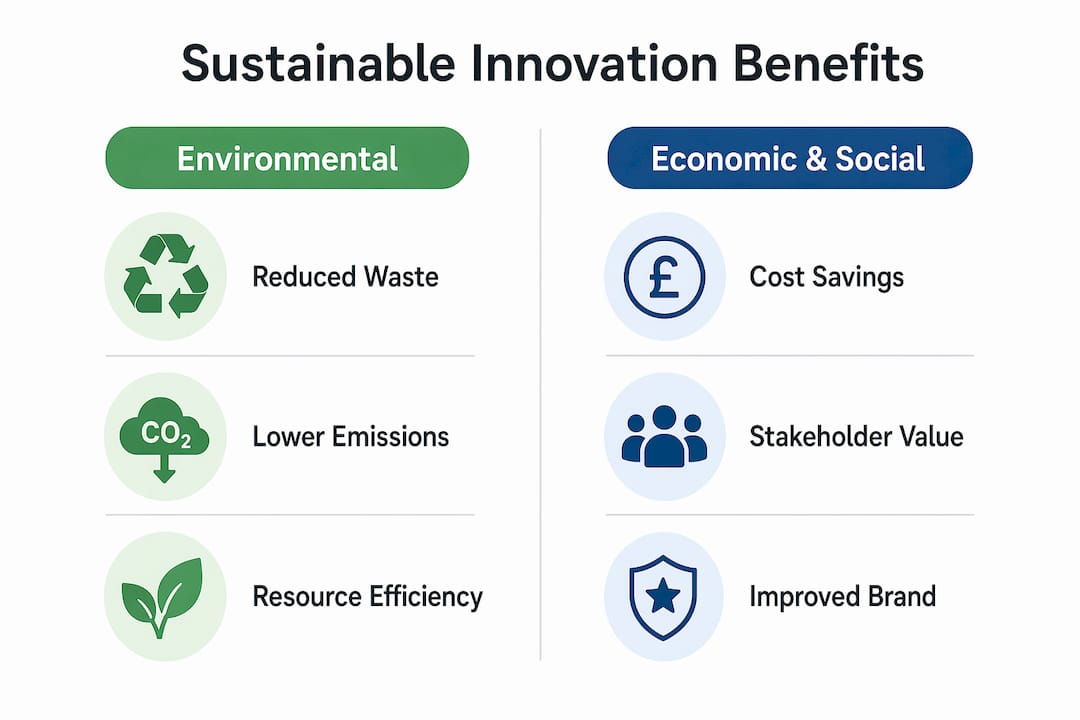
The benefits of sustainable innovation, when implemented well, are concrete. Organisations report stronger stakeholder trust, reduced regulatory risk, lower material costs through circular design, and access to markets that require sustainability credentials. Understanding the full range of sustainable materials available is a practical starting point for any product team working through step one.
Pro Tip: Start with a life cycle assessment of your current best-selling product before designing anything new. The data will show you exactly where the largest environmental impacts sit, and that tells you where sustainable innovation will deliver the most value.
The case for recycled materials in product design is not just environmental. Reduced raw material costs, supply chain resilience, and growing consumer preference all make the business case straightforward.
Key takeaways
Sustainable innovation delivers environmental, social, and economic value only when embedded from the start of product development, managed across all four innovation dimensions, and balanced against commercial and functional requirements.
| Point | Details |
|---|---|
| Definition matters | Sustainable innovation reduces environmental harm while creating economic and social value, not just adding green features. |
| Embed early | Sustainability goals set at the concept stage produce far stronger outcomes than those added late in development. |
| Use the CORE framework | Conceptualisation, Orchestration, Realisation, and Environment give teams a structured way to manage all innovation dimensions. |
| Avoid the balance trap | Excessive sustainability focus without commercial balance produces diminishing returns, as research confirms. |
| Measure all three outcomes | Track environmental, social, and economic performance together to assess whether innovation is genuinely sustainable. |
Why I think most organisations are still getting sustainable innovation wrong
Most organisations treat sustainable innovation as a product problem when it is actually an organisational one. I have watched teams invest heavily in material research and life cycle assessments, then hand the results to a sales team that has never been part of the conversation. The product launches with strong environmental credentials on paper and weak market traction in practice, because nobody built the commercial case alongside the environmental one.
The shift I find most encouraging in 2026 is the move toward ecosystem-based thinking. Organisations that pull in suppliers, customers, and even regulators during the ideation phase consistently produce better outcomes than those that innovate in isolation. The hybrid marine engine development case, where collaborative knowledge flows across a five-phase process produced genuinely novel results, is a model worth studying regardless of your industry.
Regulatory pressure is also changing the calculus. The EU Chemicals Strategy for Sustainability is not a distant concern for large manufacturers. It is already reshaping what materials are permissible and what claims are defensible. Organisations that treat compliance as a floor rather than a ceiling, and use it as a prompt to go further, are the ones building durable competitive positions.
The honest truth is that sustainable innovation is hard precisely because it requires you to hold multiple objectives simultaneously. Environmental performance, functional quality, commercial viability, and regulatory compliance do not always point in the same direction. The organisations that manage that tension well, rather than collapsing it into a single metric, are the ones producing work worth paying attention to.
— Aaron
Sustainable accessories built on real innovation at Thecorkstore
Sustainable innovation is not abstract when you can hold it in your hands.
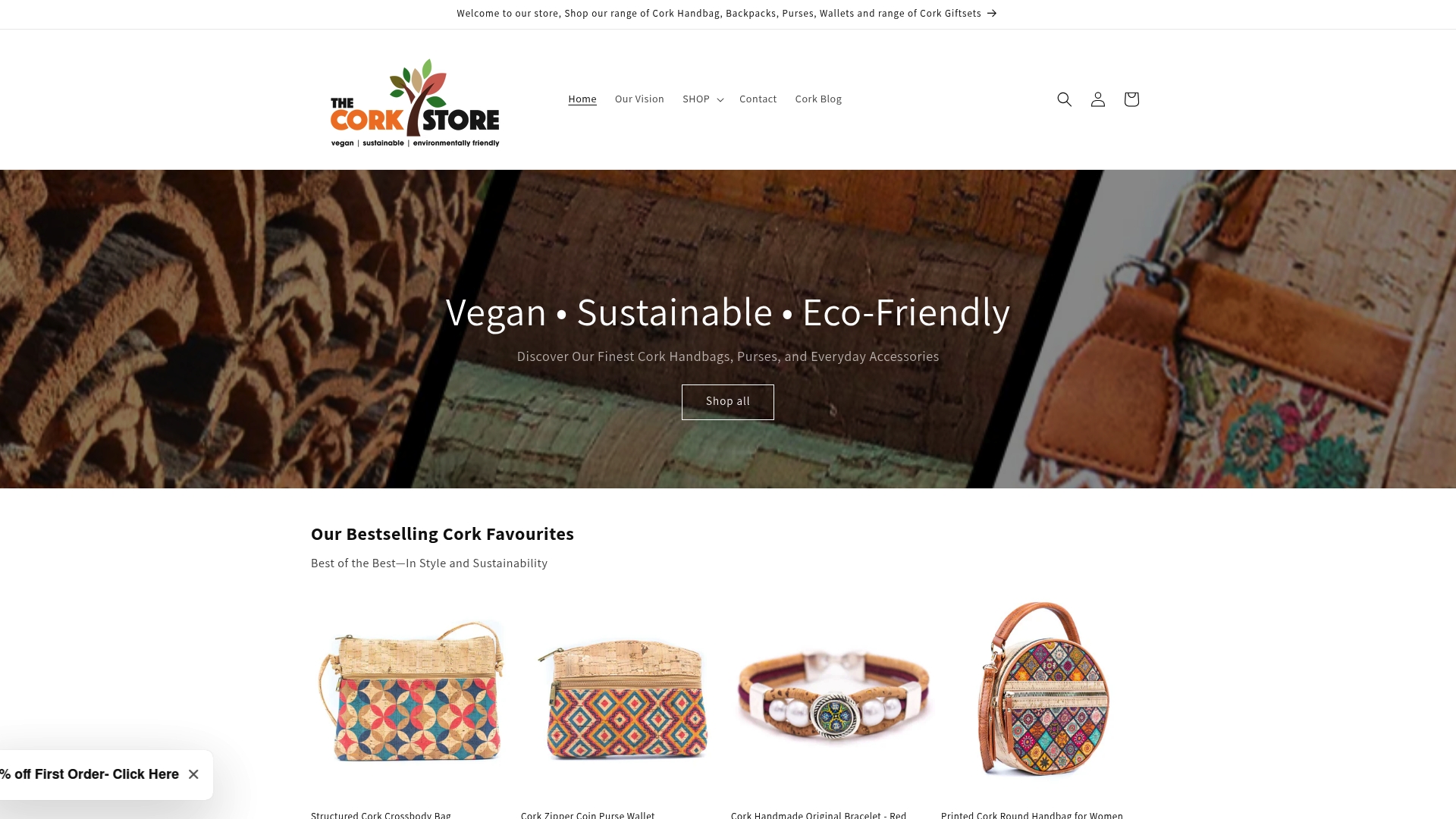
Thecorkstore designs and sells accessories made from cork, a material that is harvested without felling trees, regenerates naturally, and requires no animal products in its production. Every handbag, backpack, wallet, and purse in the collection reflects the same principles covered in this article: circular material sourcing, low-impact production, and genuine end-of-life consideration. If you want to see what eco-friendly innovation looks like at the product level, the Thecorkstore collection is a clear example of sustainable design principles applied to everyday accessories. Stylish, vegan, and built to last.
FAQ
What is sustainable innovation in simple terms?
Sustainable innovation is the deliberate creation of new products, services, or processes that reduce environmental harm while delivering economic and social value. It applies life cycle thinking from design through to disposal.
What are the best examples of sustainable innovation?
Nano-coatings on solar panels that increase energy output by 4% while cutting water use by 55%, and chemical recycling that produces performance wear from 100% textile waste, are two well-documented examples with measurable environmental benefits.
How do you implement sustainable innovation in a business?
Embed sustainability targets at the concept stage of new product development, build cross-functional teams from the start, apply life cycle thinking throughout, and balance environmental goals with commercial and functional requirements.
What are the main benefits of sustainable innovation?
Sustainable innovation improves environmental, social, and economic outcomes simultaneously when managed well. Benefits include lower material costs, stronger stakeholder trust, reduced regulatory risk, and access to sustainability-conscious markets.
What is the CORE framework for sustainable innovation?
CORE stands for Conceptualisation, Orchestration, Realisation, and Environment. It is a framework that structures new product development around four interdependent domains to produce genuinely sustainable innovation outcomes.