

Why buy recycled materials: benefits worth knowing
TL;DR:
- Buying recycled materials significantly reduces energy use and greenhouse gas emissions, supporting a resilient economy. Supporting domestic recycling industries creates jobs, stabilizes supply chains, and lowers environmental impacts compared to virgin resources. Consumers can enhance sustainability by choosing certified recycled products, proper sorting, and supporting brands with transparent recycling practices.
Buying recycled materials is one of the most direct ways a consumer can reduce energy consumption, cut greenhouse gas emissions, and support a more stable, resilient economy. Manufacturing with recycled inputs can cut energy use by up to 90% and slash greenhouse gas emissions by up to 96% compared to using virgin materials. The Recycled Materials Association (ReMA) reports that recycled materials already supply roughly 40% of raw inputs for US manufacturing. For sustainability-minded shoppers, understanding why buy recycled materials goes well beyond personal conscience. It connects your purchasing choices to a global system of environmental protection, job creation, and supply chain strength.
Why buy recycled materials: the environmental case
The environmental benefits of recycled materials are measurable, not theoretical. Producing aluminium from recycled scrap uses around 95% less energy than smelting it from bauxite ore. Recycled steel production cuts energy demand by roughly 60–74% compared to blast furnace methods. These are not marginal gains. They represent a fundamental shift in how much the planet pays for the things we make.
Resource conservation is the other side of this equation. Every tonne of recycled material used means less mining, less deforestation, and less habitat destruction. Recycled plastics, for example, reduce the need to extract and refine crude oil. When you choose a product made with recycled content, you are voting against the extraction economy with your wallet.
The impact of recycling on the environment also shows up in landfill diversion. Materials that are recycled do not decompose in landfill sites, where they would generate methane, a greenhouse gas far more potent than carbon dioxide over a 20-year period.
- Aluminium: Recycling saves up to 95% of the energy needed for primary production.
- Steel: Over 70% of US steel is now made from recycled scrap, reducing both energy use and mining pressure.
- Plastics: Recycled plastic resins reduce reliance on fossil fuel feedstocks and lower lifecycle carbon emissions.
- Batteries: More than 90% of metals can be recovered from used batteries and fed back into manufacturing.
Pro Tip: When shopping for eco-friendly material options, look for products that state the percentage of post-consumer recycled content on their label. A product with 50% or more post-consumer recycled content delivers a meaningfully larger environmental benefit than one using pre-consumer waste alone.
What are the economic and social advantages?
The recycled materials industry is not a niche concern. It is a significant economic force. Recycled materials industries generate $184 billion in economic activity across the United States, with $71 billion of that flowing directly through recycling businesses. That scale matters because it shows recycling is not a charitable act. It is a productive sector of the economy.
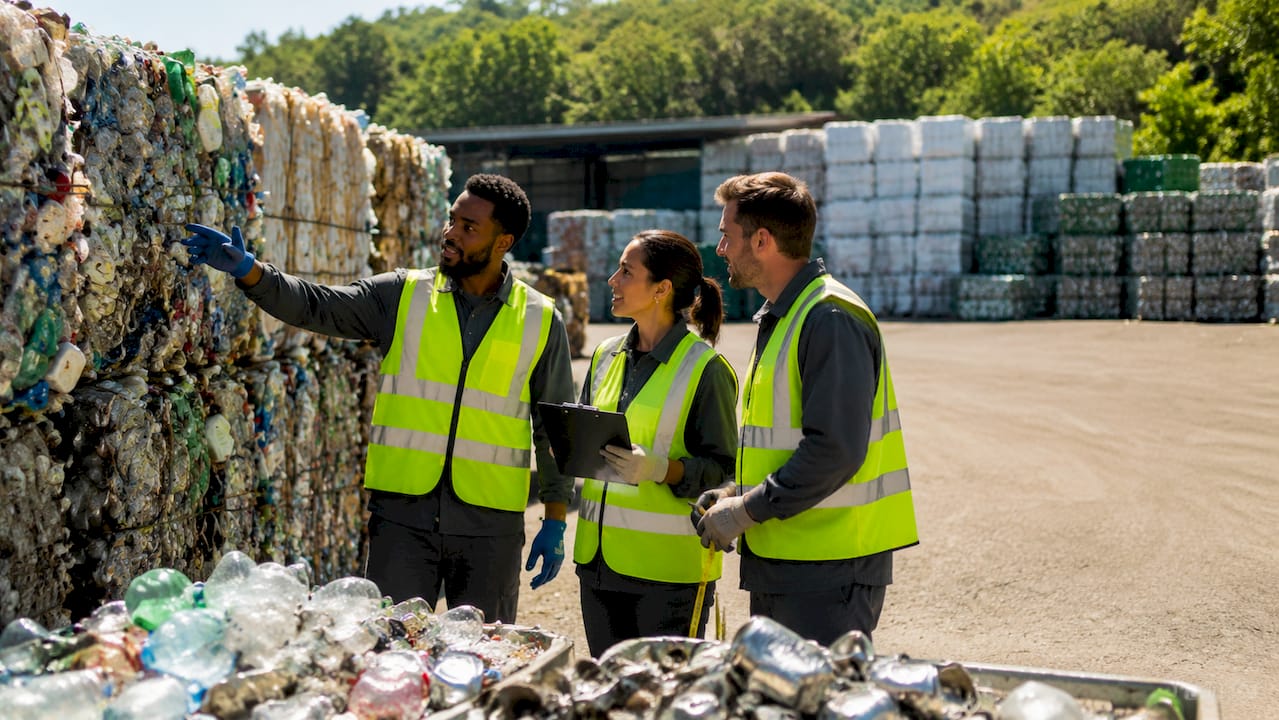
The social dimension is equally compelling. Recycling-related activity in the US supports 757,000 jobs and generates $36.6 billion in wages. These are local, domestic jobs that cannot be offshored in the same way that raw material extraction often is. When you buy a product made from recycled content, you are supporting that employment base.
The tax contribution is another underappreciated benefit. The recycled materials sector pays $21 billion annually in federal and state taxes. That revenue funds public services, infrastructure, and community programmes. Choosing recycled products is, in a very real sense, a contribution to the public good.
- Economic output: $184 billion in total economic activity generated by the recycled materials sector.
- Job creation: 757,000 recycling-related jobs supported across the US economy.
- Wage contribution: $36.6 billion in wages paid to workers in the sector.
- Tax revenue: $21 billion paid annually to federal and state governments.
- Market stability: Consumer demand for recycled products helps stabilise recycling markets, making the whole system more financially viable.
39% of consumers say environmental impact is extremely or very important in their purchasing decisions. That figure shows the market is ready to reward companies that use recycled content. When enough consumers act on that preference, manufacturers respond by sourcing more recycled inputs, which in turn funds more recycling infrastructure.
How do recycled materials strengthen supply chains?
Supply chain resilience is one of the most compelling and least discussed reasons to use recycled products. Virgin raw materials are subject to geopolitical disruption, trade tariffs, and commodity price swings. Recycled materials, by contrast, are largely sourced domestically. Approximately 77% of recycled materials processed in the US are used domestically. That local sourcing reduces exposure to the kind of global shocks that have repeatedly disrupted manufacturing in recent years.
“Supporting recycled materials closes the loop and maintains local, stable, and sustainable supply chains, reducing commodity market volatility.” — Business Case for Recycling Critical Materials
Price stability is another advantage. Recycled plastic resins, for instance, are less directly tied to crude oil price movements than virgin plastic. When oil prices spike, manufacturers using recycled content absorb less of that shock. This is a concrete financial argument for procurement teams, not just an ethical one.
Technology is also improving the quality and consistency of recycled materials. Advanced AI sorting systems now identify and separate materials with greater precision than manual methods, reducing contamination and improving the grade of recycled output. This directly addresses one of the historic criticisms of recycled materials: that they were inconsistent in quality.
| Factor | Virgin Materials | Recycled Materials |
|---|---|---|
| Price volatility | High, tied to commodity markets | Lower, more stable domestic pricing |
| Supply risk | Exposed to geopolitical disruption | Primarily domestic sourcing |
| Environmental cost | High energy and emissions | Up to 90–96% lower energy and emissions |
| Quality consistency | Uniform by default | Improving rapidly with AI sorting |
| Job creation | Often offshore extraction | Domestic processing and manufacturing |
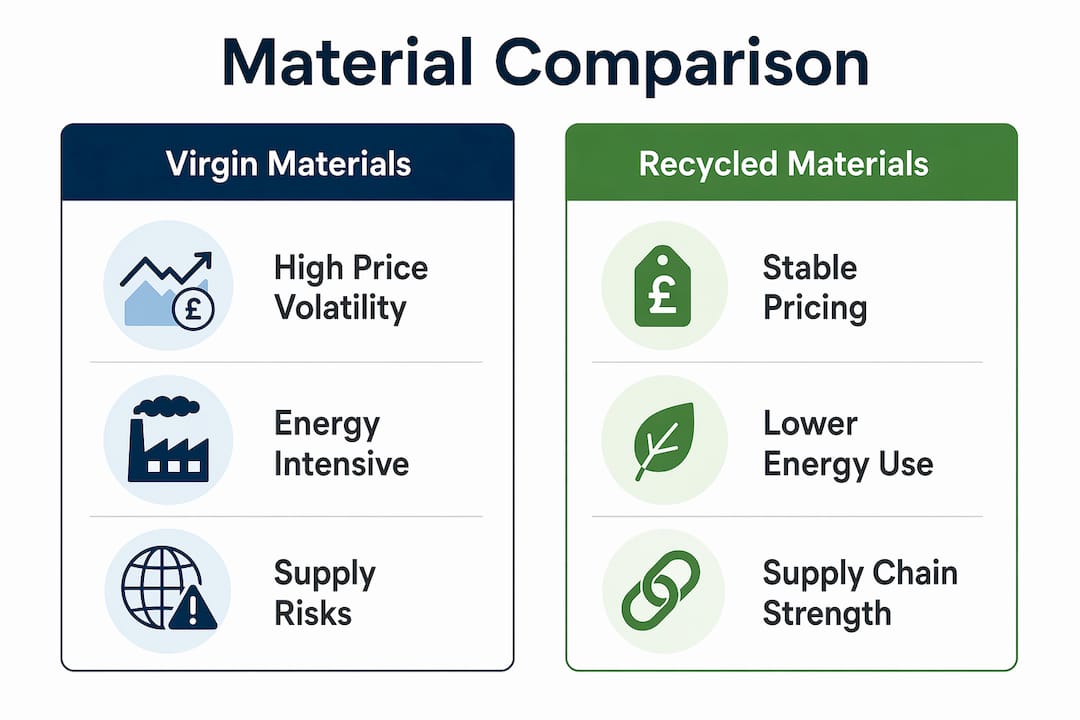
The table above illustrates why the advantages of buying recycled extend well beyond environmental sentiment. For businesses and consumers alike, recycled materials represent a more predictable, locally grounded supply option.
Practical considerations when buying recycled products
Recycled materials are not without challenges, and understanding them helps you make better purchasing decisions. The most common barrier is cost. Recycled materials can be 10–50% more expensive than virgin alternatives, due to the complexity of collection, sorting, and reprocessing. That premium is real, but it reflects the true cost of responsible production rather than an inflated price.
Consumer behaviour plays a direct role in keeping those costs manageable. Contamination of recyclables by consumers, such as placing greasy food containers or non-recyclable plastics in recycling bins, increases processing costs and reduces the quality of the final recycled material. Proper cleaning and sorting at home is one of the simplest ways to support the recycled materials economy.
Product design is the third factor most consumers overlook. Design for disassembly is the principle that products should be built so their components can be separated and recycled again at end of life. A product made from recycled cork, for example, that is also designed to be composted or disassembled, is genuinely circular. A product glued together with mixed materials may use recycled content but cannot itself be recycled again.
- Check for certification: Look for labels such as the Global Recycled Standard (GRS) or Recycled Claim Standard (RCS) to verify recycled content claims.
- Prioritise post-consumer content: Post-consumer recycled material has already been used by a consumer, making it a stronger environmental choice than pre-consumer industrial waste.
- Support brands with take-back schemes: Some manufacturers offer end-of-life collection, which closes the loop on the products they sell.
- Avoid wishful recycling: Only place items in recycling bins that your local authority confirms it accepts. Contamination undermines the whole system.
Pro Tip: When evaluating sustainable building materials or fashion accessories, ask the brand directly what percentage of their product is post-consumer recycled content and whether the product itself is recyclable at end of life. Brands with genuine credentials will answer clearly. Those that cannot are worth scrutinising further.
You can also learn how to spot sustainable materials when shopping for eco-conscious fashion and accessories, which helps you distinguish genuine recycled content from greenwashing.
Key takeaways
Buying recycled materials reduces energy use by up to 90%, supports 757,000 jobs, and strengthens domestic supply chains against global price shocks.
| Point | Details |
|---|---|
| Environmental savings | Recycled materials cut energy use by up to 90% and emissions by up to 96% versus virgin production. |
| Economic scale | The recycled materials sector generates $184 billion in activity and supports 757,000 jobs. |
| Supply chain resilience | Around 77% of US recycled materials are used domestically, reducing exposure to global disruption. |
| Cost reality | Recycled products can cost 10–50% more, but deliver price stability and lower environmental costs. |
| Consumer role | Proper sorting at home and choosing certified recycled products directly improves market quality and viability. |
The shift i think most shoppers are missing
I have followed the sustainable materials space for a long time, and the conversation still gets stuck in the same place. People frame buying recycled as a sacrifice. They focus on the price premium, the occasional quality variation, and the inconvenience of checking labels. What they miss is that the calculus has fundamentally changed.
The recycled materials industry is no longer a cottage sector running on goodwill. It is a $184 billion economy with advanced AI sorting, domestic supply chains, and measurable quality standards. When you choose a cork accessory over a leather one, or a product certified to the Global Recycled Standard over a generic alternative, you are not making a compromise. You are backing a system that is genuinely outperforming the old one on multiple measures.
The part that genuinely surprises people when I explain it is the supply chain argument. Most consumers think about recycling as a waste management issue. It is actually a manufacturing strategy. Brands that source recycled content are less exposed to commodity price shocks, less dependent on politically unstable supply regions, and increasingly able to offer consistent quality. That is a competitive advantage, not a liability.
My honest view is that the eco-conscious shopping guide conversation needs to move from “should I pay more for recycled?” to “why would I accept the hidden costs of virgin materials?” The environmental damage, the geopolitical risk, and the wage suppression in extraction economies are all costs. They are just costs that do not appear on the price tag.
— Aaron
Explore recycled and sustainable products at Thecorkstore
If you are ready to put these principles into practice, Thecorkstore offers a curated range of eco-friendly accessories made from cork, a naturally harvested, renewable, and recyclable material. Cork products require no animal products and no synthetic plastics, making them a genuinely sustainable alternative to leather and conventional accessories.
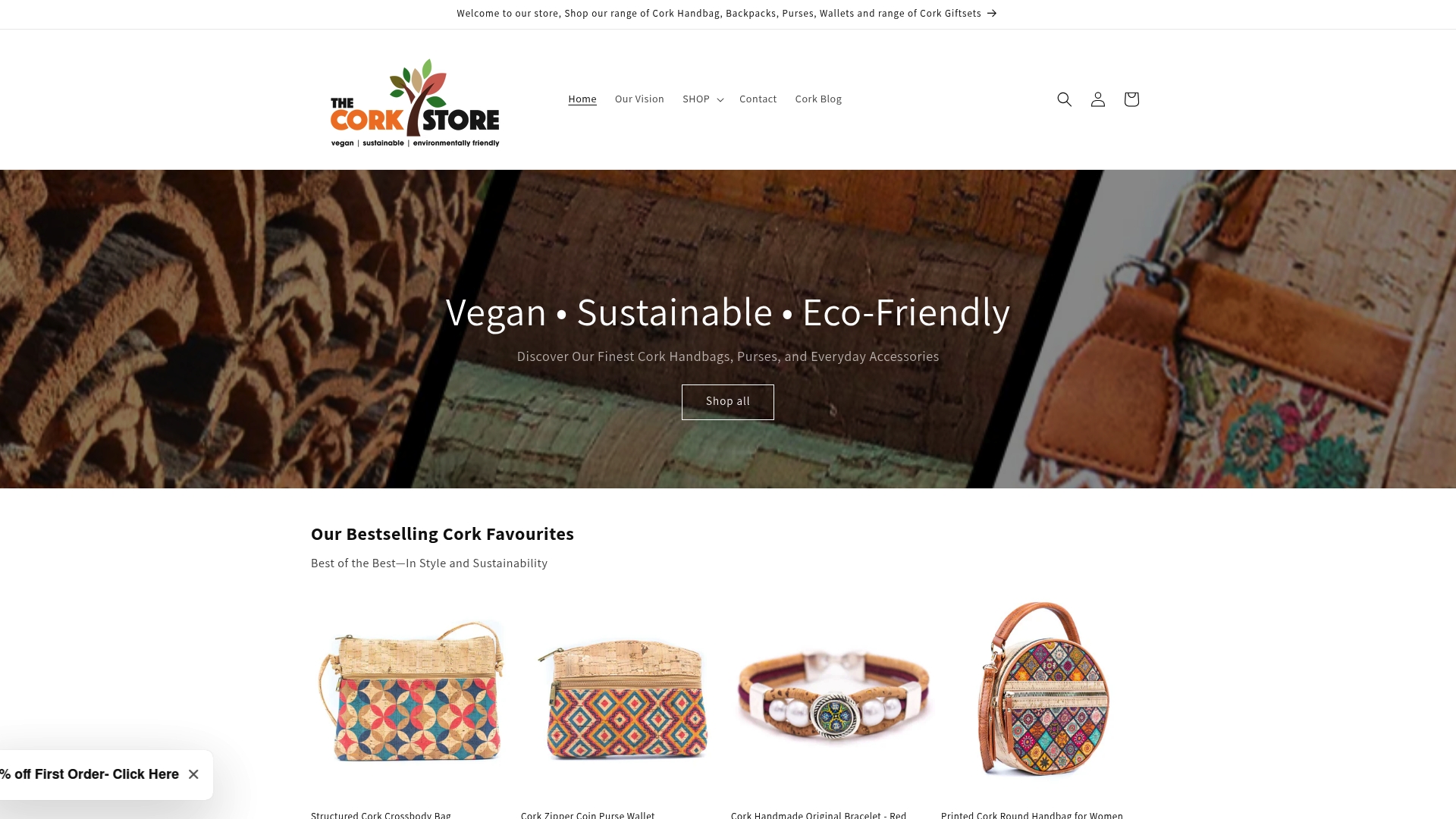
Thecorkstore’s collection includes handbags, wallets, backpacks, and gift sets, all designed with durability and environmental responsibility in mind. Cork is harvested without cutting down trees, making it one of the most genuinely sustainable material options available in fashion today. If you want to make purchasing decisions that align with your values without compromising on style, Thecorkstore is a strong place to start. Browse the full collection at thecorkstore.co.uk.
FAQ
What are the main benefits of recycled materials?
Recycled materials reduce energy consumption by up to 90% and greenhouse gas emissions by up to 96% compared to virgin production. They also support domestic jobs, stabilise supply chains, and reduce pressure on natural resources such as forests and mineral deposits.
Why do recycled products sometimes cost more?
Recycled materials can cost 10–50% more than virgin alternatives due to the complexity of collection, sorting, contamination management, and reprocessing. That premium reflects the true cost of responsible production and typically comes with lower environmental impact over the product’s lifetime.
How does buying recycled products create jobs?
The recycled materials sector supports 757,000 jobs in the US alone, with $36.6 billion in wages paid annually. These are primarily domestic roles in collection, processing, and manufacturing, making them more locally resilient than jobs tied to offshore raw material extraction.
Does recycled material quality match virgin material quality?
Quality has improved significantly with the adoption of advanced AI sorting technology, which reduces contamination and improves consistency. Certified recycled content, verified by standards such as the Global Recycled Standard, now meets the specifications required by major manufacturers across multiple industries.
How can i tell if a product genuinely contains recycled content?
Look for third-party certifications such as the Global Recycled Standard (GRS) or the Recycled Claim Standard (RCS) on product labels. These certifications verify the percentage and source of recycled content, distinguishing genuine recycled products from unverified marketing claims.