
Portugal Supplies Half the World's Cork: Origins and How to Verify
Cork is the outer bark, known botanically as the phellem, of the cork oak tree (Quercus suber). Almost all of the world’s commercial supply comes from the western Mediterranean, with Portugal harvesting about half the global crop and Spain producing most of the rest, alongside smaller volumes from Italy and north-west Africa.
TL;DR:
- Portugal accounts for about half of global cork harvest, with Spain providing roughly a third, totaling approximately 300,000 tonnes annually.
- Cork oak trees are harvested every 9 to 12 years starting at age 25, with careful manual stripping ensuring tree health and cork quality.
- Most cork reaches consumers through a traceable process, with batch labels verifying origin and quality, especially in Portugal and Spain.
- Properly managed cork forests support high biodiversity, act as carbon sinks, and reduce wildfire risks, all without felling the trees.
- When buying cork products, prioritize traceability and harvest data over vague origin claims, and look for clear batch references for authenticity.
Table of Contents
- Where cork grows: main regions and production figures
- Botany of cork oak: why Quercus suber grows thick cork bark
- Harvesting rules and the stripping technique
- Post-harvest processing: stabilisation, boiling and product routes
- Properties and common uses of cork
- Sustainability, forest management and certification
- How cork reaches the consumer: provenance and quality clues
- Author perspective and site proof points
- Where does cork come from: what buyers should actually check
- If you want responsibly sourced cork accessories
- Sources
Where cork grows: main regions and production figures
The cork oak has a surprisingly narrow home. It grows naturally across the western Mediterranean basin but simply doesn’t occur east of the Ionian Sea, which means the forests of Greece or Turkey never developed the wild cork oak populations you find further west. Sardinia and Calabria mark the eastern edge of its natural range, according to distribution data from the FAO.
Portugal dominates the industry in a way few raw materials are dominated by a single country. It accounts for about half of the annual global cork harvest, with Spain contributing around a third, and worldwide production running to roughly 300,000 tonnes a year, according to the Natural Cork Council. That leaves a smaller but meaningful share spread across the rest of the range.
The main producing regions include:
- Alentejo, Portugal, the heartland of the industry and home to the densest cork oak forests anywhere
- Extremadura, Spain, a major inland producing region with a long harvesting tradition
- Sardinia, Italy, sitting at the eastern limit of the tree’s natural distribution
- The Moroccan coastal strip and parts of Algeria and Tunisia, where cork oak forests persist in cooler, wetter microclimates
Why Portugal and not somewhere else? Partly geology, partly climate, but mostly centuries of accumulated forestry knowledge. Portuguese landowners have managed cork oak stands as a working forest resource since at least the 18th century, which means the country has both the tree density and the trained harvesters that newer producing regions haven’t yet built up.
Botany of cork oak: why Quercus suber grows thick cork bark
Every tree has bark, but Quercus suber does something unusual: it grows a phellem layer thick enough to strip and sell. Most oaks produce a thin protective bark that would tear apart under a harvester’s axe. Cork oak evolved a defence against Mediterranean wildfire and summer drought instead, and that defence happens to be commercially extraordinary.
Under a microscope, cork looks like a honeycomb, with tens of millions of tiny, gas-filled cells packed into every cubic centimetre. That structure isn’t decorative. It’s the reason cork springs back after compression, resists water, and won’t easily conduct heat. The cell walls are built mainly from two compounds: suberin, making up around 40% of the material, and lignin, at roughly 22%, according to a structural review published in BioResources. Suberin is a waxy polymer that repels water; lignin provides rigidity. Together they explain almost every practical property cork has.
Cork oak thrives in conditions that would stress most trees:
- Acidic, well-drained soils, often sandy or granitic
- Hot, dry summers with mild, wet winters, the classic Mediterranean pattern
- Low-nutrient ground where few other commercially valuable trees would establish
That tolerance for poor soil is one reason cork oak forests occupy land that’s otherwise marginal for agriculture, a point that matters later when it comes to sustainability.
Harvesting rules and the stripping technique
A cork oak isn’t touched for its first quarter century of life. Commercial stripping begins at roughly 25 years old, and after that first harvest, the tree is left alone for another 9 to 12 years before it’s stripped again, according to horticultural data from North Carolina State University’s plant database. A single tree can live 150 to 200 years, meaning it might be harvested a dozen or more times across its lifespan.
The timing within each year matters just as much as the interval between harvests:
- Harvesting runs from mid-May to August, when the tree is in its most active growth phase and the cork layer separates cleanly from the trunk.
- Harvesters make a horizontal incision around the circumference of the trunk, then vertical cuts to divide the bark into workable sections.
- The cork is prised away by hand, using a specialised curved axe designed to lever the bark off without gouging the living tissue beneath.
- The inner bark, the cork cambium, must survive untouched, because that thin living layer is what regenerates a new phellem for the next harvest cycle.
Cut too deep, too early in the season, or too soon after the previous harvest, and the tree simply won’t produce usable cork again. That’s why harvesting remains a skilled trade rather than mechanised forestry. Amorim, one of the industry’s largest processors, notes that precise manual stripping by experienced, often multi-generational, harvesters is what protects both tree health and the eventual quality of the cork, based on its own account of the raw material process. Bark from a tree’s first harvest, sometimes called “virgin cork,” is typically too hard and irregular for wine stoppers, and only becomes suitable for premium use after the second or third stripping.
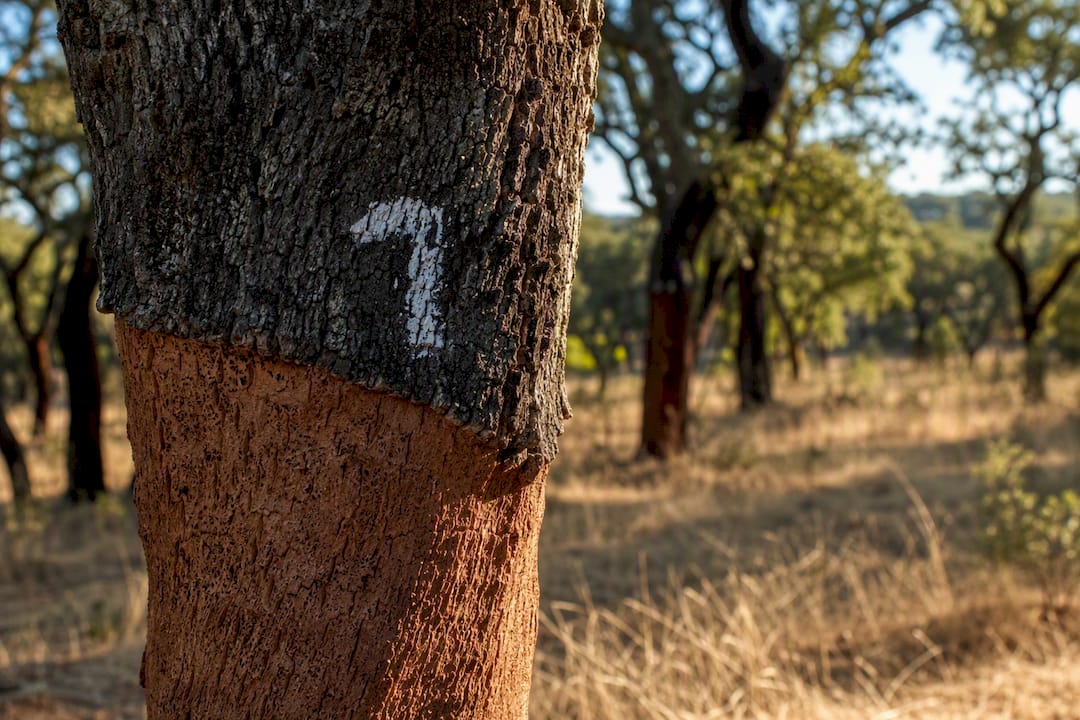
Pro Tip: If you ever see cork oak trunks with a painted number on them, that’s not vandalism. Producers mark the last digit of the harvest year directly onto the bark, so anyone walking the forest can tell at a glance which trees are due and which need another few years to rest.
Post-harvest processing: stabilisation, boiling and product routes
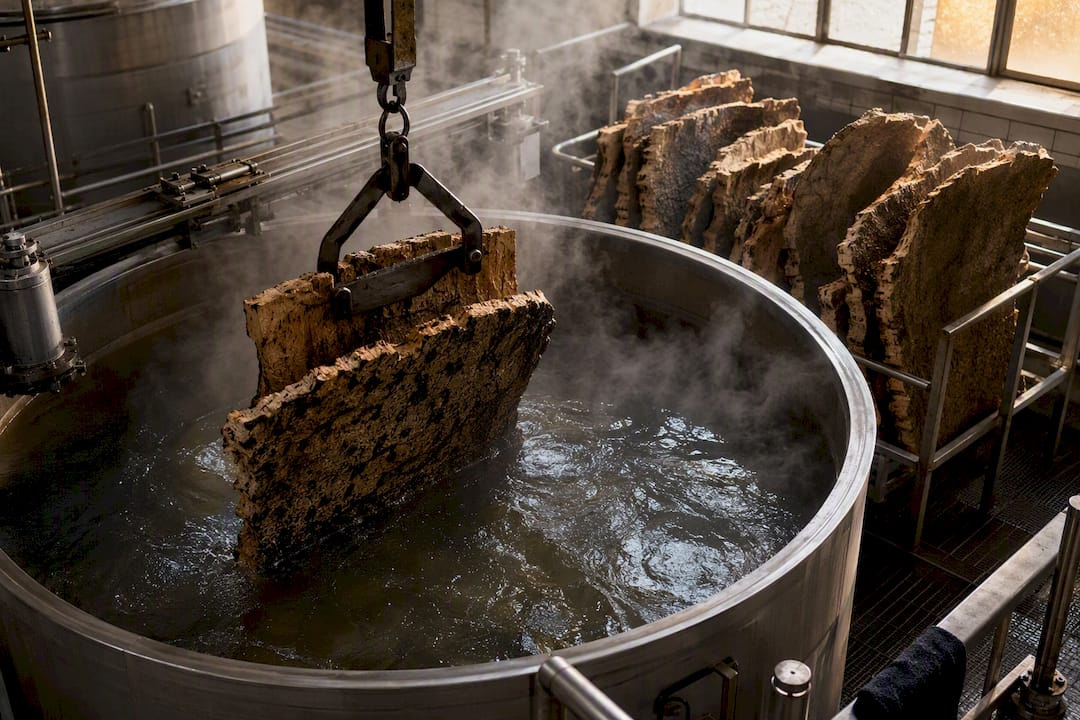
Freshly stripped planks don’t go anywhere near a factory straight away. They’re stacked in open yards and left to stabilise, often for six months or longer, while moisture content evens out and the bark loses its initial curvature.
Each batch gets labelled at this stage, a step that turns out to matter well beyond simple stock control:
- Batch labelling establishes traceability back to the specific forest and harvest year, which underpins later certification claims.
- Boiling follows the resting period, softening the cork, flattening the planks, and washing out tannins and dirt.
- Sorting by thickness comes next, separating the material into grades: thicker, cleaner planks are punched into natural stoppers, while thinner or more irregular pieces go into technical or fashion-grade uses.
This staged approach, moving from field to yard to boiler to sorting line, is described in detail by Amorim’s own production process documentation, and traceability at the batch level is central to how the industry substantiates claims of genuine Portuguese or Spanish origin. Thecorkstore’s own guide to the cork production process walks through how these same graded materials eventually become the sheet cork used in bags and accessories, well beyond the wine industry that most people associate cork with.
Properties and common uses of cork
Cork’s honeycomb structure does a lot of quiet work. Because each cell is a sealed pocket of gas, cork resists water penetration far better than solid wood, and because those cells compress under pressure and spring back afterwards, cork can be squeezed into a bottle neck and still form an airtight seal. The same structural review from BioResources ties this cell arrangement directly to cork’s elasticity, its low thermal conductivity, and its natural fire retardancy.
Its main properties, in practical terms:
- Impermeable to liquids, which is why it seals wine bottles for decades without leaking
- Highly compressible and elastic, springing back to its original shape after compression
- A poor conductor of heat, making it a genuinely effective insulating material
- Buoyant and lightweight, historically used in life jackets and fishing floats
- Naturally fire-resistant, since the suberin content slows combustion
Those properties map neatly onto its uses. Compressibility is why it still dominates wine closures despite decades of competition from screw caps. Water resistance and low weight explain its long history in flotation devices and, more recently, in durable bags, wallets, and travel accessories that need to withstand rain without absorbing it.
Sustainability, forest management and certification
Stripping bark sounds like it should harm a tree. In cork oak’s case, the opposite tends to be true when the work is done correctly: careful harvesting can actually improve a tree’s vigour, and the wider forest system, known as montado in Portugal and dehesa or alcornocal in Spain, delivers benefits well beyond the bark itself, according to the Natural Cork Council’s sustainability data.
These cork oak landscapes:
- Support unusually high biodiversity, hosting species from the Iberian lynx to migratory birds
- Act as long-term carbon stores, since a stripped tree absorbs more carbon during regrowth than an unharvested one
- Combine grazing, cork production and cereal farming in the same land, a traditional multi-use system that reduces the pressure to convert forest to monoculture
- Reduce wildfire severity in some areas, because managed stands are typically thinned and cleared as part of routine forestry work
Roughly 300,000 tonnes of cork are harvested globally each year without felling a single tree, unlike almost every other bark or timber product on the market. Certification schemes such as the Forest Stewardship Council (FSC) exist specifically to verify that a given batch of cork traces back to a responsibly managed forest, and that verification depends entirely on the batch labelling established at the stabilisation yard. Thecorkstore covers this in more depth in its piece on how cork production supports forests.
How cork reaches the consumer: provenance and quality clues
The supply chain runs in a fairly straight line: forest, stabilisation yard, processor, manufacturer, then exporter or brand. Each stage adds a layer of processing, but the traceability data attached at the yard stage is what eventually lets a finished product carry a credible claim of Portuguese or Spanish origin.
A few practical things to check if you’re buying cork goods:
- A stated country of origin, ideally Portugal or Spain given their harvest volumes, rather than a vague “Mediterranean sourced” label
- A visible or certified traceability reference, such as an FSC mark, rather than unverifiable sustainability language
- A tight, fine-grained texture, which usually indicates cork from a tree’s second or later harvest rather than coarser virgin bark
- Consistent density across the material, a sign of proper sorting and grading rather than off-cuts bundled together
Thecorkstore’s guide to buying vegan cork accessories goes into more detail on spotting these signals on finished products.
Author perspective and site proof points
Aaron, who covers sustainable materials and has written extensively on cork production for Thecorkstore’s blog, has tracked how the industry’s traceability claims have shifted from marketing language to something closer to verifiable fact over the past decade. His earlier piece on how cork is harvested covers the stripping technique in more hands-on detail than fits here.
Thecorkstore operates as an educational retailer as much as a shop, publishing process breakdowns alongside its product range of cork bags, wallets and accessories. Readers wanting to see the finished side of this supply chain, rather than just the forestry, can browse the current collection directly.
Where does cork come from: what buyers should actually check
The honest answer to where cork comes from is duller than most marketing copy suggests: it’s bark, from one specific tree species, grown in one specific corner of the world, harvested on a strict clock. That’s the whole story, and it’s more reassuring than a vaguer “sustainably sourced” claim because every part of it is checkable.
Where the conventional advice falls short is treating “Portuguese cork” as a quality guarantee on its own. Origin tells you the forest was probably well-managed, given how tightly Portugal and Spain regulate harvest cycles, but it tells you nothing about which harvest that specific piece came from. A first-harvest virgin cork and a fourth-harvest plank from the same tree are genuinely different materials.
If you’re buying cork goods, prioritise the harvest and traceability signals over the country label alone. Ask whether a batch reference exists, not just whether the product says “Portugal” on the tag. That single question filters out a surprising amount of loosely substantiated sustainability marketing, and it’s the one thing most buyers never think to ask.
— Aaron
If you want responsibly sourced cork accessories
There is a growing demand for accessories made from cork, a material that is grown, stripped, and regrown from the same living tree for well over a century, unlike many vegan leather alternatives made from plastic. If the sourcing detail in this article matters to you, that’s precisely the gap Thecorkstore was built to fill: accessories made from a material whose entire supply chain, from Alentejo forest to finished product, can actually be traced.
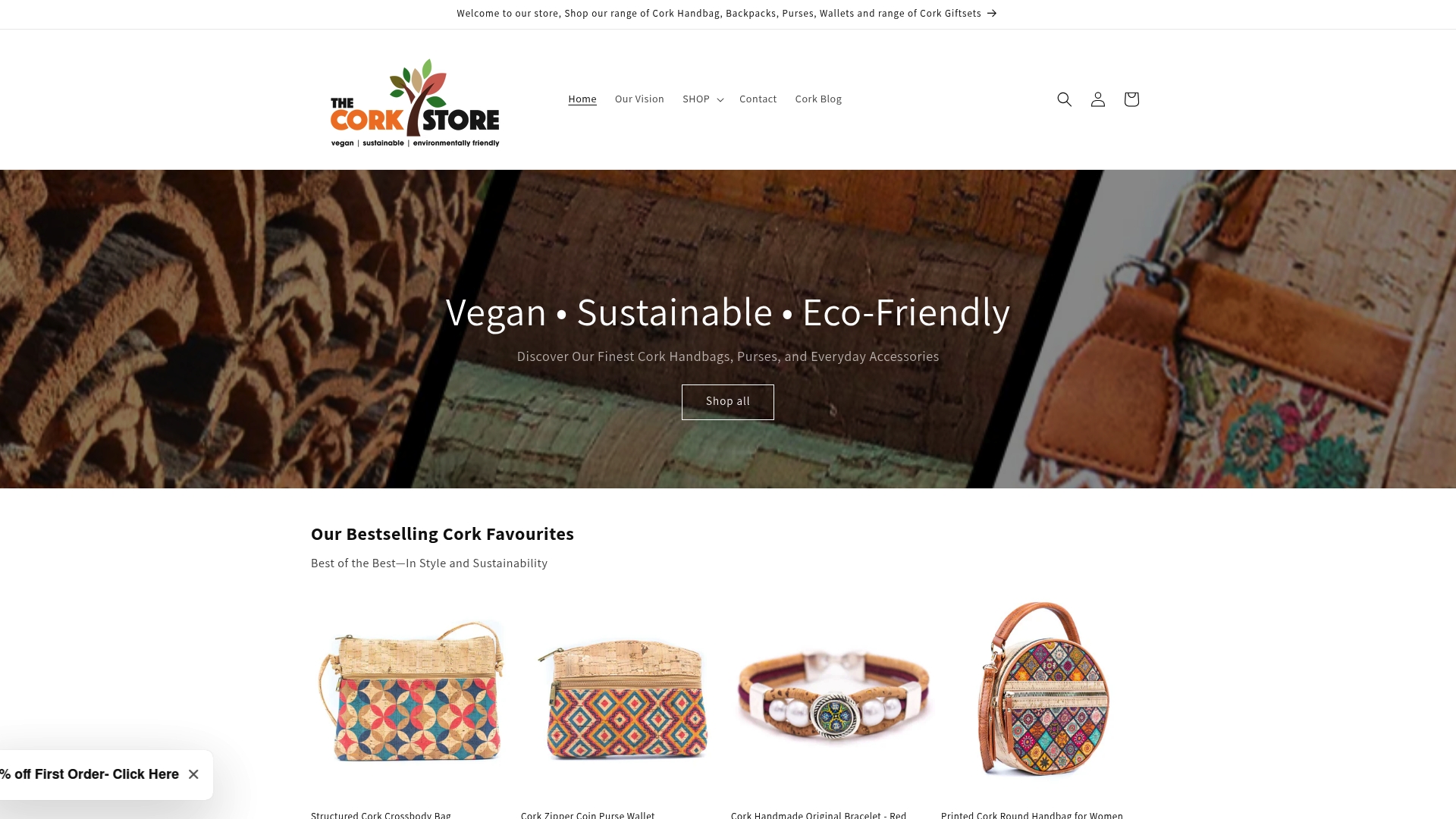
Many cork products such as bags, wallets, purses, and backpacks are made from cork sheet processed through stabilisation and boiling stages similar to those described above. For more on how sourcing decisions get made, the cork production process explained breaks down forest to finished good in more depth, and the current cork oak habitat and forest guide covers the ecological side further. Browse the collection at Thecorkstore to see which pieces are in stock now.
Sources
- Natural Cork Council — reports and statistics
- Quercus suber (cork oak) — North Carolina State Extension
- The rationale behind cork properties — review of structure and chemistry
- Amorim — cork raw material and production process