
Why choose natural materials for vegan bags and wallets
TL;DR:
- Natural materials like cork are a renewable, biodegradable alternative to synthetics when responsibly sourced. Cork offers practical advantages for accessories, including water resistance, light weight, and developing a natural patina. Verifiable certifications ensure ethical and sustainable sourcing, making natural options a systemic benefit for the environment and local communities.
Choose natural materials when you want a lower-carbon, biodegradable alternative to conventional synthetics that also feels better in your hands. Natural fibres are renewable, biodegradable, and reduce dependence on petroleum-based resources. Cork, the material at the heart of Thecorkstore’s range of vegan handbags, wallets and backpacks, adds water resistance and a distinctive warmth that most synthetics cannot replicate. FSC certification is a key indicator that a natural material has been responsibly sourced.
Here is what this article covers:
- Why natural materials have a lower environmental footprint (with caveats)
- How cork performs for everyday accessories
- Ethical and vegan credentials, and how to verify them
- A practical buying checklist and care guide
- Honest trade-offs, and when a synthetic might serve you better
Table of Contents
- Why natural materials matter for the environment
- How cork performs for everyday accessories
- Are cork accessories genuinely vegan and ethical?
- Practical buying checklist for cork accessories
- How to care for cork accessories
- Honest trade-offs: what natural materials do not solve
- Natural materials versus synthetic alternatives
- Other natural materials used in sustainable accessories
- Does natural material choice align with your values and budget?
- Thecorkstore: vegan cork accessories for UK buyers
- Key takeaways
- The case for cork is stronger than most guides admit
- Further reading and sources
Why natural materials matter for the environment
The environmental case for natural materials rests on three pillars: renewability, biodegradability, and circularity. Cork oak bark, for instance, regenerates after harvest without felling the tree, and the material biodegrades at the end of its life instead of persisting indefinitely in landfill like many synthetic polymers.
Sourcing determines everything. A natural fibre grown in a pesticide-heavy monoculture and shipped halfway around the world can carry a heavier carbon footprint than a locally produced recycled synthetic. The raw material is only the starting point.
Irresponsible sourcing can erase those gains entirely, which is why certification matters. FSC (Forest Stewardship Council) accreditation is the benchmark to look for on cork products; it confirms responsible forest management and traceability. For other fibres, GOTS (Global Organic Textile Standard) and OEKO-TEX serve a similar function.
Pro Tip: When reading a product page, look for a named certification with a licence number, not just the word “sustainable.” A logo without a number is unverifiable.
| Material property | Natural materials | Many synthetics |
|---|---|---|
| Feedstock | Renewable (plant/animal origin) | Petroleum-based |
| Biodegradability | Yes, under correct conditions | Rarely; persists in landfill |
| Circularity | Compostable or recyclable | Limited; often downcycled |
| Carbon in production | Lower when responsibly sourced | Higher embedded carbon |
How cork performs for everyday accessories
Cork is not just an ethical choice. It earns its place on practical grounds. The cellular structure of cork bark gives it a favourable strength-to-weight ratio that natural fibres share with high-performance industrial applications, which is why it holds up to daily use without adding bulk to a bag or wallet.
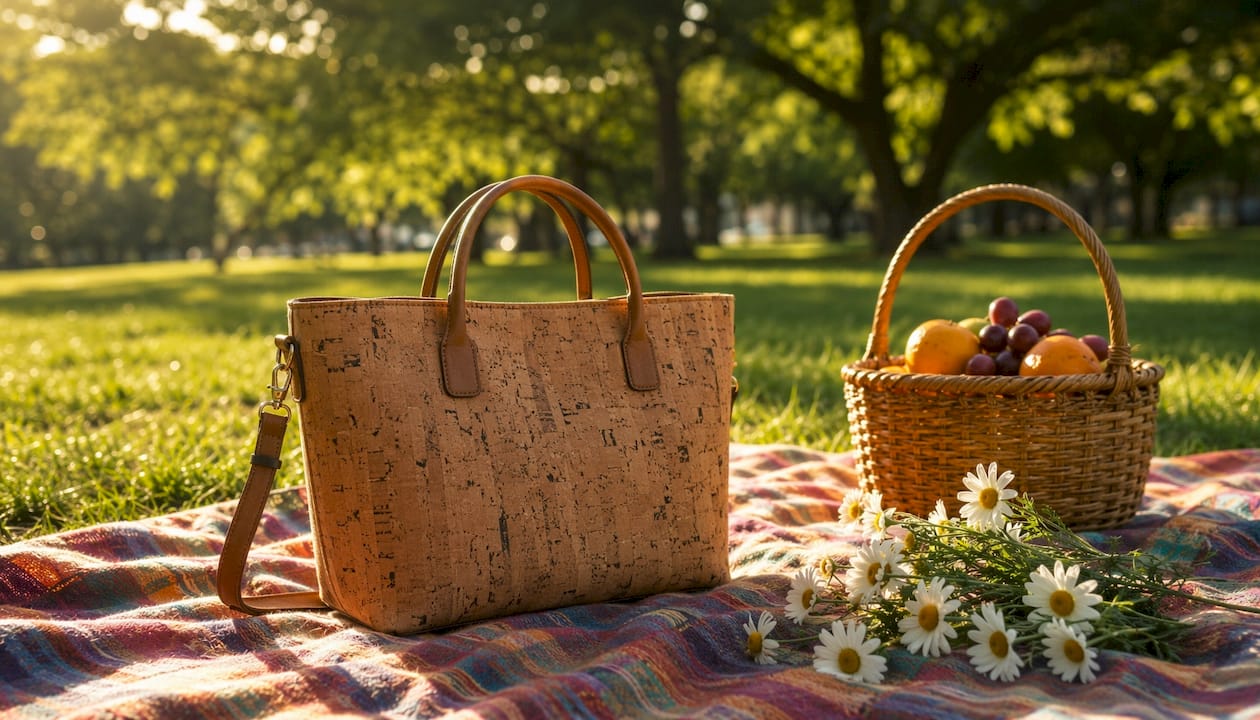
Design experts note that human nervous systems respond positively to natural textures. Cork’s micro-variations absorb light differently from smooth synthetics, creating a visual depth that reads as warmth rather than flatness. That is a design asset, not a manufacturing inconsistency.
For accessories specifically:
- Water resistance: Cork’s waxy suberin content repels light moisture, making it practical for wallets and everyday bags in British weather.
- Weight: Cork fabric tends to be lighter than many leather alternatives of similar thickness.
- Breathability: Unlike PU-coated synthetics, cork allows minor air exchange, reducing the trapped-heat feel of a bag worn close to the body.
- Patina: Cork develops a subtle sheen with use rather than peeling or cracking the way bonded leather does.
| Use case | Priority material trait | Cork rating |
|---|---|---|
| Daily handbag | Abrasion resistance, weight | Good |
| Travel wallet | Water resistance, flexibility | Very good |
| Evening clutch | Texture, visual interest | Excellent |
| Technical sports bag | Extreme abrasion, structure | Consider a blend |
Pro Tip: For small accessories like card holders and coin purses, cork’s flexibility and light weight matter more than abrasion resistance. For a larger tote used daily, check the backing fabric and stitching quality — those determine longevity more than the cork face itself.
Are cork accessories genuinely vegan and ethical?
Cork harvesting is entirely animal-free. Workers strip the outer bark from living cork oak trees on a recurring cycle that allows the bark to regenerate; the tree is never felled and no animal products are involved at any stage. This contrasts sharply with leather, where the hide is a direct by-product of slaughter.
FAO research highlights that natural fibre production also supports rural livelihoods, particularly in regions where cork oak forests are a primary economic resource. Responsible sourcing in those regions sustains communities as well as ecosystems.
What a credible vegan claim should include on a product page:
- Clear statement that no animal products or by-products are used in the material or adhesives
- Named certification (FSC for cork; PETA-approved vegan or equivalent for the full product)
- Country of origin for the cork fabric
- Information on the backing material (some cork fabrics use a cotton or linen backing; others use synthetic backing, which affects the overall vegan and environmental profile)
Practical buying checklist for cork accessories
Before you buy, run through these checks on the product page or in store:
- Grain and texture: Photos should show the cork surface clearly. Uniform, flat texture with no variation is a sign of heavy coating that may crack.
- Backing material: Look for a natural or recycled fabric backing rather than a thick PU layer.
- Stitching and edges: Seam photos matter. Fraying edges or unfinished seams indicate lower construction quality.
- Hardware: Zips, clasps and rings should be metal, not lightweight plastic, for longevity.
- Material content label: The product listing should name every material, including lining and hardware.
- Care instructions: A quality product always includes specific care guidance.
- Sourcing statement: Look for origin information and a named certification, not just a sustainability badge.
- Price versus lifespan: A well-made cork bag generally has longer durability compared to typical fast-fashion PU alternatives. Factor that into the cost comparison.
Pro Tip: To test cork feel without damaging a product in store, press lightly with a fingernail. Quality cork fabric springs back cleanly; lower-grade material may leave a mark or feel stiff.
For a deeper guide on spotting sustainable materials, Thecorkstore’s blog covers the specific markers to check.
How to care for cork accessories
Cork is low-maintenance, but a few habits extend its life considerably.
- Daily cleaning: Wipe with a damp cloth and mild soap. Rinse with a clean damp cloth and air dry away from direct heat.
- Stain response: Act quickly. Blot (do not rub) with a damp cloth. Avoid bleach, acetone, or abrasive pads.
- Storage: Keep cork bags away from prolonged direct sunlight, which can fade the surface. Store in a dust bag or pillowcase rather than a sealed plastic bag, which traps humidity.
- Humidity: Moderate humidity is fine. Avoid leaving cork accessories in very dry environments (near radiators in winter) for extended periods, as this can cause minor surface cracking.
Pro Tip: A very light application of natural beeswax or cork-specific conditioner once or twice a year maintains suppleness. Avoid silicone-based sprays, which can clog the surface and affect the natural texture.
Honest trade-offs: what natural materials do not solve
Natural does not mean universally superior. Practitioners point out that the real value of a natural material comes from matching its physical properties to the product’s actual use case, not from a blanket health or performance claim.
- Variability: Natural materials vary batch to batch. Two cork bags from the same range may show slightly different grain patterns. This is normal and desirable, but buyers expecting uniformity should know it upfront.
- Moisture sensitivity: Cork handles light moisture well, but sustained soaking is a different matter. It is not a waterproof material.
- Abrasion limits: For high-friction applications (a gym bag dragged across rough surfaces daily), a blended or synthetic option may outlast a natural one.
- Price premium: Responsibly sourced natural materials cost more to produce than commodity synthetics. Expect to pay more upfront; the value case rests on longevity and reduced replacement frequency.
In the UK, cork accessories are increasingly available through specialist sustainable retailers. FSC and PETA-approved vegan labels are the certification markers you will most commonly see on reputable product listings.
Natural materials versus synthetic alternatives
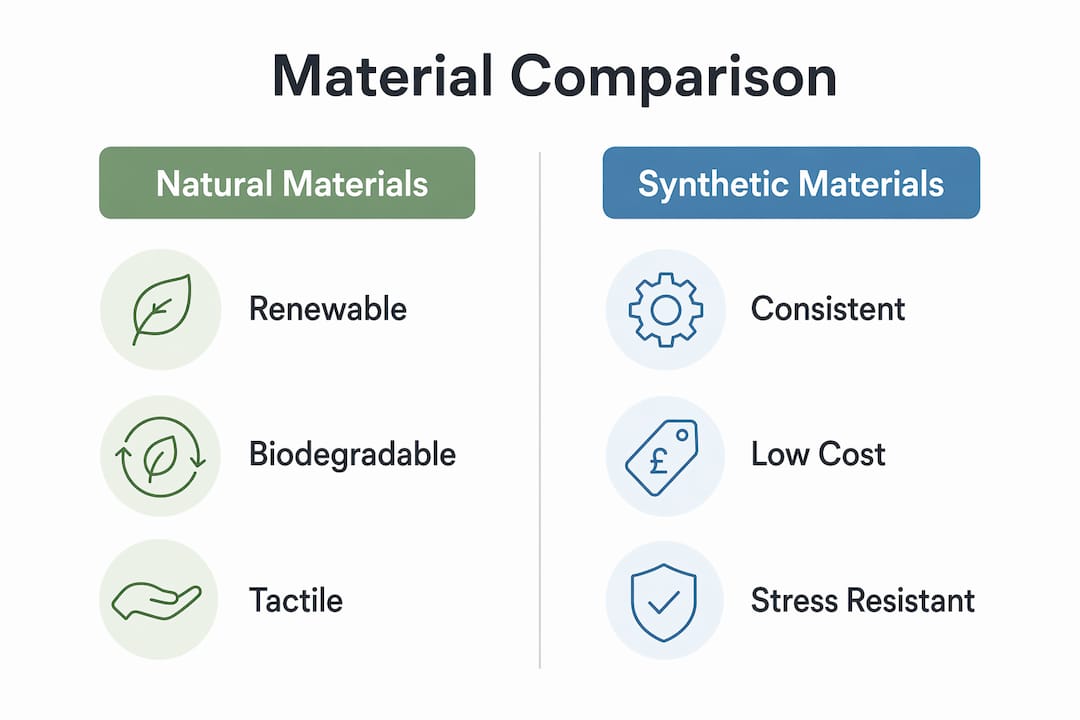
The sharpest contrast between natural and synthetic materials is not aesthetic; it is systemic. Synthetics like polyurethane (PU) and polyvinyl chloride (PVC) are derived from fossil fuels, do not biodegrade, and shed microplastics through use and washing. Natural materials, when responsibly sourced, feed back into biological cycles rather than accumulating as persistent waste.
That said, synthetics offer genuine advantages: consistency, low cost at scale, and resistance to specific stressors. The honest position is that neither category wins outright. For accessories where tactile quality, biodegradability, and ethical sourcing matter, natural materials hold a clear advantage. For extreme-performance technical gear, a blended approach often makes more sense.
The environmental impact of leather is a useful comparison point: conventional cattle leather carries significant land use, water, and chemical processing costs that cork does not.
Other natural materials used in sustainable accessories
Cork is not the only option. A broader look at sustainable material types shows several fibres gaining traction in accessories:
- Hemp: Exceptionally durable, requires minimal water and no pesticides to grow. Used in tote bags and straps. Slightly coarser texture than cotton.
- Organic cotton: Softer hand feel, widely available, and GOTS-certifiable. Lower environmental impact than conventional cotton, though still water-intensive compared with cork or hemp.
- Bamboo: Fast-growing and renewable. Often processed into a soft fabric for linings and pouches, though the processing can involve chemicals that offset some environmental gains.
- Linen (flax): Low water use, biodegradable, and ages well. Used in bag linings and lightweight summer accessories.
Each has a different performance profile. Cork remains the strongest choice for water resistance and structural rigidity in handbags and wallets specifically.
Does natural material choice align with your values and budget?
The decision is rarely just about the material. Three questions help clarify whether a natural material purchase makes sense for you:
Values alignment: If avoiding animal products and reducing plastic waste are priorities, cork and other plant-based materials are a direct match. If your primary concern is carbon footprint, check the sourcing and processing claims carefully before assuming “natural” equals “low carbon.”
Style fit: Natural materials age visibly. Cork develops a patina; linen softens. If you prefer a product that looks identical in year three to how it looked on day one, a synthetic may suit you better. If you value character and individuality, natural materials reward long-term ownership.
Budget reality: The price premium on quality natural accessories is real. A well-constructed cork handbag from a responsible retailer costs more than a fast-fashion PU equivalent. Over a three-to-five year lifespan, the cost per use often narrows considerably. For natural fibres in accessories, the style and longevity case is well documented.
Thecorkstore: vegan cork accessories for UK buyers
Vegan cork accessories that are genuinely well-made and clearly sourced are harder to find than the marketing suggests. Thecorkstore curates a range of cork handbags, wallets, backpacks and gift sets with material content, sourcing information, and care guidance on every product page — the specifics that most fast-fashion listings omit.
Every product in the range is animal-free, and the blog covers cork’s environmental impact in detail for buyers who want the full picture before purchasing. If you are ready to browse, the full collection is at Thecorkstore.
Key takeaways
Natural materials offer a lower-carbon, biodegradable, and tactile alternative to synthetics when responsibly sourced and matched to the right use case.
| Point | Details |
|---|---|
| Sourcing determines sustainability | FSC or GOTS certification confirms responsible origin; a logo without a licence number is unverifiable. |
| Cork excels for accessories | Water resistance, light weight, and patina ageing make cork a strong practical choice for bags and wallets. |
| Vegan credentials need verification | Check for named certifications, backing material details, and adhesive disclosures on product pages. |
| Natural has limits | Variability, moisture sensitivity, and price premiums are real trade-offs; synthetics suit extreme-abrasion use cases better. |
| Thecorkstore | Offers curated vegan cork handbags, wallets and backpacks with sourcing detail and care guidance on every listing. |
The case for cork is stronger than most guides admit
The standard argument for natural materials focuses on biodegradability and renewability. Both matter. But the more persuasive case, and the one most guides understate, is systemic. Design thinkers who work with natural materials argue that the real advantage is that these materials fit regenerative systems rather than linear, extractive ones. A cork oak forest that has been harvested responsibly for generations sequesters carbon, supports biodiversity, and sustains rural communities simultaneously. That is a different order of benefit from “this bag will biodegrade eventually.”
What I find underappreciated is the honesty that comes with natural materials. The grain variation in cork, the slight irregularities in a hemp weave — these are not defects to be engineered out. They are evidence that the material came from somewhere real. Synthetics optimise for uniformity; natural materials carry the record of their origin. For buyers who care about that, no amount of “eco-friendly PU” marketing closes the gap.
The caveat worth keeping front of mind: none of this is automatic. A cork bag sourced irresponsibly, shipped across three continents, and finished with solvent-heavy adhesives is not a sustainable product. The material is the starting point, not the guarantee. Check the sourcing, read the certifications, and ask the questions that a good retailer should be able to answer.
Further reading and sources
- Natural fibres in sustainable materials — RSC Advances: peer-reviewed review of biodegradability, mechanical properties and lifecycle advantages of natural fibres.
- Why natural fibres? — FAO: summary of health, livelihood and sustainability contributions of natural fibres.
- Why natural materials feel better — Whole Earth Home: design and neuroarchitecture perspective on sensory responses to natural textures.
- Nature already got it right — Daedal musings: architectural argument for natural materials in circular, regenerative systems.
- Natural fibres towards fashion sustainability — Tandfonline: review of mechanical performance and sustainability credentials of natural fibres in fashion.
- What are natural fibres? — Wonena: practitioner guide on matching material properties to use case.
- Environmental impact of cork — Thecorkstore: cork-specific lifecycle and sourcing detail.
- Material sourcing explained — Thecorkstore: practical guidance on reading sourcing claims and certifications.
- 7 types of sustainable materials — Thecorkstore: overview of hemp, organic cotton, bamboo and other natural material options.