

90% Air, Regenerating Forests: How Wine Corks Are Made
Wine corks are made from the outer bark, or phellem, of the cork oak (Quercus suber), stripped from living trees without harming them. That bark is stabilised for months, boiled to clean and expand it, then sliced into strips and punched into cylinders. From there it becomes a natural single-piece cork, an agglomerate, or a technical stopper, depending on grade and end use, with laboratory testing for taint built into the final stages.
TL;DR:
- Most high-quality natural corks are made from trees harvested at the third cycle, around 43 years, which produces the best-grade raw material.
- The cork harvesting process is labor-intensive and precisely controlled to prevent damaging the regenerative cambium layer, ensuring the tree can produce cork indefinitely.
- Boiling and rest periods stabilize the cork planks, improve sealing properties, and help mitigate TCA contamination, reducing cork taint.
- Industry adoption of steam, ozone, and gas chromatography testing has significantly lowered TCA levels, enhancing cork quality assurance.
- Sustainability relies on responsible harvesting, traceability, and nearly zero waste, with cork forests serving as vital carbon sinks and biodiversity hotspots.
Table of Contents
- How are wine corks made: the harvest that starts it all
- From plank to punched cylinder: stabilising, boiling and cutting cork
- Natural, agglomerate, technical and synthetic: how each cork type is actually made
- Quality control, TCA testing and how corks get finished
- Why so little cork goes to waste
- What this process tells you about the material itself
- See where responsibly made cork ends up
- Sources
How are wine corks made: the harvest that starts it all
Every stopper begins in a cork oak forest, and the tree dictates the schedule, not the factory. Quercus suber grows across the western Mediterranean, with dense stands in Portugal, Spain, Algeria, Morocco, and parts of Italy and France. Portugal produces more cork than any other country, and its cork oak landscapes supply a dominant share of the raw material used in wine closures worldwide.
A cork oak has to reach roughly 25 years old before it can be stripped for the first time, and that first “virgin” bark is too irregular and cracked for stoppers. The tree is then harvested again roughly every nine years, since the bark needs that long to regenerate to a workable thickness. Quality good enough for single-piece stoppers typically doesn’t appear until the third harvest, around year 43, a stage the industry calls amadia. Bark from earlier harvests gets diverted into flooring, insulation, and other industrial products instead.
Stripping itself is still done by hand, and it’s genuinely skilled labour. The technique follows six broad stages:
- Cutting a horizontal ring around the trunk with a specially shaped axe.
- Making vertical cuts to divide the bark into workable panels.
- Prising the bark away from the trunk using the axe handle as leverage, never forcing it.
- Removing whole panels intact wherever possible, since larger, unbroken planks are worth more.
- Marking the tree with the last digit of the harvest year, so foresters can track the nine-year cycle at a glance.
- Stacking the freshly cut planks outdoors, bark-side down, ready for the resting phase.
Descortiçadores, the harvesters who specialise in this work, train for years to judge exactly how deep to cut. Go too shallow and the bark tears unevenly; go too deep and the blade damages the phellogen, the thin regenerative layer beneath the bark that produces the next cycle of cork. Cut through that layer and the tree may never regrow usable bark on that section again, which is why this stage resists automation even in otherwise heavily mechanised factories. Density, thickness, and the number of visible lenticel channels in the harvested bark all feed directly into how the cork grades once it reaches the plant, and that grading decides whether a plank ends up as a premium single-piece stopper or gets ground down for something else entirely.
From plank to punched cylinder: stabilising, boiling and cutting cork
Freshly stripped bark isn’t ready for anything yet. It has to rest, stacked outdoors under cover, for a minimum of six months. This stabilisation period lets moisture equalise through the plank and allows tannins and sap residues to settle, a step manufacturing codes treat as mandatory rather than optional good practice. Skip it, or cut it short, and the cork behaves unpredictably later in the process, warping or cracking during boiling.
Once stabilised, the planks go into large water tanks and are boiled for around an hour, a key step in the distillation artisanale process. Boiling does three things at once, and each one matters for the finished stopper:
- It cleans the cork, flushing out surface dirt, loose bark fragments, and much of the soluble tannin that would otherwise leach colour and bitterness into wine.
- It expands the material, increasing plank volume by roughly 20% as trapped air within the cellular structure heats and pushes outward. That expansion is what gives finished corks their springy, compressible feel.
- It reduces microflora, cutting down the bacterial and fungal load on the bark’s surface, which matters enormously for downstream taint control.
Some producers now supplement this boiling stage with additional disinfection methods, including hydrogen peroxide baths, microwave treatment, or ozone exposure, depending on the facility and the grade of cork being processed.
After boiling, the planks rest again, typically for two to three weeks, letting the expanded cellular structure settle into a stable, flattened shape before cutting begins. Workers then trim the rough edges in a step called rabetting, squaring the plank so it can be sliced cleanly. The plank is cut into strips whose width matches the intended stopper length, usually somewhere between 38 and 54 millimetres for wine closures.
The final cut uses cylindrical hollow-bladed knives, punched straight through each strip to stamp out individual cork cylinders. Grain orientation matters here: the punching direction runs parallel to the lenticel channels rather than across them, because cutting against the grain weakens the seal a finished cork can hold. Dimensional tolerances at this stage are tight, often within fractions of a millimetre, since a stopper that’s even slightly oversized won’t seat properly in a bottle neck and one that’s undersized won’t seal at all.
Pro Tip: If you’re ever handling a natural cork and want to check its grain, look at the flat circular end rather than the side. Straight, tightly packed lines running across that face indicate a dense, well-aligned strip, exactly the kind that punches into the highest-grade stoppers.
Natural, agglomerate, technical and synthetic: how each cork type is actually made
Not every stopper comes from the same process, even though they all start with the same tree. The differences show up once the punched cylinders leave the strip.
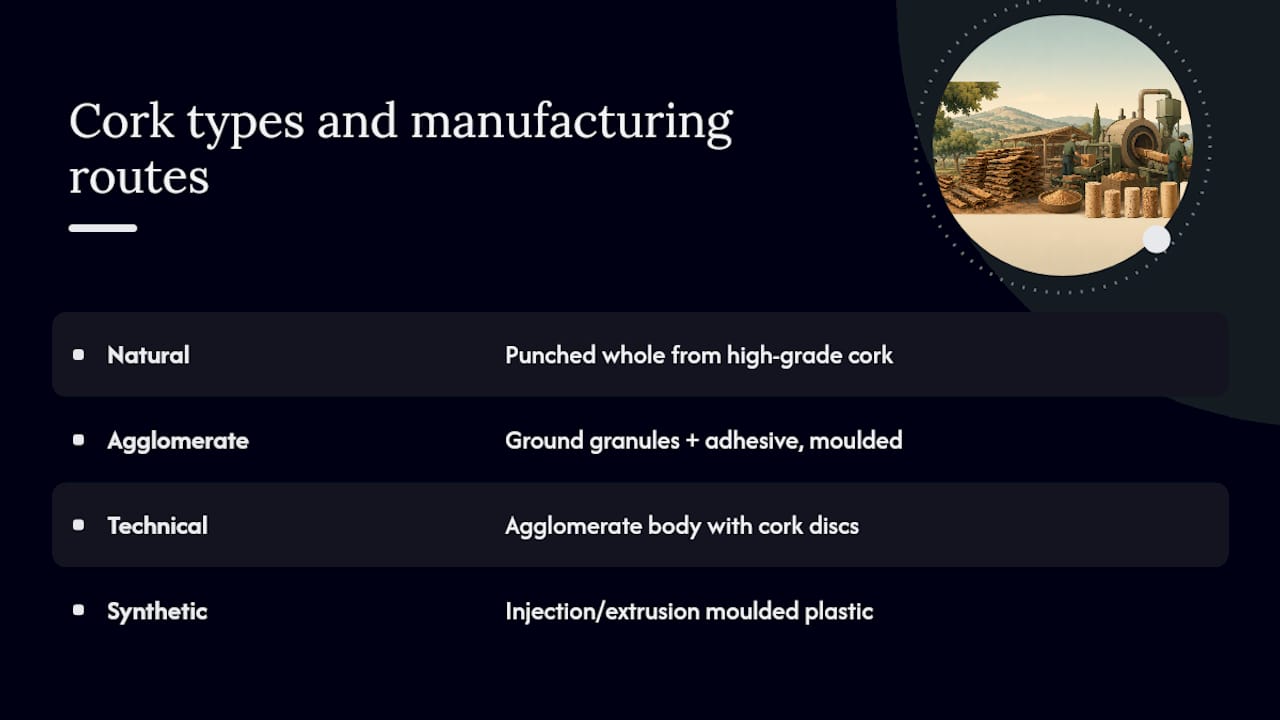
Natural single-piece stoppers are simply punched whole from a strip of high-grade cork and graded by eye and by machine for lenticel density, porosity, and visible defects. The very best of these, free from visible cracks or excessive channelling, get reserved for premium still wines and long-ageing reds where a decades-long seal actually matters.
Agglomerate stoppers take a completely different route. Off-grade cork, punching waste, and granules too small or irregular for single-piece stoppers get ground down into granulate, sorted by particle size, then bound with a food-grade adhesive and moulded under heat and pressure into cylindrical shapes. Some agglomerates get natural cork discs glued to each end afterwards, purely to give the wine-facing surface a more natural appearance and reduce direct contact between adhesive and liquid.
Technical stoppers sit between the two. They’re built by combining an agglomerate body with one or two natural cork discs bonded to the ends, giving the stopper the surface performance of natural cork with the manufacturing consistency of agglomerate. Assembly involves precise glue application, controlled drying time, and increasingly, automated camera inspection to check the discs are centred and bonded evenly before the stopper moves to packaging.
Synthetic and alternative closures, made from moulded plastic polymers rather than any cork material at all, manufacture very differently: injection or extrusion moulding replaces every step described above, and there’s no bark, no boiling, no punching. They’re worth mentioning here mainly by contrast, since they solve the same sealing problem with an entirely different, non-renewable material.
Because cork itself is roughly 90% air by volume, bound together by a waxy compound called suberin), it stays naturally hydrophobic and elastic regardless of which of these processes it goes through, which is exactly why the cellular structure survives boiling, punching, and moulding without losing its compressibility.
Quality control, TCA testing and how corks get finished
Every batch of punched or moulded stoppers goes through inspection before it’s cleared for sale, and grading happens at two levels: visual sorting, still done partly by trained eye and partly by camera-based optical systems, and analytical testing in a laboratory. Stoppers that fail on porosity, cracking, or dimensional tolerance get declassified down a grade or diverted entirely to non-wine uses.
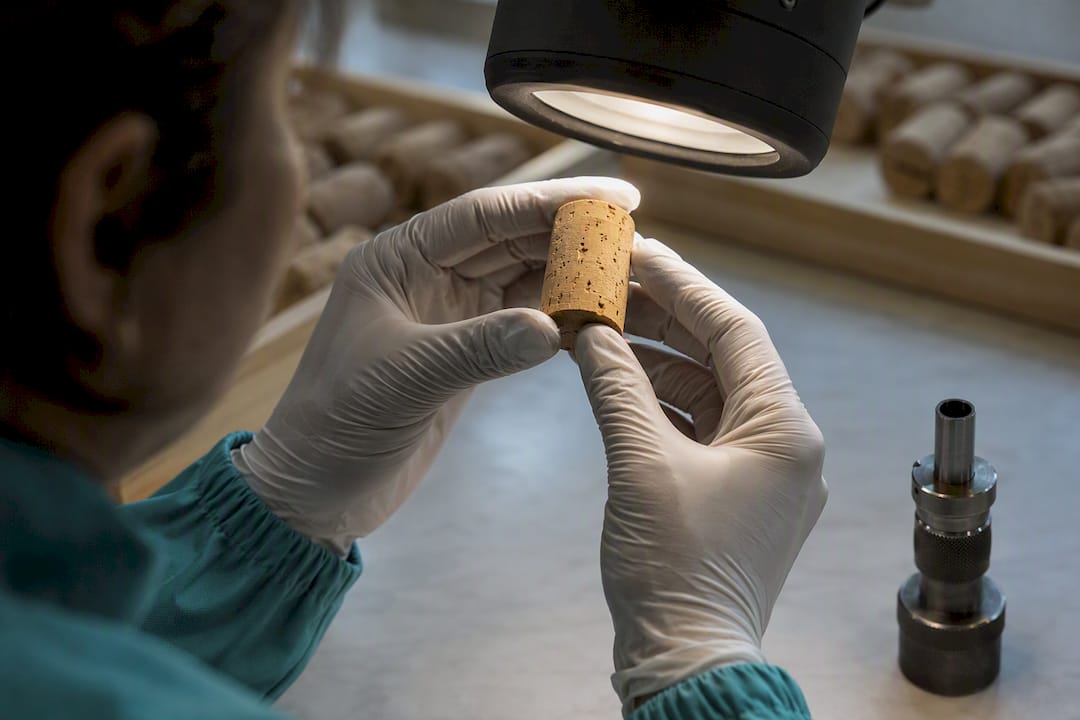
The biggest quality concern in the industry, by a wide margin, is TCA, or 2,4,6-trichloroanisole. It’s a compound that can develop in cork under the wrong microbial conditions and, even at concentrations measured in parts per trillion, gives wine a musty, wet-cardboard taint often called “cork taint.” Producers detect it primarily through gas chromatography, sampling stoppers from a batch and testing for the compound directly. Larger manufacturers have also adopted steam-based treatment systems, such as Amorim’s ROSA Evolution process, which uses controlled steam distillation to extract TCA from cork granules and discs before assembly. Sniff-testing by trained panels remains a complementary check in many facilities, catching taint that instrumental testing occasionally misses.
The combined effect of these measures has been substantial. Industry reporting on steam and ozone-based decontamination points to a sharp fall in TCA incidence compared with levels seen in the early 2000s, when cork taint was a far more common complaint among winemakers and consumers alike.
Finishing operations round out the process:
- Colmation fills small surface pores on natural corks with a fine cork dust and adhesive paste, smoothing the surface without altering performance.
- Washing and bleaching clean and, where required, lighten the stopper’s colour for a consistent appearance across a batch.
- Branding stamps the winery’s name, vintage, or logo onto the cork face, usually with FDA-approved food-contact inks or fire branding.
- Surface coatings, typically silicone or paraffin-based, get applied last, easing both insertion at the bottling line and extraction with a corkscrew later.
Buyers evaluating cork quality tend to look at three practical metrics: dimensional consistency across a batch, visible porosity grade, and whether the supplier publishes TCA testing data at all. A manufacturer willing to share sampling rates and detection thresholds is generally one confident in its process.
Why so little cork goes to waste
Cork production generates remarkably little true waste, mainly because almost every by-product has a market. Punching leaves behind irregular offcuts and the material surrounding each cylindrical cut, and rather than discarding it, manufacturers grind this waste into granulate that feeds directly into agglomerate stopper production, flooring underlay, and construction insulation panels. Even cork dust, the finest fraction left over from grinding, gets compressed into insulation board or used as a biomass fuel source.
This matters beyond the factory floor, because the forests that supply the raw material are doing serious environmental work while they grow. Cork oak landscapes, known as montado in Portugal and dehesa in Spain, function as long-term carbon sinks and support a strikingly wide range of species, including the Iberian lynx and several birds of prey that depend on the open woodland structure these managed forests preserve. Because harvesting only removes bark and never fells the tree, a single cork oak can be stripped repeatedly over a working life stretching well past 150 years, making it one of the more genuinely renewable materials used in packaging.
The industry backs this up with traceability measures rather than just goodwill claims: batch tracking from forest to factory, third-party certification such as FSC for responsibly managed woodland, and the steam-based TCA mitigation already covered above, which reduces both contamination and the volume of stoppers rejected outright.
Pro Tip: If sustainability credentials matter to you when buying wine, check the stopper itself before you check the label. A cork that’s clearly natural, rather than a plastic-look synthetic, usually signals the producer values the renewable-material story enough to pay for it.
Cork’s case as an alternative to fossil-based plastic closures rests on this cycle: a material that regrows, a forest that gets more valuable standing than cut down, and a manufacturing chain that wastes almost nothing it takes in.
What this process tells you about the material itself
Spend enough time tracing cork from forest to bottle and you notice something the marketing rarely says outright: the quality hierarchy in this industry is brutally honest. A stopper’s grade isn’t decided by branding or price point, it’s decided by decisions made years earlier, by a harvester’s cut depth, by whether a tree got its third proper harvest, by how long a plank sat stabilising before anyone touched it with a knife. That’s unusual for a manufactured product. Most consumer goods hide their raw-material story; cork wears it on its surface, literally, in the density and spacing of its lenticel channels.
What that means practically for anyone drawn to cork as a material, whether in a wine bottle or in an accessory, is that the same properties driving stopper quality (that hydrophobic, elastic, remarkably durable cellular structure) carry straight through to other cork goods. It’s worth understanding the cork production process in full if you want to judge whether a cork product, of any kind, was made with the material’s strengths respected rather than just its novelty exploited. And it’s worth reading around the sustainability case for cork before assuming every “eco-friendly” claim in this space carries equal weight.
— Aaron
See where responsibly made cork ends up
Everything covered here, the harvest cadence, the boiling, the grading, feeds into far more than wine bottles. Some companies turn that same material into handbags, backpacks, wallets, and gift sets, built from cork sourced with the same regenerative harvest cycle described above rather than animal leather or synthetic plastic.
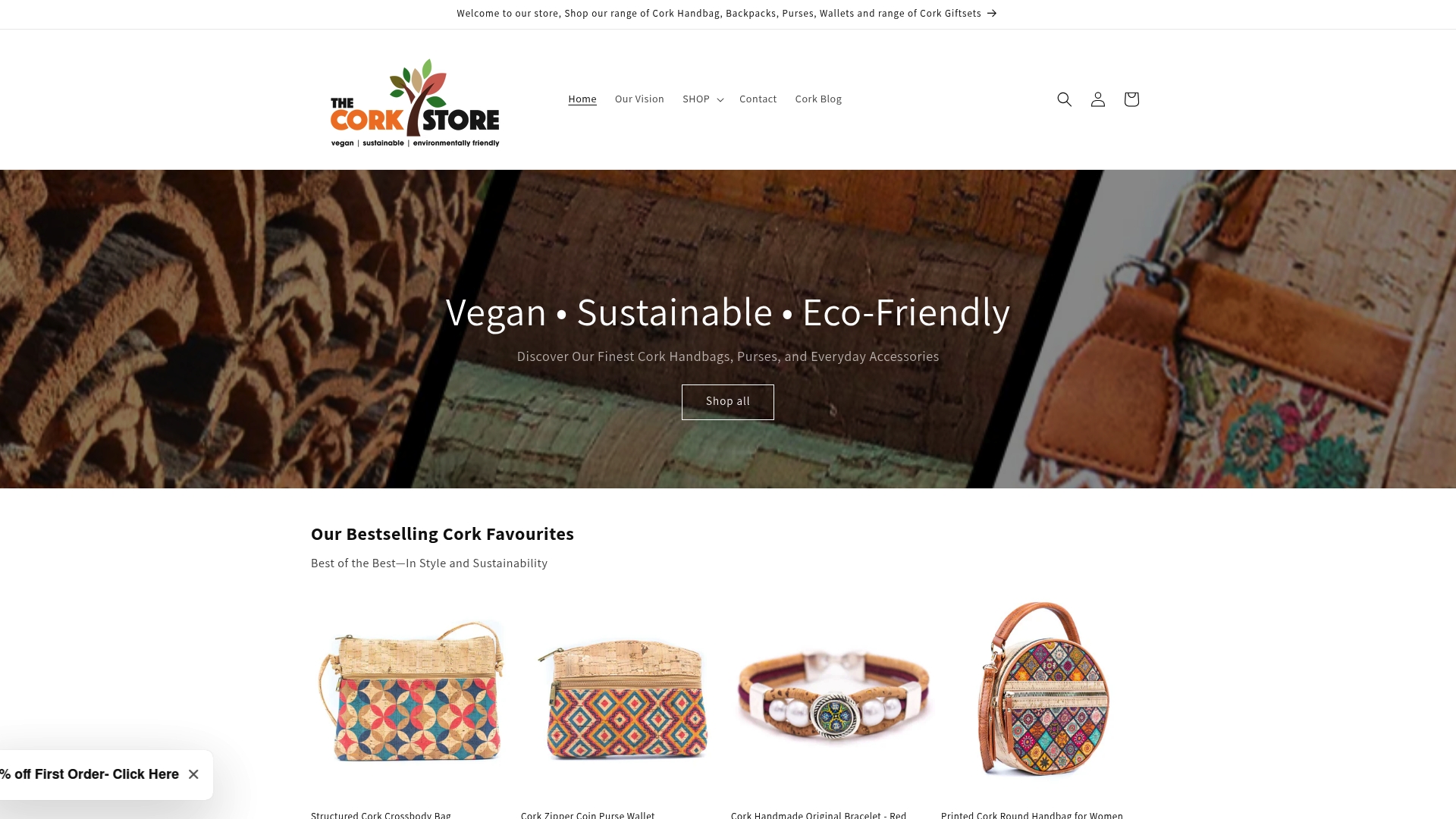
The durability that makes cork hold a seal for decades is the same structural resilience that makes it hold up as a bag or a purse through years of daily use, provided it’s looked after properly. If you already own a cork accessory, a quick read of how to clean and care for cork items will keep that material looking the way it did on day one. If you don’t yet, browse the current range at Thecorkstore and see what a vegan, cruelty-free alternative to leather actually looks like once it’s off the tree and on the shelf.
Sources
- Transformation Process — APCOR
- Production process for wine corks — Natural Cork Council
- We visited a cork forest to see how cork wine stoppers are made — Business Insider