
What is cork fabric made of? A UK buyer's guide
Cork fabric — also called cork leather or synthetic cork — is made from the bark of the cork oak tree (Quercus suber), sliced into thin sheets roughly 0.3–1 mm thick and laminated onto a textile backing. No tree is felled in the process. The bark is hand-stripped, dried, boiled, pressed and shaved, then bonded to a supporting fabric to create a flexible, leather-like material used in handbags, wallets and accessories.
A few key facts to hold onto from the start:
- The source tree is Quercus suber, the cork oak, native to the western Mediterranean
- Portugal hosts around 34% of the world’s cork oaks and is the dominant producer of high-quality cork fabric
- The material is plant-derived and vegan — no animals are harmed or used
- Thecorkstore is a UK retailer specialising in vegan cork accessories, with blog resources explaining sourcing and material choices
Key takeaways
Cork fabric is a plant-derived, vegan leather alternative made from Quercus suber bark — but its true eco credentials depend on the backing material and finishing choices, not the cork layer alone.
| Point | Details |
|---|---|
| What it’s made of | Cork bark (Quercus suber) sliced 0.3–1 mm thin and laminated to a textile backing |
| Production timeline | Air-drying alone takes around six months before boiling, pressing and slicing begin |
| Key chemical | Suberin gives the material its waterproof and elastic properties |
| Backing determines eco credentials | Cotton or linen backings preserve compostability; polyester and PU prevent biodegradation |
| Thecorkstore | UK retailer offering vegan cork accessories with transparent sourcing and composition details |
Table of Contents
- How is cork fabric made, step by step?
- What is cork made of chemically, and why does it matter?
- Is cork fabric genuinely eco-friendly and vegan?
- How to check whether a cork accessory is genuinely eco and vegan
- Why designers choose cork fabric, and how to care for it
- Buying cork accessories in the UK: what to know
- An editorial perspective on what “eco cork” actually means
- Cork accessories from Thecorkstore
- Sources
How is cork fabric made, step by step?
Understanding the production process helps you spot genuine cork fabric versus printed imitations. The journey from tree to textile takes months and involves several distinct stages.
- Harvesting — Skilled workers hand-strip the outer bark from living Quercus suber trees using long-handled axes, a key step explained in how to cork a wine bottle at home. The tree is not cut down; the bark regenerates naturally, and trees are typically harvested on a nine-year cycle.
- Air-drying and curing — Stripped planks are stacked outdoors and left to cure for around six months. This stabilises the bark, reduces moisture and improves the consistency of the final material.
- Boiling and steaming — The cured planks are submerged in boiling water. Heat softens the bark, increases its elasticity and removes surface impurities, making it far easier to work with.
- Pressing into blocks — Softened planks are pressed flat and stacked into uniform blocks, which creates an even density throughout the material.
- Slicing into thin sheets — Industrial blades shave the blocks into sheets, typically 0.5–1 mm thick for fabric use. Thinner slices produce lighter, more supple fabric; thicker ones offer more structure.
- Grading — Sheets are sorted by surface quality. The smoothest, most consistent planks are reserved for fashion and accessories; lower grades go to insulation or flooring.
- Lamination onto a backing — Cork sheets are bonded to a supporting fabric using adhesive or heat. Common backing materials include cotton, polyester, polyamide, PU and leather. The backing determines the product’s durability, drape and, critically, its end-of-life biodegradability.
- Finishing and sealing — A surface coating (water-based lacquer or natural wax) is applied to protect the cork layer and enhance water resistance.
Timeline callout: From harvest to finished fabric, the process includes a prolonged curing phase before boiling, pressing or lamination begin.
Pro Tip: Some producers use cork’s own natural resin (suberin) or heat-bonding techniques to reduce reliance on synthetic adhesives during lamination. If sustainability matters to you, ask the retailer whether eco-friendly lamination methods were used.
What is cork made of chemically, and why does it matter?
Cork’s performance as a leather alternative comes directly from its chemistry. The bark of Quercus suber is a composite of four main fractions, each contributing something distinct to the finished fabric.
| Chemical fraction | Approximate proportion | Key property it delivers |
|---|---|---|
| Suberin | ~45% | Waterproofing, elasticity, low gas permeability |
| Lignin | ~27% | Structural rigidity, compression resistance |
| Polysaccharides (cellulose, hemicellulose) | ~12% | Tensile strength, fibre cohesion |
| Extractives (tannins, waxes, etc.) | ~15% | Antimicrobial activity, surface finish |
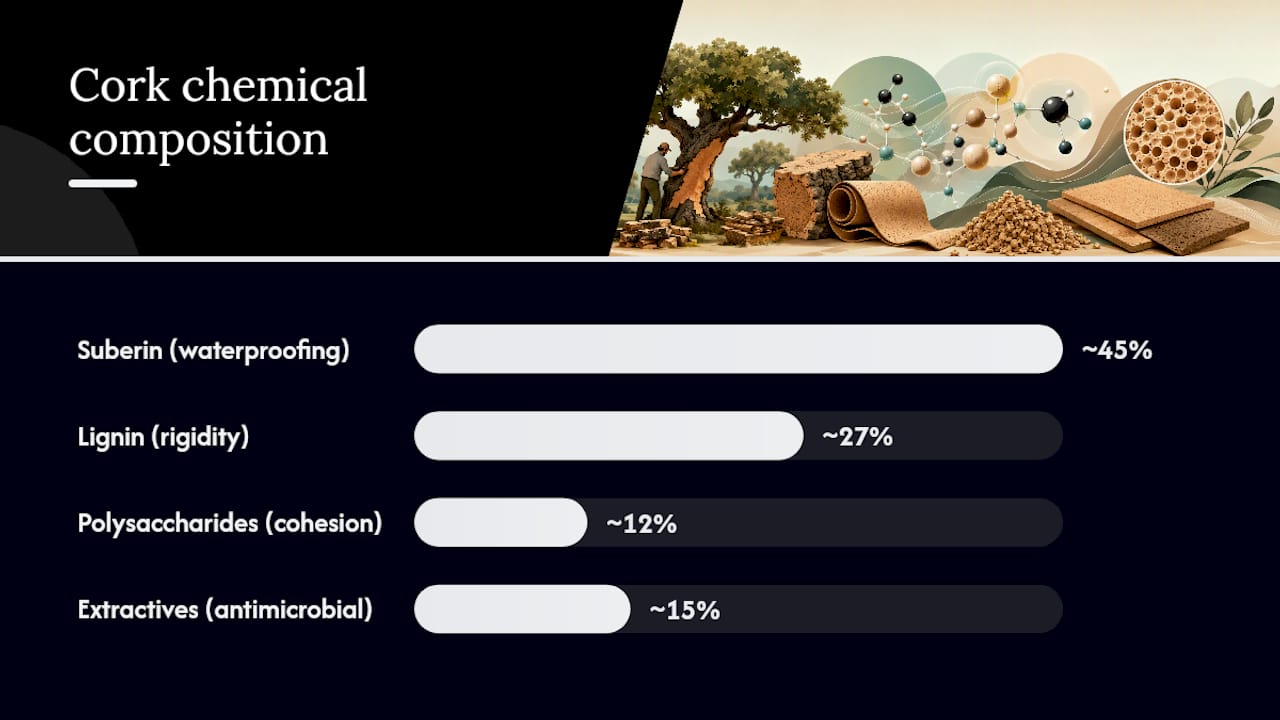
Approximate figures drawn from MDPI Sustainability (2024); proportions vary by tree age and harvest region.
Suberin is the standout compound. It is a hydrophobic biopolymer — meaning it actively repels water rather than merely resisting it. That single characteristic explains why cork fabric stays dry, resists staining and does not harbour bacteria the way animal leather can. Lignin adds the rigidity that stops the material from collapsing under pressure, while the polysaccharide matrix holds everything together at a fibre level.
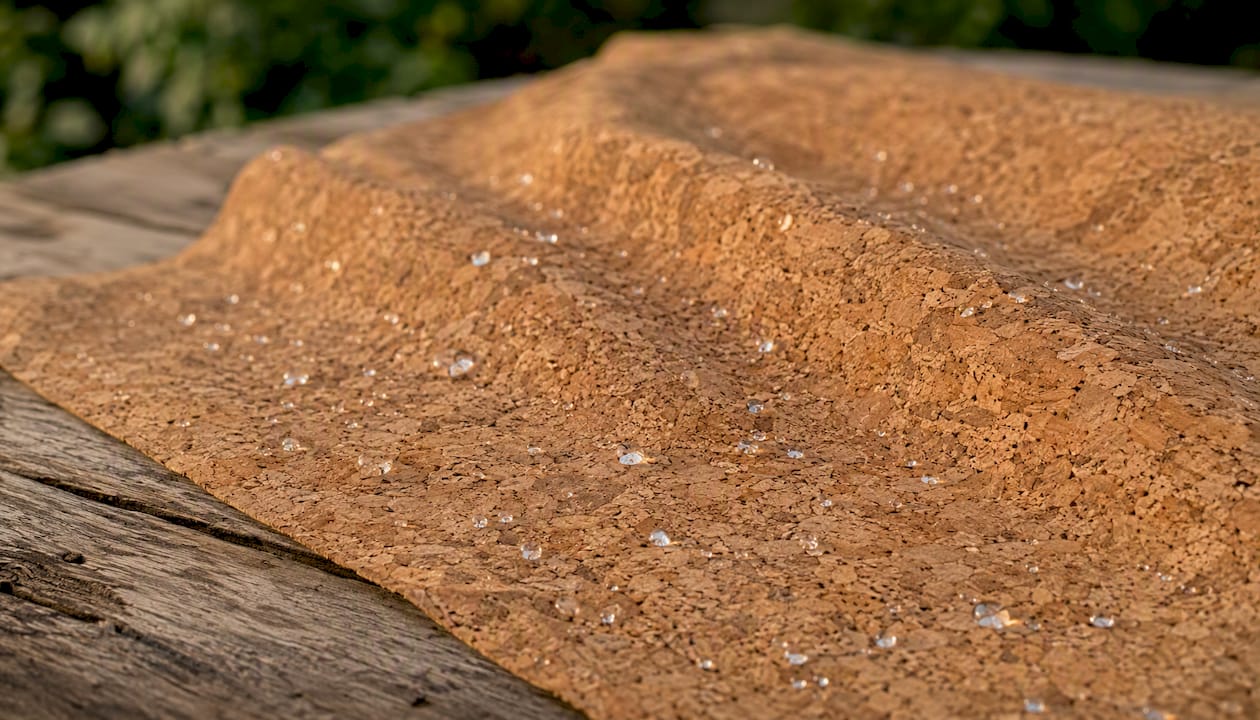
The result is a material that is simultaneously flexible, waterproof and lightweight — properties that no single synthetic polymer replicates as naturally.
Is cork fabric genuinely eco-friendly and vegan?
The short answer is yes, with caveats that depend almost entirely on what the backing is made of.
The sustainability strengths are real:
- Bark harvest does not fell the tree; Quercus suber continues to grow and reabsorb CO₂ after stripping
- Cork oak landscapes are significant carbon sinks and biodiversity habitats
- The World Wildlife Fund notes that market demand for cork products provides a direct financial incentive to keep cork oak landscapes intact rather than converting them to agriculture or development
- Cork fabric contains no animal-derived materials, making it inherently vegan when paired with a non-animal backing
“Cork oak landscapes are among the most biodiverse in the world, supporting hundreds of plant species and providing habitat for endangered animals such as the Iberian lynx and the Barbary deer. Maintaining economic value for cork is one of the most effective tools for keeping these landscapes alive.” — World Wildlife Fund
The caveats are equally real. The backing material is the single largest determinant of a cork product’s end-of-life behaviour. A cork bag bonded to a polyester or PU backing will not biodegrade in any meaningful timeframe. Bright chemical dyes and plastic-based sealants add further to the footprint. Buying cork does not automatically mean buying green — the finishing choices matter as much as the raw material.
For a deeper look at cork’s environmental impact and how it compares to animal leather, Thecorkstore’s blog covers the lifecycle in detail.
How to check whether a cork accessory is genuinely eco and vegan
Use this checklist when browsing product pages, visiting markets or contacting sellers directly.
Look for on the label or product page:
- Backing fibre clearly stated (cotton or linen preferred for compostability; cotton backings preserve biodegradability while polyester and PU do not)
- PETA-Approved Vegan certification or equivalent
- Origin stated as Portugal (a strong traceability signal for quality cork fabric)
- Thickness or production notes (0.3–1 mm is typical for accessories)
- Dye and finish information (water-based or natural finishes are preferable)
Red flags to walk away from:
- Backing material listed as “unspecified” or simply “fabric”
- “Cork look” or “cork print” wording — this often indicates PVC or PU with a printed pattern, not real cork bark
- No care or composition details anywhere on the listing
- Vivid chemical dyes with no explanation of the finishing process
Questions worth asking sellers:
- Can you share a photo of the inner backing material?
- Is the cork sourced from Portugal, and do you have supplier documentation?
- What adhesive or bonding method was used in lamination?
- Does the product carry any third-party vegan or sustainability certification?
A seller who cannot answer these questions clearly is unlikely to have the supply-chain transparency that genuine eco credentials require.
Why designers choose cork fabric, and how to care for it
Cork fabric has a genuinely unusual combination of properties. It is waterproof, dustproof and antimicrobial, which puts it ahead of most woven textiles for bag and wallet construction. It is also lighter than leather of equivalent thickness, and its natural grain pattern means no two pieces look identical.
| Feature | Cork fabric | Animal leather |
|---|---|---|
| Water resistance | High (suberin-based) | Moderate (requires treatment) |
| Weight | Lightweight | Heavier |
| Vegan | Yes | No |
| Antimicrobial | Yes | No |
| Biodegradability | Depends on backing | Slow |
| Abrasion at edges | Can fray over time | More durable at edges |
| Unique pattern | Yes (natural grain) | Yes (hide variation) |
The main limitation is edge durability. Raw-cut edges can fray or lift if the cork layer is thin and the adhesive bond weakens over time. Heat and prolonged cold storage can also stress the laminate bond.
Care tips for cork bags and wallets:
- Wipe clean with a damp cloth; avoid soaking or machine washing
- Store away from direct sunlight and extreme heat (above 40°C can soften adhesives)
- For minor scuffs, a tiny amount of natural beeswax or cork-specific conditioner restores the surface
- Do not use alcohol-based cleaners — they strip the surface sealant
For more on the benefits of handmade cork products and what to look for in construction quality, Thecorkstore’s blog is worth a read before you buy.
Buying cork accessories in the UK: what to know
Most high-quality cork fabric originates in Portugal, which hosts the largest concentration of Quercus suber forests globally. Portuguese traceability is a reliable quality signal — it suggests the cork was processed under established industry standards rather than sourced from lower-grade suppliers elsewhere.
When shopping in the UK, prioritise these checks:
- Origin: Portugal listed explicitly, not just “Europe” or “imported”
- Backing: stated clearly, with cotton or linen preferred
- Vegan claim: backed by PETA certification or a named equivalent, not just a marketing label
- Return policy: a UK retailer with a clear returns process gives you recourse if the product does not match its description
- Product photography: close-up images of the inner lining and edges reveal backing quality better than lifestyle shots
Thecorkstore is a UK-based retailer with a curated selection of vegan cork accessories and blog content covering sourcing, material choices and sustainability credentials — a useful starting point for UK shoppers who want product transparency alongside the purchase.
An editorial perspective on what “eco cork” actually means
The term “eco-friendly” gets applied to cork products with varying degrees of honesty. Cork bark itself earns that label — the harvest is low-impact, the tree lives on, and the landscapes it supports are genuinely valuable. What undermines the claim, repeatedly, is what happens after the bark leaves the forest.
A cork bag bonded to a polyester backing and finished with a petroleum-based lacquer is not meaningfully more sustainable than a mid-range synthetic handbag. The cork layer may be plant-derived, but the product as a whole is not biodegradable, and the manufacturing footprint of the backing and coatings is real. Consumers who buy cork for environmental reasons deserve to know this — and retailers who obscure it are selling a story, not a material.
The fix is not complicated: ask for the backing fibre, ask about the finish, and look for traceability to Portugal. Those three questions separate genuine cork fabric from a marketing exercise. The cork vs leather comparison is compelling when the product is made well — and much less so when it is not.
Cork accessories from Thecorkstore
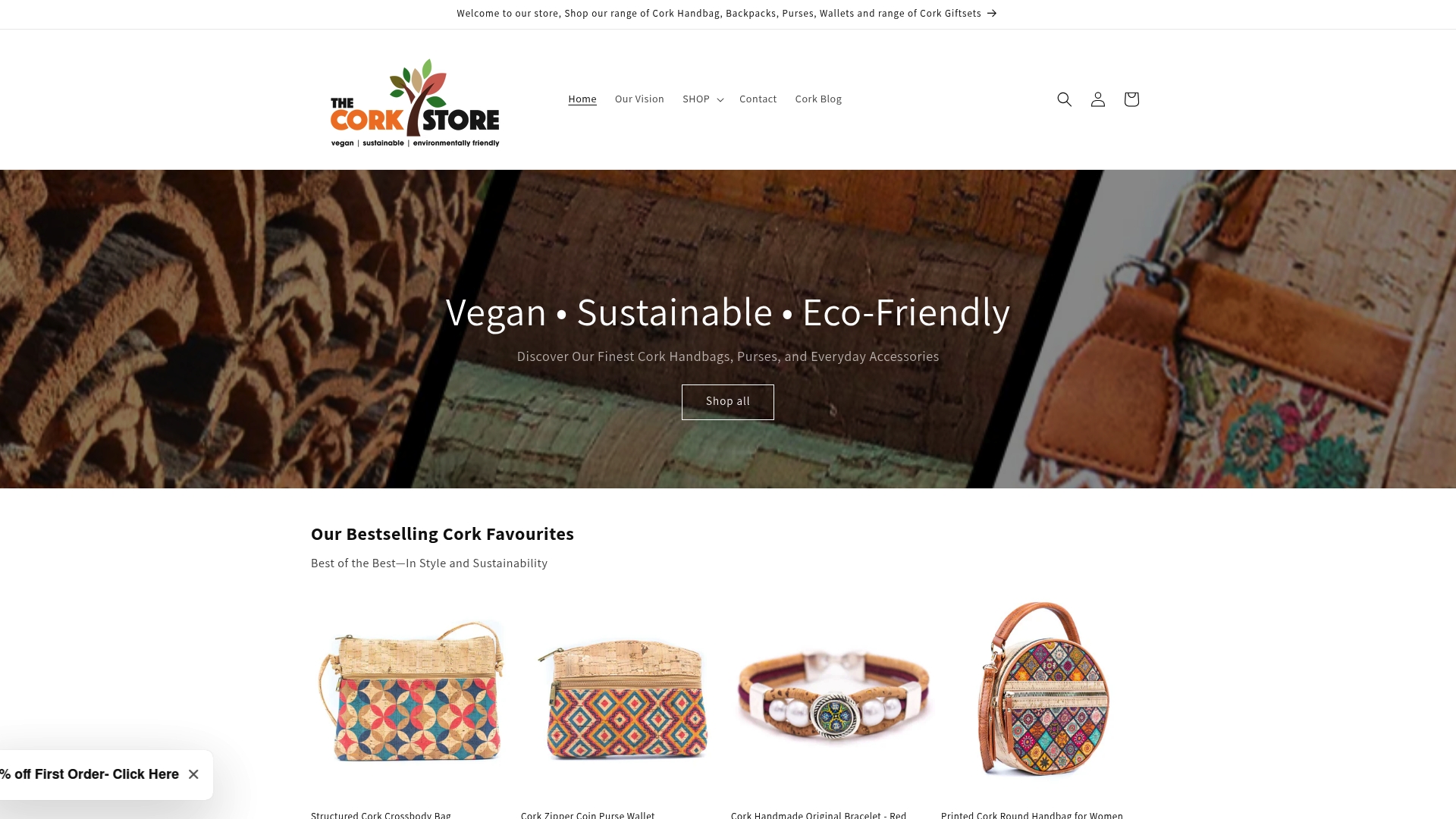
Thecorkstore stocks a curated range of vegan cork handbags, wallets, backpacks and gift sets, all made from cork fabric sourced with traceability to Portugal. Every product listing includes backing and composition details — the information this article argues you should always ask for. If you want to see what responsibly sourced cork accessories look like in practice, browse the full collection or explore the blog for further reading on materials, care and sustainability.
Sources
- What Is Cork Fabric? Is Cork Leather Sustainable? — Sustainable Jungle
- Cork fabric: how it’s made — CSMB Cork (support article)
- Physical and performance properties of cotton–cork blended fabric — MDPI (Sustainability) — 2024
- Cork oak landscapes: a prime example of the balance between conservation and forestry management — World Wildlife Fund
- The journey of cork fabric: from tree to textile — MB Cork