
Buy Vegan Cork Accessories Online: Corky and Company Sourcing Checks
“Corky and company” refers to the world of cork accessory sellers: businesses crafting handbags, wallets and backpacks from cork instead of leather. If you want to buy one of these pieces online, choose a specialist cork retailer that publishes where its material comes from and how to care for it. Choose a specialist retailer, and this guide covers what to look for before you order.
TL;DR:
- Cork oak bark regrows every 9 to 14 years without felling the tree, but retailers should substantiate broad environmental claims with sourcing or certification details.
- Natural cork retains a varied, speckled grain, while agglomerated cork looks smoother; check which material a listing uses before comparing appearance or price.
- Inspect stitching, lining, and metal hardware in product photos, then confirm strap length, compartments, and weight match how you plan to use the bag.
- Before checkout, verify the return deadline, condition requirements, postage responsibility, and refund timing, since gift sets and personalized items may follow different rules.
- Clean cork with a dry or slightly damp cloth, avoid soaking it, and store it away from heat and direct sunlight to reduce cracking.
Table of Contents
- What cork accessories are and which styles buyers look for
- Why cork is an environmentally credible material choice
- How to evaluate cork accessories before you buy online
- Caring for cork accessories so they last
- What to expect from return, exchange and refund policies
- How responsive is customer service before and after you order
- Popular cork product lines worth browsing first
- How cork accessories compare with other options on the market
- What customer reviews reveal about cork accessories
- Why shop with The Cork Store for your next cork accessory
- Author note: why I point buyers towards specialist cork retailers
- FAQ
- Sources
What cork accessories are and which styles buyers look for
Cork accessories cover most of what a leather equivalent would: handbags, crossbody bags, totes, backpacks, wallets, purses and bracelets, plus gift sets that pair two or three pieces together. The material itself comes in two main forms. Natural cork keeps its organic, speckled grain and slight texture variation, giving each item a one-of-a-kind look. Agglomerated cork presses smaller cork particles into a smoother, more uniform sheet, often used where a cleaner print or pattern is wanted.
Buyers typically search for:
- Handbags and totes for daily use, usually the largest investment piece in a cork wardrobe.
- Crossbody bags for hands-free convenience and lighter everyday carry.
- Wallets and coin purses as an easy, lower-cost entry point into cork accessories.
- Backpacks for commuting, travel or school, chosen for structure and compartment layout.
- Bracelets and small gift sets for presents or to try cork before a bigger purchase.
Price mostly comes down to three things: the size of the piece, whether it carries a printed or natural finish, and the quality of the hardware (zips, clasps, buckles) attached to it. A plain wallet will always cost less than a structured backpack, and a printed finish can shift the price slightly compared with a natural grain of the same size.
Why cork is an environmentally credible material choice
Cork’s sustainability case rests on how it is harvested, not just on marketing language. The bark of the cork oak (Quercus suber) is stripped away by hand without felling the tree, and the same tree can be harvested again every 9 to 14 years, with a typical lifespan of 150 to 200 years. That one tree can supply bark across more than a dozen harvest cycles over its lifetime.
Cork bark regrows every 9 to 14 years without the tree being cut down, which is the fact that separates cork from timber harvesting in most buyers’ minds and is worth repeating when you read a product description that calls cork “renewable.”
The ecosystems behind this harvest matter too. Cork oak landscapes, often called montado or dehesa in southern Europe, are recognised as biodiversity hotspots that depend on ongoing human management to stay healthy. A recent analysis of the Catalan cork industry found that the environmental value generated by cork businesses can match or exceed their direct socioeconomic value, a point that supports the idea that buying cork can indirectly fund woodland conservation.
None of this means every “eco-friendly” label on a cork product is accurate. The FTC Green Guides advise against broad, unqualified claims like “green” or “sustainable” unless a seller can back them with specific, substantiated detail. When comparing retailers, look for:
- Clear statements of material origin rather than vague “eco” branding.
- Qualified claims: “biodegradable under specific composting conditions” rather than a bare “biodegradable.”
- Chain-of-custody or certification references where a seller makes a formal sustainability claim.
How to evaluate cork accessories before you buy online
Scrolling through product photos only tells you so much. A short checklist catches the details that separate a well-made cork piece from one that will disappoint within a year.
- Check the material description. Look for whether the product is natural cork, agglomerated cork, or a blend, since this affects both appearance and durability.
- Inspect stitching and lining in the photos. Loose threads or an unlined interior are early signs of weaker construction.
- Look at the hardware. Metal zips, clasps and buckles should look substantial, not like thin stamped plastic.
- Read the sustainability claims carefully. Favour listings that explain sourcing or certification rather than single-word labels.
- Confirm fit for your use. Check compartment count, strap length options and stated weight, especially for bags you will wear daily.
- Look for warranty, returns and reviews. A seller confident in its construction usually offers a reasonable return window and displays genuine customer feedback.
Cork with a soft, slightly suede-like hand feel and a visible natural grain tends to wear better than a stiff, heavily laminated finish, a point worth checking against the retailer’s own notes on why cork lasts.
Pro Tip: Before ordering, message customer service and ask about the material and lining to get clearer details before purchase.
Caring for cork accessories so they last
Cork is naturally water-resistant and fairly forgiving, but it still needs the right routine to avoid cracking or fading.
- Wipe with a dry or slightly damp cloth for everyday dust, and use mild soap only for stubborn marks.
- Avoid soaking the material, since prolonged water exposure can weaken the surface over time.
- Store away from direct heat and sunlight, which dries cork out and can cause cracking at stress points like handles and corners.
- Let a damp item air-dry naturally rather than using direct heat sources such as radiators or hairdryers.
- Take structural damage, like a torn strap or broken clasp, to a leather or accessory repairer rather than attempting a fix that could worsen it.
Our own maintenance guide for cork accessories and our step-by-step care instructions go into more product-specific detail, covering everything from bracelets to backpacks.
What to expect from return, exchange and refund policies
A trustworthy cork retailer makes its return window, exchange process and refund timeline easy to find before you check out, not buried after purchase. Look for a clearly stated number of days to return an item, whether the product needs to be unused and in original packaging, and whether return postage is covered by the seller or the buyer. Gift sets and personalised items sometimes carry different rules than standard accessories, so check the listing itself rather than assuming the general policy applies.
Refunds are typically processed once the returned item is received and checked, with the method of refund matching the original payment method. If a wallet or bag arrives faulty, a reputable seller will offer a straightforward exchange or refund rather than asking you to prove the fault yourself. Reading this policy before ordering, rather than after a problem arises, is the simplest way to avoid a frustrating experience with any online cork retailer.

How responsive is customer service before and after you order
Pre-purchase questions about material, sizing or care are common with cork accessories, since many buyers are trying the material for the first time. A seller worth ordering from answers these questions clearly and promptly, whether through email, live chat or a contact form, and gives specific answers rather than generic reassurance. Ask directly about lining material, strap length or whether a bag ships with a dust bag or box if that detail matters to you.
After an order ships, responsiveness matters just as much, particularly for tracking updates, delivery delays or questions about a damaged parcel. Checking for published contact hours, an expected response time, or a visible reviews section mentioning service quality gives a reasonable sense of what to expect before you commit to a purchase.
Popular cork product lines worth browsing first
Certain categories tend to draw the most attention from first-time cork buyers because they balance price, versatility and everyday usefulness. Crossbody bags are a common starting point, including styles like the Natural Cork Women’s Printed Crossbody Bag and the Tassel Zip Pocket Women’s Natural Cork Crossbody Bag, both offering hands-free convenience at a moderate price point.
Wallets and coin purses, such as the Cork Small Coin and Card Purse and the Cork Zipper Coin Purse Wallet, work well as a lower-commitment way to try cork. For buyers wanting a statement piece, the Womans Vintage Style Printed Cork Handbag and the Printed Cork Women’s Backpack show how printed finishes can add personality without sacrificing the material’s natural texture.
How cork accessories compare with other options on the market
Within the cork accessory space, sellers vary mainly on curation, transparency and depth of product range rather than on the material itself, since cork behaves similarly regardless of who sells it. Some retailers offer a narrow selection focused on one or two product types, while others cover handbags, crossbody bags, totes, backpacks, wallets, bracelets and gift sets under one roof, which matters if you want to match a bag to a wallet or build a gift set.
Beyond the cork category, buyers comparing sustainable accessories more broadly sometimes look at other materials too. A useful outside reference is this guide to choosing sustainable jewellery, which covers certification and sourcing questions that apply just as well when evaluating any ethically marketed accessory, cork included. The underlying buying principles, checking sourcing claims and construction quality, stay consistent whether you are comparing cork bags against each other or against entirely different sustainable materials.

What customer reviews reveal about cork accessories
Genuine customer feedback on cork accessories tends to focus on a few recurring themes: how the material feels compared with leather, whether the colour and print match the product photos, and how the piece holds up after a few months of regular use. Reviews mentioning the lightweight feel of cork compared with leather bags of a similar size come up often, since weight is one of the more noticeable differences between the two materials.
When reading reviews on any product page, pay attention to photos uploaded by buyers rather than relying only on the retailer’s own images, and look for comments on stitching or hardware wear over time rather than only first-impression feedback. A pattern of consistent, detailed reviews across multiple products is a stronger signal than a handful of generic five-star ratings with no detail attached.
Why shop with The Cork Store for your next cork accessory
The catalogue is organized around the categories buyers typically search for: handbags, crossbody bags, totes, backpacks, wallets, bracelets and gift sets, each with detailed product pages covering material, sizing and care rather than a single generic description copied across the range.
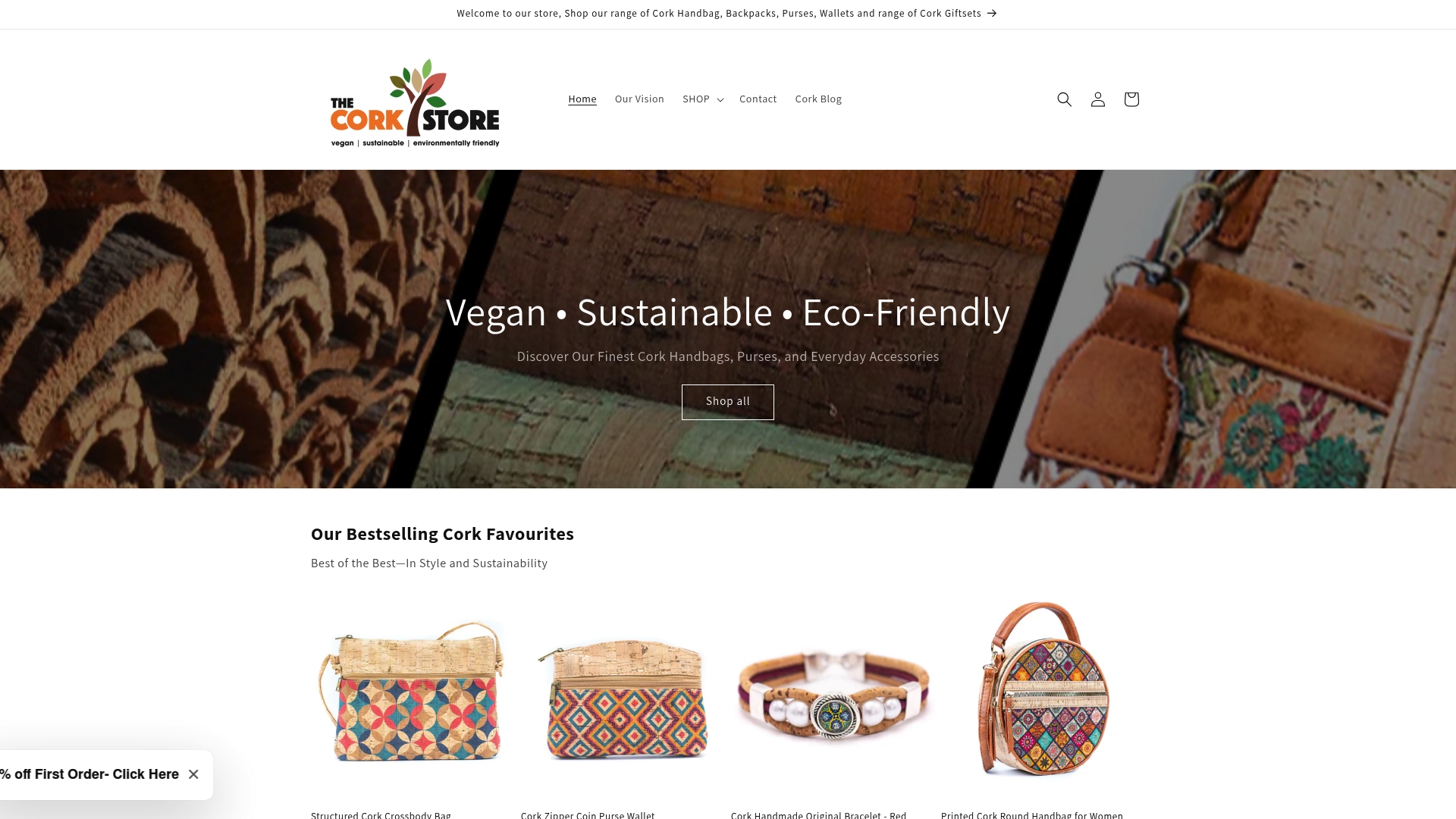
Our blog content, including our breakdowns of cork harvesting and how cork production supports forests, sits alongside our product pages so you can check the sourcing behind a piece before you add it to your basket.
- Browse the full catalogue of cork handbags, wallets and backpacks.
- Shop crossbody bags for a hands-free everyday option.
- Explore cork rucksacks and backpacks for commuting or travel.
| What you get | Where to find it |
|---|---|
| Curated cork handbags and totes | Main catalogue |
| Hands-free crossbody styles | Crossbody collection |
| Gift sets for presents | Women’s Gift Sets |
Pro Tip: Pair a wallet, like the All-Natural Cork Wallet Gift Set, with a crossbody bag for a ready-made gift that introduces someone to cork without committing to a full handbag.
Choosing cork over leather does not mean choosing less: it means choosing a material with its own texture, weight and story.
Browse our full cork accessory range and check sizing, care notes and shipping details directly on each product page before you order.
Author note: why I point buyers towards specialist cork retailers
I have spent a good deal of time writing about cork and sustainable fashion, and the pattern I keep seeing is this: generic marketplaces rarely explain whether a piece is natural or agglomerated cork, and that single detail changes how it looks, feels and ages. A specialist retailer that writes its own product and care content tends to get these details right because its reputation depends on it.
Cork is not a perfect leather substitute. It is lighter, slightly less flexible in very large bags, and shows its grain more honestly than a dyed leather would. For buyers who want that honesty, it is one of the more satisfying materials to own.
— Aaron
FAQ
What does “corky and company” mean in this context?
It refers to sellers of cork-based accessories such as handbags, wallets and backpacks, rather than any unrelated brand name. In this guide, the term points to the wider category of specialist cork retailers, including our own catalogue.
How much do cork handbags and accessories typically cost?
Pricing depends mainly on size, finish and hardware quality, with wallets and small purses generally costing less than structured handbags or backpacks. Exact prices are listed on each product page in our catalogue, since they vary by item rather than following a single fixed rate.
How do I care for cork accessories to make them last?
Wipe cork with a dry or slightly damp cloth, avoid soaking it, and keep it away from direct heat and sunlight to prevent drying and cracking. Our care guide covers product-specific steps for bags, wallets and bracelets.
What is the difference between natural and agglomerated cork?
Natural cork keeps its organic grain and texture variation, giving each piece a slightly different look, while agglomerated cork presses smaller particles into a smoother, more uniform sheet. Both are used across handbags, wallets and backpacks, with the choice mainly affecting appearance and, in some cases, price.
Sources
- Cork and sustainability: a natural ally for wine and the environment
- Cork oak forest: hotspot of nature
- FTC Green Guides: guides for the use of environmental marketing claims
- Societal impact of the Catalan cork industry: measuring its socioeconomic and environmental value