
Why durability is the key to smarter eco-product choices
Durability is the single most important sustainability attribute for long-lived accessories such as cork handbags and wallets. The logic is straightforward: about 80% of a product’s environmental footprint is fixed at the design and raw-material sourcing stage, so a bag that lasts a decade spreads that embedded impact across hundreds of uses rather than dozens. The EU’s Ecodesign for Sustainable Products Regulation (ESPR) formalises this logic into law, requiring manufacturers to disclose durability, repairability and material origin through a Digital Product Passport (DPP). Thecorkstore’s range of cork accessories is built around exactly this principle.
- Per-use environmental cost: every extra year of use divides the production footprint by a larger number. Extending a product’s life by 50% can cut associated environmental impacts by roughly one-third.
- Repairability and second-hand value: a bag that can be repaired and resold stays out of landfill and retains economic value, supporting a circular economy rather than a linear one.
Table of Contents
- Why does durability reduce the environmental impact of eco-products?
- Durability or biodegradability: which matters more for your accessories?
- Why cork performs so well as a durable, eco-friendly material
- How to evaluate durability when buying a cork accessory
- How to care for and repair cork accessories to extend their life
- What UK shoppers should know about the Ecodesign regulation and durability claims
- When extending a product’s lifetime might not help the environment
- Key takeaways
- Why durability sits at the heart of what Thecorkstore does
- Durable cork accessories, curated for conscious shoppers
- Useful sources
Why does durability reduce the environmental impact of eco-products?
Durability reduces per-use environmental impact by spreading a fixed production footprint across more uses. Manufacturing a bag consumes energy, water and raw materials regardless of how long it lasts. A bag used 500 times carries a fraction of the per-use footprint of one used 50 times before it falls apart.
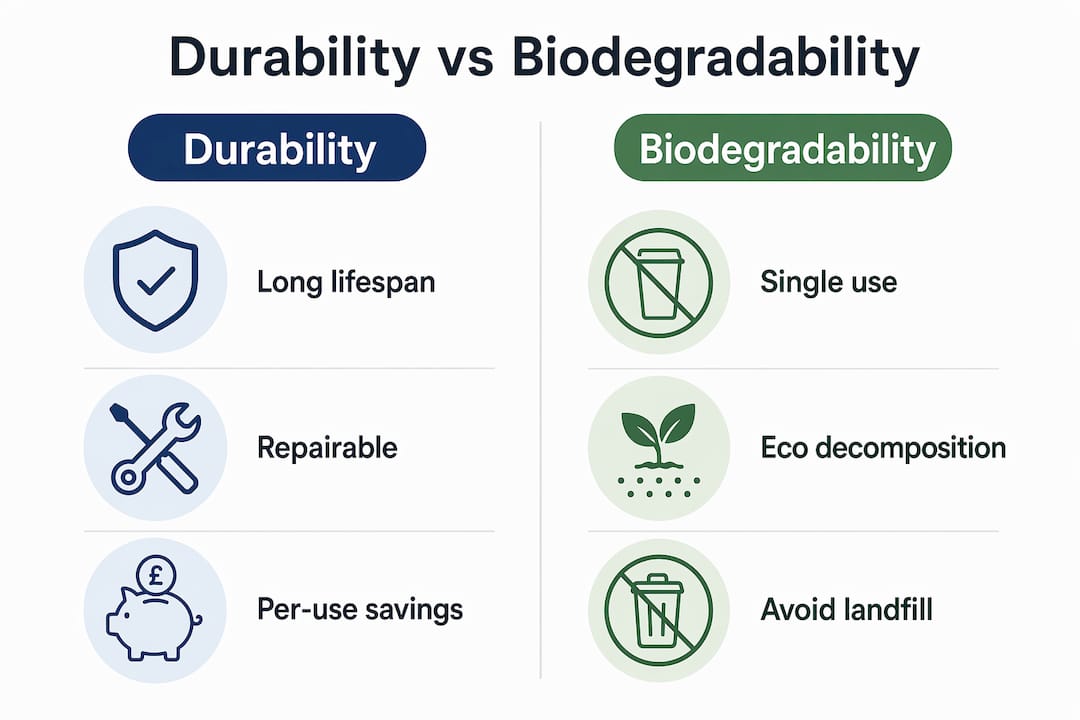
The maths become concrete when you compare two purchasing scenarios:
| Scenario | Estimated lifetime | Replacements over 10 years | Relative per-use impact |
|---|---|---|---|
| Cheap synthetic bag | ~2 years | ~4 | ~5× higher |
| Durable cork bag | ~10 years | — | Baseline |
NIST’s circular-economy research confirms that a 50% life extension typically yields roughly a one-third reduction in associated impacts, because fewer replacement cycles means less manufacturing, transport and disposal. The environmental impact of accessories compounds quickly when cheap items are replaced repeatedly.
There is also a documented consumer bias worth knowing about. Research from Columbia Business School identifies “durability neglect”: buyers systematically undervalue long-lived goods at the point of purchase, even when they recognise the durability benefit in the abstract. Framing a purchase as cost-per-use rather than sticker price directly counteracts this bias.
- A £120 cork bag lasting 8 years costs roughly £15 per year.
- A £35 synthetic bag replaced every 18 months costs roughly £28 per year and generates far more waste.
Durability or biodegradability: which matters more for your accessories?
For long-lived accessories, prioritise durability and repairability. For unavoidable single-use items, prioritise verified biodegradability or compostability. The two priorities are not interchangeable, and confusing them leads to worse outcomes for both the environment and your wallet.
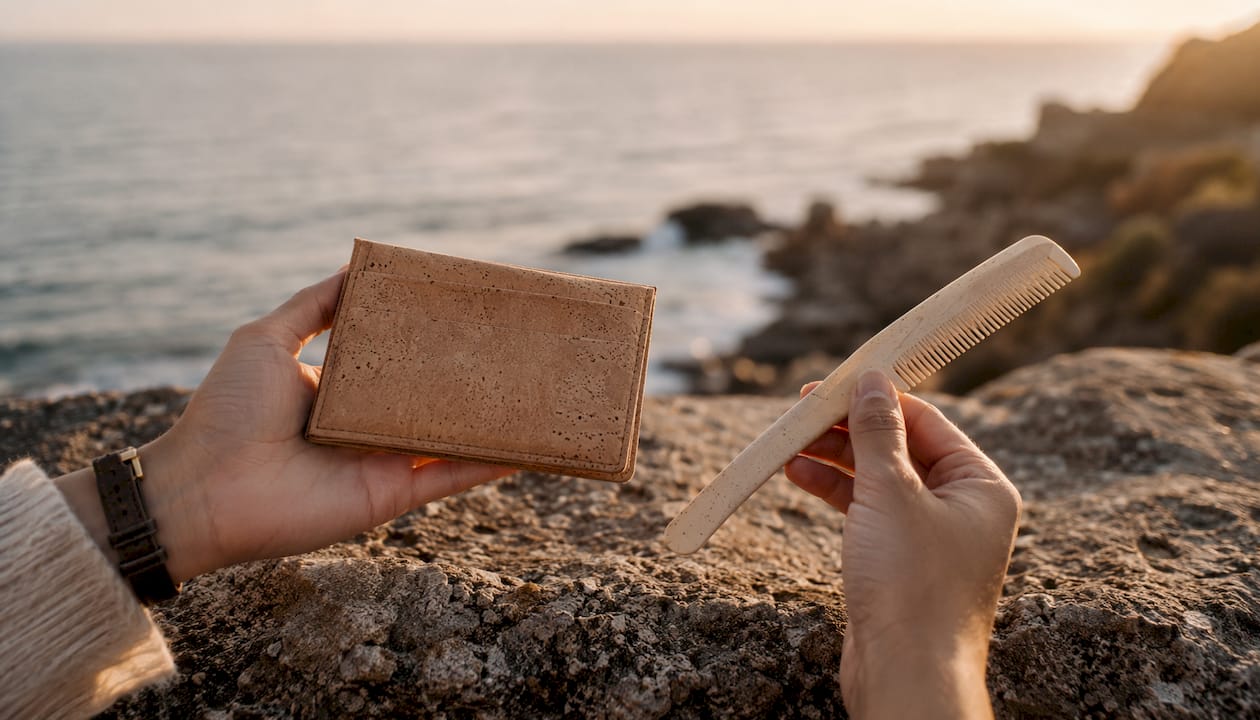
Expert guidance is clear: biodegradability is the right priority when an item cannot realistically be reused, such as food packaging or a disposable coffee cup. For a handbag or wallet that you carry daily, biodegradability is actively counterproductive. A bag designed to break down will do exactly that, triggering premature replacement and multiplying the production footprint you were trying to minimise.
Three questions to ask at the point of purchase:
1. What is the intended lifespan? If the answer is “years”, durability wins. If the answer is “one use”, biodegradability matters.
2. How likely is loss, damage or fashion obsolescence? A classic, well-made design in a timeless material like cork ages into a patina rather than looking dated, reducing the risk of premature disposal.
3. Can it be repaired, and are spare parts available? Repairability is the practical mechanism that converts physical durability into actual extended service life.
Why cork performs so well as a durable, eco-friendly material
Cork combines inherent toughness, low maintenance and an ageing quality that reads as patina rather than deterioration. That combination is rare in fashion materials and explains why eco shoppers increasingly prefer cork accessories for long-term use.
Key material properties that support eco-friendly product longevity:
- Abrasion resistance: cork’s cellular structure absorbs surface friction without degrading the outer layer.
- Water resistance: natural suberin content repels moisture, protecting both the material and any contents.
- UV stability: cork does not fade or crack under sunlight the way many synthetic vegan leathers do.
- Ease of cleaning: a damp cloth removes most marks; no specialist products needed.
- Low maintenance: unlike leather, cork requires no conditioning oils or seasonal treatments.
- Aesthetic ageing: minor scuffs develop character rather than signalling failure, which supports emotional durability — the attachment that keeps you from replacing something that still works.
Because about 80% of a product’s footprint is fixed at the design and sourcing stage, choosing an inherently durable material like cork at the point of purchase is more impactful than any post-production offset. Thecorkstore’s sustainable accessory range shows how cork handles both the technical and aesthetic demands of daily use.
Pro Tip: Run your thumb firmly across a seam on any cork accessory before buying. A well-bonded cork textile will not separate or bubble under moderate pressure. If it does, the lamination is likely to fail within months of regular use.
How to evaluate durability when buying a cork accessory
A durable accessory costs less per year of use than a cheap one. The checklist below lets you assess durability from a product page or in person, without relying on marketing language.
- Material thickness: cork textile should feel substantial, not papery. Thin laminate over a weak backing delaminates quickly.
- Stitching and seam finish: double-stitched seams with sealed edges outlast single-stitched ones by years at stress points like handles and zip surrounds.
- Hardware quality: metal rivets and YKK-style zips outlast plastic equivalents. Test zip smoothness; gritty resistance is a warning sign.
- Lining and stress points: a reinforced lining at base corners and strap attachments is the difference between a bag that lasts two years and one that lasts ten.
- Warranty and spare parts: a brand that offers a warranty and sells replacement hardware is signalling confidence in its own construction.
- Repair network and resale value: check whether the brand offers repair guidance or partners with a repair service. A second-hand market for the product is a proxy for quality.
Identifying genuinely eco-friendly accessories requires looking past surface claims to these structural details.
Pro Tip: Ask the seller directly: “Can I buy a replacement strap or zip?” A brand that cannot answer that question has not designed for repairability.
Pro Tip: Avoid any product description that leads with “vegan leather” but gives no information on material composition, warranty or care instructions. Opacity on those points usually means the product is not built to last.
How to care for and repair cork accessories to extend their life
Proper care and timely simple repairs typically extend a cork accessory’s useful life by several years, keeping per-use footprint low and resale value high.
- Clean regularly: wipe with a slightly damp cloth after use. For stubborn marks, a drop of mild soap on the cloth works well. Avoid soaking.
- Dry naturally: never use a hairdryer or radiator. Cork contracts under direct heat, which can crack the surface layer.
- Store correctly: keep in a dust bag or pillowcase away from direct sunlight when not in use. Avoid compression under heavy objects.
- Condition the textile annually: a light application of beeswax or a cork-specific conditioner maintains flexibility. Skip petroleum-based products.
- Address wear early: a small patch of surface abrasion is easy to treat with a cork repair kit. Left untreated, it spreads.
For repair decisions:
- Patch surface scuffs yourself using a cork repair adhesive and a matching offcut.
- Replace hardware (zips, rivets, D-rings) at a local cobbler or leather repair shop; most can work with cork textile.
- Seek professional repair for structural failures such as delamination or broken strap anchors. The cost is almost always less than replacement.
Before resale, clean thoroughly, replace any worn hardware, and photograph the item in natural light. A well-maintained cork bag holds its value well on second-hand platforms.
Pro Tip: A bamboo cutting board set or wooden cutlery set alongside your cork accessories rounds out a low-maintenance, durable eco-lifestyle kit — all materials that age well with simple care.
What UK shoppers should know about the Ecodesign regulation and durability claims
Regulatory momentum is pushing manufacturers to disclose durability, repairability and material origin. The EU’s Ecodesign for Sustainable Products Regulation (ESPR), Regulation (EU) 2024/1781, requires that products be designed to avoid becoming waste and introduces the Digital Product Passport to carry material origin and repairability data. While the UK is no longer subject to EU law, British retailers selling into the EU market or sourcing from EU-compliant manufacturers will increasingly carry DPP information, and UK policy is tracking the same direction.
The ESPR requires ecodesign requirements to address durability, reusability, repairability, upgradability and recyclability, and mandates that repairability and durability scores use easy-to-understand language and pictograms so consumers can compare products effectively. — Regulation (EU) 2024/1781, Recitals 15, 16 and 30.
Practical questions to ask any seller:
- Does the product carry a repairability score or DPP data?
- What is the warranty period and what does it cover?
- Are spare parts listed on the product page?
- Does the brand publish care and repair guidance?
A brand that answers all four confidently is one that has designed for longevity, not just marketed it.
When extending a product’s lifetime might not help the environment
Lifetime extension usually reduces environmental impact, but not always. LCA research identifies three scenarios where the benefit shrinks or disappears.
- High-emission repair logistics: shipping a bag overseas for specialist repair can generate more emissions than the repair saves, particularly for lightweight accessories with a modest original footprint.
- Long idle periods: a bag stored unused for years accumulates no use-hours against its production footprint. Service lifetime (actual use) matters more than technical lifetime (how long it could last).
- Fashion or functional obsolescence: if a product is replaced because it no longer suits the owner’s needs rather than because it has failed, the durability investment is wasted. Timeless design and emotional attachment are the practical countermeasures.
Simple rules of thumb:
- Repair locally whenever possible; avoid international shipping for minor repairs.
- If you have not used an item in 12 months, resell or donate it rather than storing it indefinitely.
- When a product is genuinely at end of life, choose a replacement with verified durability credentials rather than the cheapest available option.
Key takeaways
Durability is the primary sustainability lever for cork accessories: buy for per-use value, maintain consistently, and repair before replacing.
| Point | Details |
|---|---|
| Per-use framing beats sticker price | A £120 cork bag lasting 8 years costs roughly £15 per year, far less than repeated cheap replacements. |
| 50% longer life, ~33% less impact | Extending a product’s life by 50% cuts associated environmental impacts by roughly one-third. |
| Check repairability before buying | Warranty length, spare parts availability, and repair guidance are the real durability signals. |
| Cork ages into patina, not failure | Water resistance, UV stability, and low maintenance make cork a strong choice for long-lived accessories. |
| Thecorkstore | Browse cork handbags, wallets, and backpacks with care guides and product information at thecorkstore.co.uk. |
Why durability sits at the heart of what Thecorkstore does
Durability is not a marketing claim — it is a design commitment that shows up in material selection, construction standards, and the willingness to publish care and repair guidance. Thecorkstore’s focus on cork accessories reflects a straightforward conviction: the most sustainable product is the one you never need to replace.
Sustainable accessories earn their credentials through years of use, not through a single label. The blog resources on Thecorkstore cover material properties, care routines, and styling guidance precisely because an informed buyer is one who keeps their purchase for longer. That is the long game for both the customer and the planet.
Durable cork accessories, curated for conscious shoppers
If this guide has shifted how you think about eco-friendly product longevity, the next step is straightforward. Thecorkstore offers a curated range of cork handbags, wallets, and backpacks selected for construction quality, repairability, and timeless design — the three attributes that translate durability into real environmental value.
Every product page includes care guidance, and the team is accessible for repair queries. Cork accessories that are built to last and styled to stay relevant are available now at thecorkstore.co.uk.
Useful sources
- Ecodesign for Sustainable Products Regulation — EUR-LEX summary: policy overview of ESPR durability and DPP requirements.
- Regulation (EU) 2024/1781 — full text, EUR-LEX: primary legislative source for repairability and durability score requirements.
- Product Longevity — NIST: circular-economy research on life extension and impact reduction.
- Consumer behaviour and durability neglect — Columbia Business School: behavioural research on why buyers undervalue durable goods.
- Why durability is the ultimate sustainability strategy — Brevn: accessible summary of the 80% design-stage footprint finding and brand-value argument.
- Should product developers prioritise durability or biodegradability? — Sustainability Directory: decision framework for choosing between the two priorities.
- Product lifetime in LCA of circular economy strategies — Springer Nature: LCA review of scenarios where lifetime extension provides limited benefit.