

25–40% fabric waste: DIY upcycling in fashion, limits and cork
Upcycling in fashion is the creative transformation of pre- or post-consumer textile waste, offcuts, deadstock or discarded garments, into new items with higher perceived value than the original material. It matters because it diverts clothing from landfill and incineration while producing something genuinely one of a kind. The techniques and examples below show how it differs from recycling, where it works best, and where it still struggles to scale.
TL;DR:
- Upcycling uses more pre-consumer waste, which is cleaner and more uniform, making it easier to scale compared to post-consumer garments.
- Only about 1% of clothing is recycled into new garments, as upcycling preserves material value, while recycling often results in downcycled products like insulation.
- High labour costs and unpredictable quality from post-consumer waste prevent upcycling from scaling widely in mass production scenarios.
- Beginners can start simple with durable materials like denim or leather, focusing on assessing quality, cleaning, and straightforward assembly techniques.
- Upcycling enhances consumer engagement through product stories and shifts perceptions toward valuing unique, authentic garments over fast fashion basics.
Table of Contents
- What is upcycling in fashion and how does it actually work?
- Upcycling vs recycling: what’s the real difference?
- The environmental, social and commercial case for upcycling
- Common upcycling techniques and what people actually make
- Why upcycling struggles to scale
- How to try upcycling and how to judge upcycled items when buying
- Thecorkstore’s approach to circular accessories
- Where upcycling in fashion actually came from
- Who’s actually pushing upcycling forward
- How upcycling is changing what people expect from their clothes
- An honest read on what upcycling can and can’t fix
- Sources
What is upcycling in fashion and how does it actually work?
Ask ten designers “what is upcycled fashion?” and you’ll get ten slightly different answers, but the mechanics stay consistent. Upcycling draws from two main sources: pre-consumer waste (offcuts, sample fabric, deadstock rolls sitting unused in a factory) and post-consumer waste (garments someone has already worn, donated, or thrown away). Pre-consumer material tends to be cleaner and more uniform. Post-consumer material is messier, but there’s far more of it circulating.
The typical process runs sourcing, sorting, cleaning, disassembly, redesign, then finishing. A jacket might get stripped of its lining, its panels re-cut, and its zip salvaged for a different piece entirely. Manufacturing waste alone often makes up 25 to 40% of the fabric used in production, and studies suggest up to half of that pre-consumer waste can be reused in upcycling projects, with some fabric types reaching as high as 80% potential.
What makes upcycling different from ordinary design work is the constraint. A designer working with new fabric starts with a sketch and buys what the sketch needs. An upcycler starts with whatever scraps, damaged garments, or deadstock are physically available, then designs around that shape, weight and condition. It’s design in reverse, and it’s a genuinely different skill from conventional pattern cutting.
Upcycling vs recycling: what’s the real difference?
Upcycling keeps the material’s structure intact and tries to raise its value. Recycling breaks material down into fibres or raw components, which is energy-intensive and usually produces something lower in quality than the original, a process called downcycling.
The scale of the problem makes this distinction matter. Only about 1% of clothing worldwide gets recycled back into new garments; most “recycled” textile fibre ends up in insulation, wiping cloths or industrial padding rather than new clothes. Upcycling sidesteps that value loss entirely by working with the fabric as it already exists rather than reducing it to fibre first.
That’s not an argument against recycling. It’s an argument for using each tool where it fits: upcycling for garments worth preserving as garments, recycling for material too degraded to reshape.
The environmental, social and commercial case for upcycling
The environmental logic is straightforward: making no new fabric means no new water, dye or energy input for that portion of a garment. Every offcut or old shirt reworked into something new is one less item pulled from virgin production.
Pre-consumer manufacturing waste often runs to 25 to 40% of total fabric used, and researchers estimate up to half of it is recoverable for upcycling, sometimes as much as 80% depending on the fabric type.
The social upside gets less attention than it deserves. Community-based upcycling projects build practical sewing and pattern-cutting skills, create part-time or freelance work, and often preserve craft techniques that would otherwise fade. The European Commission points to designers and local projects across Europe using high-quality fabric sourced from existing clothing as a working model for circular design, not just a niche hobby.
Commercially, upcycling gives brands something recycling rarely can: a story. Every piece has provenance, and that narrative measurably increases consumer engagement, because buyers respond to knowing where their materials have been. You can read more on how this plays out for accessories in Thecorkstore’s look at upcycling’s impact on modern fashion.
Common upcycling techniques and what people actually make
Upcycling techniques in fashion range from a kitchen-table hobby to a factory floor process, and the scale changes what’s realistic.
- Artisanal or craft upcycling: individual makers reworking single garments, often one-off pieces sold through small studios or markets.
- Pre-consumer deadstock reuse: brands buying up unused fabric rolls or factory offcuts and building new collections around whatever stock they secure.
- Garment-to-garment reconstruction: taking finished, worn clothing apart and rebuilding it into a different item, denim jeans becoming a tote bag, old shirts merged into a patchwork jacket.
- Material-based conversion: repurposing a fabric type entirely outside its original use, such as turning sailcloth, wetsuits or upholstery fabric into bags and accessories.
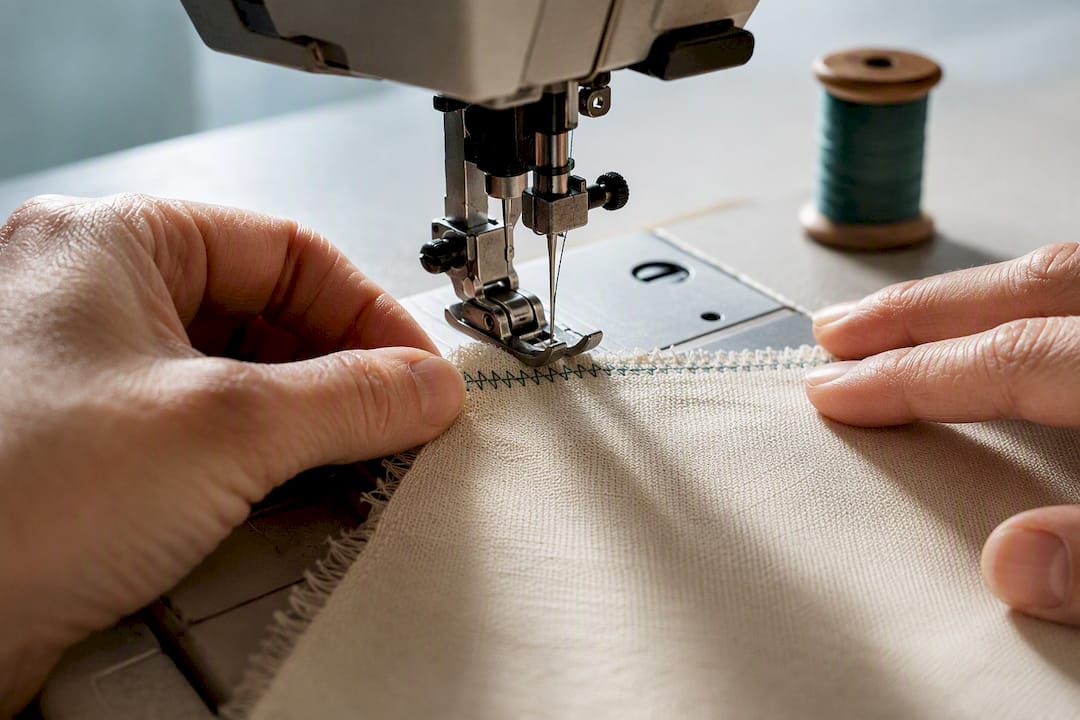
At home, the easiest starting materials are things with strong seams and durable fabric: denim, canvas, leather offcuts and heavyweight cotton all hold up to re-cutting far better than thin knitwear. A worn pair of jeans can become a set of coasters, a small pouch, or patchwork panels for a bag. An old shirt can be recut into a child’s garment or a set of reusable produce bags. None of it requires industrial equipment, just a decent pair of shears, a machine that can handle thick seams, and patience with mismatched fabric weights.
Why upcycling struggles to scale
Upcycling’s biggest constraint is labour. Every disassembled garment has to be sorted, checked and often re-cut by hand, because no two donated items are quite the same. That variability is exactly what keeps costs high and output slow, and the fashion industry’s honest position on upcycling is that it works against the logic of mass production rather than with it.
Post-consumer waste streams are unpredictable in a way factories dislike: quality varies garment to garment, contamination from mixed fibres or old finishes complicates reuse, and testing for hazardous dyes or coatings adds cost before a single stitch happens. Pre-consumer deadstock is far more uniform, which is why brands leaning on deadstock tend to scale more easily than those doing true garment-to-garment work.
This is where recycling still earns its place. A hybrid approach, upcycling for high-value pieces worth preserving, recycling for bulk material too degraded to reshape, is the more realistic path forward than expecting upcycling alone to absorb national-scale textile waste.
How to try upcycling and how to judge upcycled items when buying
A first project doesn’t need a pattern or a sewing machine that costs more than the fabric.
- Assess the garment: check seam strength, fabric weight and any stains or damage that limit what’s usable.
- Clean thoroughly, since poor-quality or contaminated input material is the single biggest reason upcycled pieces fail early.
- Cut around damage rather than through it, keeping the strongest panels intact.
- Combine pieces using a straightforward seam, overlap or patchwork join.
- Finish edges so they don’t fray with wear or washing.
Buying rather than making? Check stitch density along seams, look for reinforced stress points, and ask where the material actually came from, genuine upcycling reworks existing garments, not just deadstock rebranded as “eco.” For more consumer-facing guidance, Maker of Jacket’s upcycling tutorials walk through several beginner projects step by step.
Pro Tip: A basic leather or fabric edge binder, or even a simple zigzag stitch, will do more for an upcycled item’s lifespan than any fancy embellishment. Durable finishing is what separates a piece that lasts years from one that unravels after two washes.
Thecorkstore’s approach to circular accessories
One example is a focus on cork as a sustainable, vegan alternative to leather, an approach that shares the same underlying logic as upcycling: use materials more thoughtfully and build things meant to last. Cork itself is harvested without felling trees, which puts it in a similar circular-design conversation as reworked textiles. Readers wanting to go deeper can explore what makes an accessory genuinely circular or browse practical guidance on building a more sustainable wardrobe.
Where upcycling in fashion actually came from
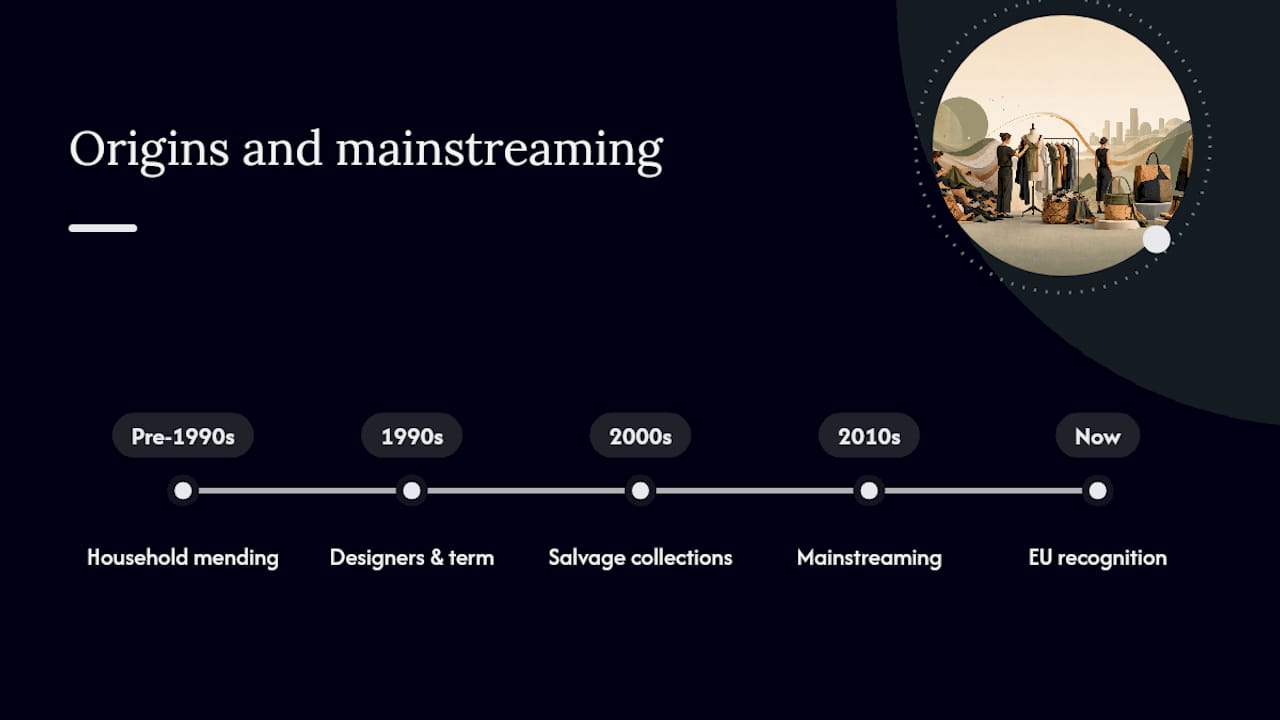
Reworking old clothes isn’t new. Households have patched, resized and repurposed garments out of necessity for as long as textiles have existed, wartime rationing across Europe in the 1940s turned “make do and mend” into official government guidance, not just thrift. What changed the framing was the 1990s, when designers began treating salvaged material as a deliberate creative statement rather than a budget compromise.
The term “upcycling” itself gained traction through waste-management writing in the 1990s before fashion adopted it as shorthand for design that adds value to discarded material rather than just reusing it out of necessity. By the 2000s, a handful of designers were building entire collections from military surplus, deadstock and secondhand garments, proving the approach could produce desirable clothing rather than obviously “recycled-looking” pieces.
The shift accelerated once fast fashion’s waste volumes became impossible to ignore. As landfill and incineration figures for clothing climbed through the 2010s, upcycling moved from a fringe craft practice into something governments, universities and mainstream brands started referencing directly. The European Commission now cites upcycling designers and local projects as part of its circular economy messaging, a level of institutional recognition the practice didn’t have twenty years ago.
Who’s actually pushing upcycling forward
Fashion Revolution, co-founded by Orsola de Castro, has done more than most organisations to push transparency around where clothing materials come from, campaigning has kept pressure on brands to disclose supply chains and rethink waste rather than simply market around it.
On the design side, independent labels working directly with deadstock and secondhand garments have shown that upcycled collections can hold their own on desirability, not just ethics. Community workshops and social enterprises matter just as much here: many operate at a scale that will never touch national waste figures, but they combine waste diversion with skills training and cultural preservation in a way that larger, faster brands generally can’t replicate.
Universities and design schools have also become quiet drivers of the movement, teaching upcycling as a legitimate design methodology rather than a stopgap. That academic legitimacy has fed back into industry, with more graduates entering brands already fluent in deadstock sourcing and garment deconstruction rather than treating it as a niche add-on skill learned later.
How upcycling is changing what people expect from their clothes
Upcycling has quietly shifted what “desirable” means in fashion. A visible seam, a mismatched panel or an obvious repurposed zip used to read as a flaw. Now it often reads as proof of authenticity, buyers increasingly treat imperfection as a sign the item is genuinely one of a kind rather than mass-produced.
That shift shows up most clearly in how consumers respond to provenance. Knowing a bag started life as a pair of jeans, or that a jacket’s lining came from an unused factory roll, increases engagement with the product because it gives the purchase a story worth repeating to someone else. Brands have picked up on this fast, leaning on transparent material journeys as a marketing angle rather than an afterthought.
It’s also nudged buying habits toward slower replacement cycles. A one-of-a-kind upcycled piece doesn’t fit into a “buy, wear twice, discard” pattern the way a fast-fashion basic does, partly because it can’t be easily replaced with an identical item, and partly because the story attached to it adds a kind of sentimental weight that a mass-produced garment never earns. For a wider view of where these habits sit within broader sustainable fashion movements, Thecorkstore’s rundown of key sustainable fashion trends is worth a look.
An honest read on what upcycling can and can’t fix
Upcycling gets oversold as a fix for fashion’s waste problem, and it isn’t one. It’s a genuinely good tool for a specific job: rescuing material that still has structural life left in it and turning that into something worth wanting. It was never designed to absorb the sheer volume of clothing the industry produces and discards each year. Pretending otherwise sets people up for disappointment when a small workshop can’t process a landfill’s worth of donations.
Where conventional advice falls short is treating upcycling and recycling as competitors. They’re not. Upcycling handles the pieces worth preserving as garments; recycling, however imperfect, handles what’s genuinely beyond saving. Chasing scale for its own sake misses the point, some of the most valuable upcycling happens in small community workshops that will never touch national waste figures but still teach real skills and keep good fabric out of landfill.
If you’re starting out, prioritise learning to judge material quality before you learn fancy techniques. A well-chosen offcut beats a clever pattern on a poor one every time, whether you’re upcycling at home or choosing a durable accessory built with the same principle in mind, like a cork bag made to outlast a trend cycle rather than follow one.
— Aaron
Sources
For readers who want to check the detail themselves: REDRESS’s upcycling guide covers definitions and recycling limits, NC State Textiles breaks down manufacturing waste figures, Vogue’s fashion exec guide is candid about scaling problems, and The Zoofamily’s overview is a solid beginner primer.
- The fashion exec’s guide to upcycling | Vogue
- A review on upcycling as a strategic marketing tool for sustainability in the fashion industry | Emerald
- UpCycling Fashion | European Commission (Environment)