

Carbon neutral fashion: Genuine progress or greenwashing?
TL;DR:
- The term “carbon neutral” in fashion often simplifies complex emissions accounting, primarily excluding Scope 3 data. Many brands rely heavily on offsets rather than meaningful reductions, leading to misleading claims and limited environmental impact. Consumers can promote genuine sustainability by demanding transparency, verification, and investments in lower-impact materials like cork instead of relying solely on labels.
The term “carbon neutral” appears on everything from trainer boxes to tote bags, but the label means far less than most shoppers realise. Brands have discovered that eco-credentials sell, and “carbon neutral” is among the most marketable claims in fashion today. Yet without understanding what actually sits behind that label, you risk spending your money on products that do little more than offset guilt rather than offset emissions. This article breaks down what carbon neutral fashion genuinely means, where brands fall short, and how to shop in a way that reflects your actual values.
Table of Contents
- What does carbon neutral fashion really mean?
- How brands claim carbon neutrality: Approaches and pitfalls
- Carbon impact: Industry trends and leading examples
- From claim to closet: How to choose authentic carbon neutral and sustainable style
- Why consumers must demand more from carbon neutral fashion
- Explore truly sustainable accessories at The Cork Store
- Frequently asked questions
Key Takeaways
| Point | Details |
|---|---|
| Carbon neutral is not net zero | Many fashion brands use offsets but true sustainability demands deeper supply chain cuts. |
| Industry lacks transparency | Few brands disclose full emissions and there is no universal standard for carbon claims. |
| Greenwashing remains common | Brands can mislead by excluding Scope 3 emissions and relying on offset certificates. |
| Choose structural change over offsets | Seek brands making genuine reductions, not just paying for offsets to hide impact. |
| Cork offers credible eco style | Cruelty-free cork accessories combine style, sustainability, and lower carbon impact. |
What does carbon neutral fashion really mean?
Carbon neutral is not a single, fixed standard. At its core, it describes a state where the greenhouse gas emissions produced by a product or organisation are balanced by an equivalent amount removed or offset elsewhere. Think of it like a set of scales: emissions go on one side, carbon offsets or removals on the other, and the goal is equilibrium.
Where it gets complicated is in the scope of that balancing act. Fashion brands frequently measure only what is directly under their control, such as energy used in their own offices or manufacturing facilities. This is known as Scope 1 and Scope 2 reporting. However, the vast majority of a garment’s carbon footprint sits in Scope 3, which covers everything from raw material extraction and supplier factories to customer transportation and end-of-life disposal. Scope 3 covers 90 to 98% of fashion’s total emissions, so any carbon neutral claim that excludes it is, frankly, incomplete.
It is also worth knowing that carbon neutral and net zero are not interchangeable, despite being treated that way. Net zero demands near-total emissions reduction across the full value chain before minimal offsetting is permitted, covering all greenhouse gases over the entire lifecycle. Carbon neutrality, by contrast, allows brands to lean far more heavily on offsetting rather than genuine reduction, and often focuses on a narrower set of emissions. Understanding this distinction is a good starting point when you are navigating fashion terminology and trying to separate substance from marketing.
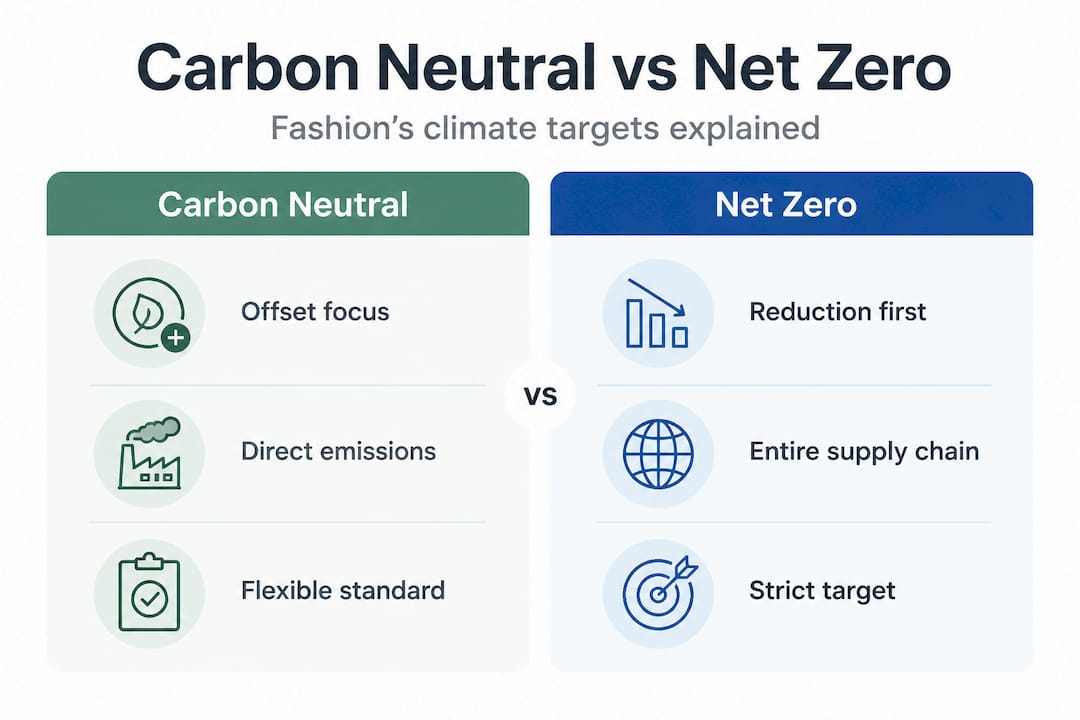
| Term | Emissions scope | Offset reliance | Ambition level |
|---|---|---|---|
| Carbon neutral | Often Scope 1 and 2 | High | Lower |
| Net zero | Full value chain | Minimal | Higher |
| Climate positive | Beyond full chain | Removal focus | Highest |
A few key points to keep in mind when you encounter a carbon neutral claim on a product:
- Scope 3 inclusion matters. If a brand does not mention supply chain emissions, question the claim immediately.
- Offsetting is not reduction. Purchasing carbon credits does not lower the pollution created; it funds projects elsewhere.
- Third-party verification adds credibility. Look for schemes like Gold Standard or Verified Carbon Standard certification on offsets.
- Timelines count. A brand claiming to be carbon neutral today might be using credits that expire or fail to deliver.
“Carbon neutrality claims that omit Scope 3 emissions are not measuring the full picture. In fashion, the vast majority of emissions occur outside the brand’s direct operations, making Scope 3 the most consequential category of all.”
How brands claim carbon neutrality: Approaches and pitfalls
With definitions established, it is worth looking at how fashion brands actually pursue carbon neutral status, and where the process breaks down.
Most brands follow a broadly similar pathway. They first measure their emissions, then reduce what they can, then offset the remainder. In theory, this is sensible. In practice, the sequence often gets compressed or reversed, with brands jumping straight to offsetting because reduction is slower and costlier.
The steps a brand typically takes include:
- Conduct a carbon audit. Map emissions across Scope 1, 2 and ideally Scope 3.
- Set reduction targets. Identify where emissions can be cut through cleaner energy, better materials, or logistics improvements.
- Implement reductions. Switch to renewable energy, change suppliers, or redesign products for lower impact.
- Offset the remainder. Purchase carbon credits from verified projects such as reforestation or renewable energy schemes.
- Publish a sustainability report. Communicate progress and methodology publicly.
The problem is that steps 4 and 5 are often given more emphasis than steps 2 and 3. Industry transparency averages just 14% across major brands, many of which rely on Renewable Energy Certificates (RECs) that can mask continued fossil fuel use in their supply chains. RECs allow a company to claim that the electricity it uses is renewable, even when the actual energy grid it draws from runs on coal or gas.
There are also growing legal risks. The adidas greenwashing ruling in Europe highlighted that vague carbon neutral claims without substantive action can result in regulatory action and reputational damage. Shoppers who know how to spot sustainable fashion will increasingly see through claims that lack specifics.
The distinction between offsetting and insetting is also important. Offsetting funds external projects to compensate for emissions. Insetting means investing in carbon sequestration or emissions reduction within the brand’s own supply chain, such as supporting regenerative farming of the cotton it uses. Insetting is considered far more credible because it directly addresses the source of emissions rather than outsourcing responsibility.
| Approach | Definition | Credibility |
|---|---|---|
| Offsetting | External carbon credits purchased | Lower |
| Insetting | Internal supply chain investment | Higher |
| RECs | Renewable energy certificates | Variable |
| Scope 3 reporting | Full value chain disclosure | Essential |
Pro Tip: When evaluating a brand’s carbon neutral claim, ask directly: “Does this include Scope 3?” If the answer is unclear, explore eco-friendly fashion resources to help you build a framework for evaluation.
Carbon impact: Industry trends and leading examples
Understanding risk and transparency is one thing, but the broader industry data paints an even starker picture of just how far fashion has to travel.
Apparel sector emissions reached 0.944 Gt CO2e in 2023, up 7.5% year on year, and only brands representing around 11% of market value are currently on track to meet their 2030 reduction targets. In other words, the industry is moving in the wrong direction. Sales volumes continue to climb, material production keeps expanding, and the per-garment carbon intensity improvements that do exist are being outpaced by sheer growth in output.
This is why real-world examples of brands making genuine progress matter so much. Reformation is frequently cited as one of the more credible players. The brand reduced product carbon intensity by 29% between 2021 and 2025 and has invested in removing more than 125% of its total carbon footprint, making it genuinely climate positive rather than merely carbon neutral.
What does credible action look like in practice? A few distinguishing features:
- Science-based targets. Brands aligned with 1.5°C warming pathways use the Science Based Targets initiative (SBTi) framework to set and verify their reduction goals.
- Full value chain reporting. Credible brands publish Scope 1, 2 and 3 data annually and disclose methodology.
- Material innovation. Switching from synthetics to lower-impact alternatives, including natural and renewable materials, reduces embedded emissions at the source.
- Circularity investment. Take-back schemes, repair services, and closed-loop production genuinely reduce the total volume of new emissions generated.
- Long-term removal commitments. Investing in removal beyond 100% of footprint signals genuine intent rather than minimum compliance.
Keeping up with eco-friendly trends in 2026 will help you understand where the industry is heading and which brands are genuinely innovating. When you understand these benchmarks, the advantages of sustainable fashion become far clearer: lower long-term environmental costs, better quality materials, and the ability to consume with genuine confidence.
“With emissions rising and fewer than one in ten fashion brands on track for 2030 targets, the gap between marketing claims and measurable progress has never been wider.”
From claim to closet: How to choose authentic carbon neutral and sustainable style
With brand examples and industry data in view, the practical question becomes: how do you translate this knowledge into better buying choices?
Experts note that carbon neutrality, when achieved primarily through offsets rather than structural change, does not represent meaningful progress. True sustainability requires brands to embed emissions reductions throughout their operations and supply chains, not simply purchase their way to a credible-sounding label. As a buyer, that distinction shapes what you should look for.
Here is a practical checklist for evaluating any carbon neutral or sustainable fashion claim:
- Check scope disclosure. Does the brand include Scope 3 in its reporting? Anything less tells only a partial story.
- Look for independent verification. Third-party auditors such as B Corp, Gold Standard, or SBTi-verified targets add accountability.
- Ask about material origins. Materials with lower embedded emissions, such as cork, recycled fibres, or organic linen, reduce the need for offsetting in the first place.
- Research reduction over time. A brand genuinely committed to progress will show year-on-year emissions reductions, not just a static carbon neutral badge.
- Avoid “offsetting only” claims. If the only action described is purchasing credits, that is a warning sign.
Knowing how to spot sustainable materials is one of the most effective skills you can develop as an eco-conscious shopper. Cork, for example, is harvested without felling the tree. The cork oak regenerates its bark naturally, continuing to absorb CO2 throughout its life. It requires no irrigation, no pesticides, and supports significant biodiversity in cork oak forests across Portugal and Spain.
When you choose sustainable accessories made from cork instead of leather or synthetic alternatives, you are not relying on an offset to compensate for the damage caused. You are choosing a material that is inherently lower impact from the start. That is the difference between genuine sustainability and a label designed to reassure rather than reform.

Pro Tip: Build your sustainable wardrobe tips around materials and brands with structural commitments, not just clever packaging. Cork accessories, recycled fabrics, and products with transparent supply chains give your purchasing decisions real weight.
Why consumers must demand more from carbon neutral fashion
Here is an uncomfortable truth: carbon neutral fashion, as it is most commonly practised, is largely a storytelling exercise. That is not to say it is entirely without value, but the gap between what the label implies and what it delivers is enormous, and the industry knows it.
The average fashion brand scores just 14% on transparency, meaning that the majority of what happens in a supply chain is invisible to consumers. Carbon neutral claims made in that environment are not independently verifiable in any meaningful sense. You are being asked to trust that a brand has done its calculations correctly, purchased high-quality offsets, and is genuinely working to reduce rather than simply compensate.
The structural issue is that carbon neutrality was designed as a transition mechanism, not a destination. It was intended to allow industries time to reduce emissions while compensating for what they could not yet eliminate. Fashion has treated it as a finishing line. Brands declare carbon neutrality, print it on their marketing materials, and move on. Meanwhile, total emissions in the sector keep rising.
What actually moves the needle is consumer pressure applied consistently over time. When shoppers ask harder questions, request Scope 3 data, and choose brands with verified science-based targets, the commercial case for genuine action improves. Your purchasing choices are a form of policy. They signal to brands what will and will not be tolerated.
Choosing materials like cork, supporting brands that publish honest supply chain data, and investing time in understanding sustainable fashion essentials are all ways of raising that standard. The industry will not reform itself without external pressure. You, as a consumer, are a significant part of that pressure.
Carbon neutrality is not the enemy. Complacency with it is. Treat it as a minimum starting point, not a seal of approval, and you will make far better choices with your money and your influence.
Explore truly sustainable accessories at The Cork Store
If you have been looking for accessories that go beyond the carbon neutral label and start from a genuinely lower-impact material, cork is worth your attention.
At The Cork Store, every product is crafted from natural cork, a renewable and cruelty-free alternative to leather that requires no animals, no synthetic chemicals, and no heavy processing. From cork handbags and backpacks to wallets, purses, and gift sets, the range is designed for people who want style without compromise. Shopping here means choosing accessories with a material story that stands up to scrutiny, not just a label that sounds good on the outside. Browse the collection and discover what sustainable fashion feels like when it is built into the product itself.
Frequently asked questions
What is the main difference between carbon neutral and net zero in fashion?
Net zero requires deeper reductions across the full value chain before minimal offsetting is permitted, while carbon neutrality often relies heavily on offsets and may not address Scope 3 emissions.
How can I avoid buying ‘greenwashed’ carbon neutral products?
Look for brands that disclose Scope 3 emissions and prioritise genuine reductions over offsets, backed by independent transparent reporting rather than self-certification.
Are cork accessories more sustainable than leather?
Cork is cruelty-free, harvested without cutting the tree, and requires no pesticides or irrigation, giving it a considerably lower carbon and environmental impact than conventional leather.
Which brands are genuinely achieving carbon neutrality?
Very few meet rigorous standards; Reformation is a notable example, having reduced carbon intensity by 29% between 2021 and 2025 and investing in removing more than 125% of its total footprint.
Is there a universal standard for carbon neutral fashion?
No; the industry lacks consistent standards for carbon neutral claims, which is a primary driver of consumer confusion and greenwashing across the sector.
Recommended
- Eco-Friendly Fashion Terminology: Making Ethical Choices – The Cork Store
- Why Eco-Friendly Fashion Matters for Conscious Shoppers – The Cork Store
- Discover the real benefits of ethical fashion today – The Cork Store
- How to Spot Sustainable Fashion: A Step-by-Step Guide – The Cork Store
- Why sustainable shoe materials matter: 47% less carbon impact – YDA UK