

What is eco luxury: the conscious buyer's guide
TL;DR:
- Eco luxury combines high-end craftsmanship with verified environmental and ethical responsibility across a product’s entire lifecycle. It emphasizes transparent sourcing, low-carbon design, ethical production, and circular economy principles to ensure genuine sustainability. Unlike typical luxury, it demands measurable data and lifecycle accountability to prevent greenwashing and promote conscious consumption.
Eco luxury is defined as the fusion of high-end exclusivity and craftsmanship with verified environmental and ethical responsibility across the entire lifecycle of a product or service. The industry term is “sustainable luxury,” but eco luxury has become the widely used shorthand for the same concept. Unlike generic sustainability claims, genuine eco luxury requires transparent evidence of low-carbon production, fair labour, and end-of-life management. This guide explains what eco luxury means in practice, how to spot the real thing, and why it matters for anyone building a more conscious wardrobe or lifestyle.
What is eco luxury, and what makes it genuine?
Eco luxury is not simply an expensive product made from organic cotton. True eco luxury requires a systemic approach covering raw materials, labour practices, logistics, repair, and end-of-life management. A single certification or one sustainable material does not qualify a product. The entire lifecycle must be accounted for.
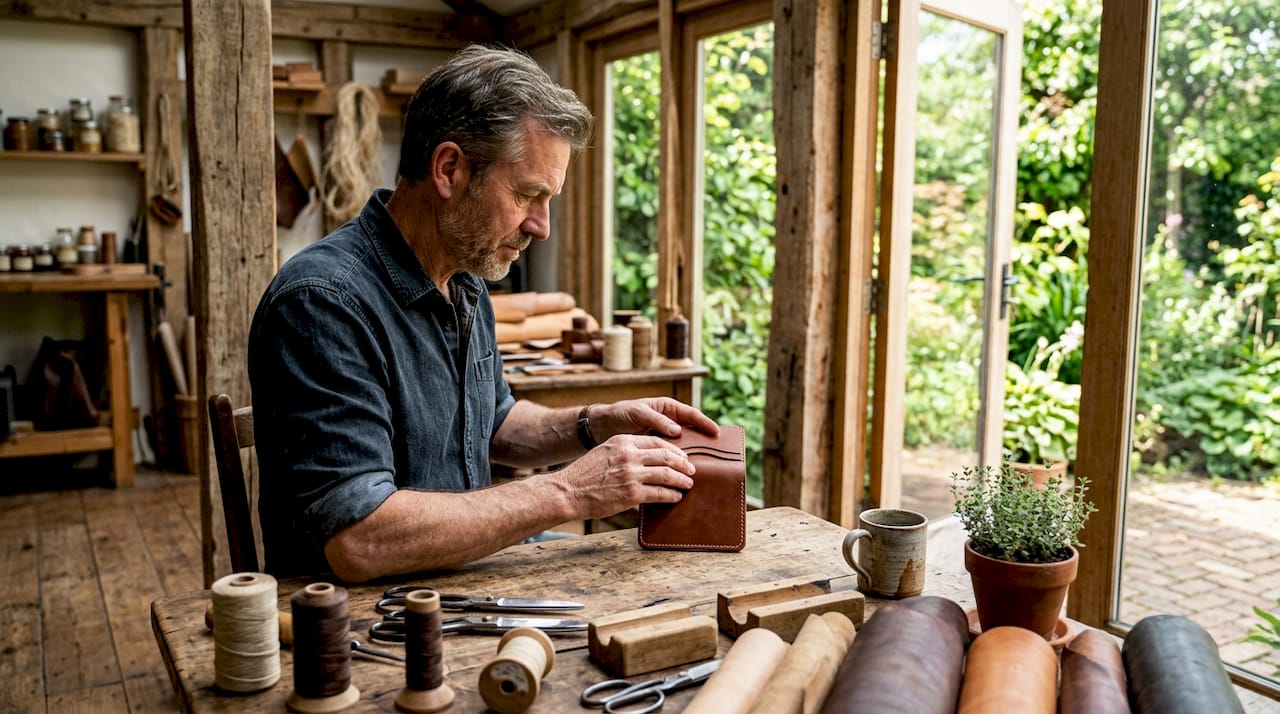
The sustainable luxury definition rests on three pillars: environmental responsibility, ethical production, and premium craftsmanship. All three must be present and verifiable. A handbag stitched from recycled textiles but produced in unsafe factory conditions fails the ethical pillar. A resort built with local stone but powered entirely by fossil fuels fails the environmental one.
Greenwashing is the primary threat to eco luxury’s credibility. Brands that use vague language like “eco-conscious” or “green” without supporting data are making unverifiable claims. Regulators across the European Union are tightening rules on environmental marketing, pushing brands to substantiate every claim with measurable evidence. That regulatory pressure is accelerating the shift from superficial green messaging to genuine lifecycle accountability.
What core principles and practices characterise eco luxury today?
Eco luxury rests on a set of specific, observable practices. These are not aspirational values but operational standards that distinguish credible brands from those trading on aesthetics alone.
- Transparent sourcing: Brands must disclose where materials originate, who processes them, and under what conditions. Supply chain transparency is the baseline, not a bonus feature.
- Low-carbon design: Some construction projects source 70% of materials from surrounding natural land to cut transport emissions. That principle applies equally to fashion: local or regional material sourcing reduces a product’s carbon footprint before it reaches the consumer.
- Ethical production: Fair labour practices, preservation of artisan techniques, and safe working conditions at every supply chain stage are non-negotiable in genuine eco luxury. This is often where mass-market luxury fails most visibly.
- Minimalist and functional design: Designers of eco-luxury spaces use minimal, uncluttered layouts with natural light and cross-ventilation to cut energy use. In fashion, minimalism means timeless pieces that do not become obsolete after one season.
- Circular economy principles: Products designed for repair, resale, or responsible end-of-life disposal reduce waste and extend material value. Circularity is the structural opposite of fast fashion.
Pro Tip: When assessing a brand’s eco luxury credentials, ask for its lifecycle assessment documentation. Any credible brand operating to genuine sustainable luxury standards will have this available, even in summary form.
The circular economy principle is particularly significant. A product built to last ten years and then be repaired or recycled has a fundamentally different environmental footprint than one designed for two seasons of use. Longevity is a core luxury value, and in eco luxury it also becomes an environmental one.
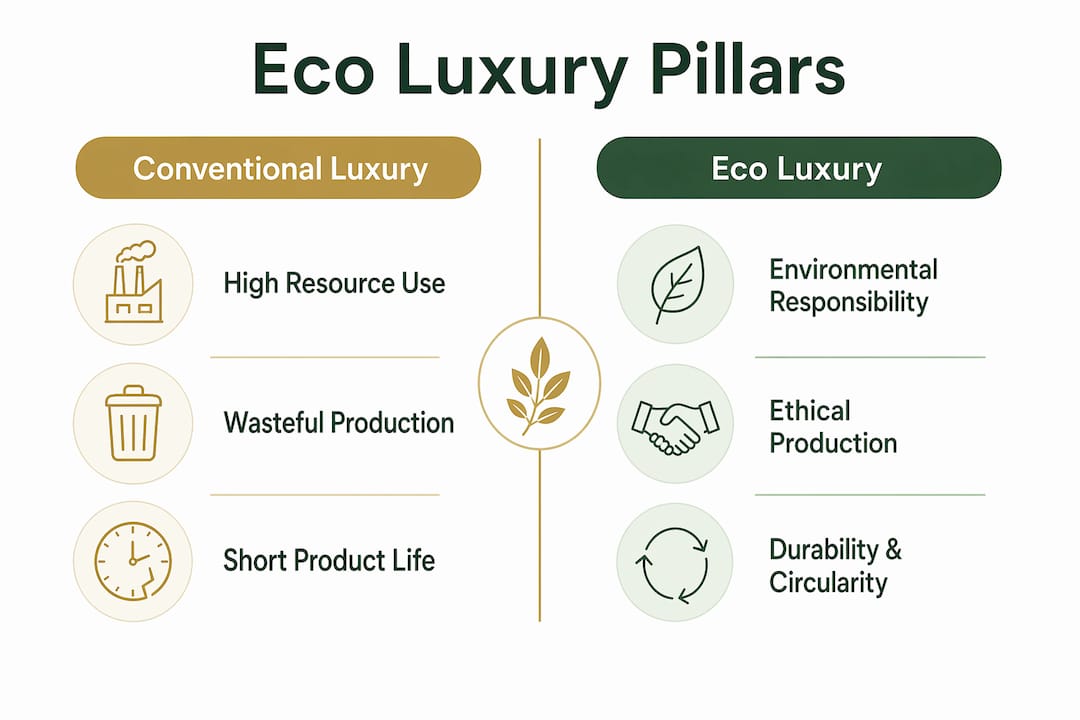
How does eco luxury differ from conventional luxury and sustainable luxury?
The distinction matters because the terms are often used interchangeably, but they describe different things.
| Dimension | Conventional luxury | Eco luxury |
|---|---|---|
| Resource use | High, often wasteful | Efficient, locally sourced where possible |
| Production ethics | Variable, often opaque | Verified fair labour and artisan preservation |
| Environmental claims | Rarely substantiated | Backed by lifecycle data and third-party verification |
| Design philosophy | Status-driven, trend-led | Timeless, functional, and low-impact |
| Pricing rationale | Exclusivity and brand heritage | Exclusivity plus verifiable sustainability credentials |
Luxury has long assumed resource intensity, but eco luxury challenges that assumption directly. The shift is from “less bad” to “actively good.” A conventional luxury leather bag may use the finest hides and the most skilled craftspeople, but if the tanning process pollutes local waterways and the supply chain is opaque, it does not qualify as eco luxury.
Sustainable luxury, as an industry term, sits closer to eco luxury than conventional luxury does. The difference is one of rigour. Sustainable luxury often describes brands making genuine progress on environmental metrics. Eco luxury adds the expectation of full lifecycle accountability and ethical production as a baseline, not a target. The eco luxury meaning is therefore stricter and more demanding than sustainable luxury in its broadest usage.
Consumers often mistakenly equate high price with sustainability. Price is not evidence. A £500 accessory is not automatically more sustainable than a £50 one. Verified credentials, material transparency, and production ethics are the actual indicators.
What are the practical applications of eco luxury in fashion and lifestyle?
Eco luxury principles show up most clearly in fashion and accessories, travel, and home design. Here are the most significant applications for conscious buyers.
-
Sustainable materials in fashion: Organic cotton, cork, recycled textiles, and plant-based leathers are the materials most associated with eco-friendly luxury. Cork is particularly notable: it is harvested without cutting the tree, is biodegradable, and produces a material with a texture and durability comparable to leather. Thecorkstore specialises in cork accessories precisely because the material meets eco luxury’s material standards without compromise. Checking how to spot sustainable materials before purchasing is a practical first step for any conscious buyer.
-
Timeless design over trend cycles: Eco luxury fashion rejects seasonal obsolescence. A well-made cork handbag or a pair of water-conscious denim jeans designed to last years rather than months embodies the eco luxury principle more accurately than a “sustainable capsule collection” dropped annually. Longevity reduces the need for replacement and cuts cumulative environmental impact.
-
Verified eco credentials in accessories: The sustainable accessory trends of 2025 and 2026 show growing consumer demand for accessories with traceable origins. Buyers are asking where materials come from, how workers are paid, and what happens to the product at end of life. Brands that cannot answer these questions are losing ground to those that can.
-
Eco-luxury travel and hospitality: Certain eco-luxury resorts recycle over 15 million litres of wastewater annually and compost kitchen waste to nourish local gardens. That scale of resource management demonstrates that luxury hospitality and genuine environmental responsibility are compatible. The experience remains premium; the footprint is dramatically reduced.
-
Lifecycle perspective from production to disposal: Energy-efficient technologies within eco luxury are increasingly recognised as investments that deliver both environmental benefits and long-term economic savings. Buyers who understand this stop seeing the premium price as a cost and start seeing it as a return.
Pro Tip: Before buying any accessory marketed as eco-friendly luxury, check whether the brand publishes its material sourcing policy and labour standards. If neither is publicly available, treat the sustainability claim with scepticism.
What challenges and future directions shape the eco luxury sector?
The eco luxury sector faces real structural tensions. Experts note the inherent conflict between luxury values built on scarcity and eco values demanding efficiency and circularity. Resolving that tension requires brands to substantiate claims with data rather than imagery.
Greenwashing remains the sector’s most damaging problem. A brand can photograph its products in a forest, use earthy tones in its packaging, and describe its supply chain as “responsible” without any of that being verifiable. Regulatory frameworks in the EU, including the Green Claims Directive, are designed to close that gap. Brands that cannot back their claims with evidence will face legal exposure, not just reputational risk.
Design innovation is one of the most promising routes forward. Using local natural materials such as volcanic rock or bamboo in construction reduces embodied emissions and integrates products into their natural environment. The same logic applies to fashion: materials grown or harvested locally, processed with low-energy methods, and designed for durability represent the direction the sector is moving.
Consumer sophistication is also rising. Buyers who once accepted a brand’s word on sustainability now expect third-party verification, lifecycle data, and supply chain disclosures. That shift in expectations is the most powerful force shaping the future of eco luxury. Brands that treat transparency as a marketing exercise will be exposed. Those that treat it as a business standard will build lasting trust.
Key takeaways
Eco luxury is the only form of luxury that requires verifiable environmental and ethical accountability across the full product lifecycle, not just at the point of sale.
| Point | Details |
|---|---|
| Lifecycle accountability | Genuine eco luxury covers materials, labour, logistics, and end-of-life, not just one certified ingredient. |
| Greenwashing risk | High price does not equal sustainability; verified data and third-party credentials are the only reliable indicators. |
| Ethical production | Fair labour, artisan preservation, and safe working conditions are non-negotiable pillars of eco luxury. |
| Circular design | Products built for longevity, repair, and responsible disposal have a fundamentally lower environmental footprint. |
| Consumer responsibility | Asking for sourcing policies and lifecycle documentation is the most direct way to hold brands accountable. |
Why eco luxury is a systemic shift, not a shopping category
Aaron’s perspective here is direct: eco luxury is not a product type. It is a way of thinking about what you buy, who made it, and what happens to it when you are finished with it.
The fashion industry has spent years attaching the word “sustainable” to products that are marginally less harmful than their predecessors. That is not eco luxury. Eco luxury demands that every stage of a product’s life meets a genuine standard. The material must be traceable. The workers must be paid fairly. The design must be built to last. And when the product reaches the end of its useful life, there must be a plan for it.
What I find genuinely encouraging is the regulatory direction. The EU’s Green Claims Directive and human rights due diligence legislation are forcing brands to treat sustainability as a legal obligation rather than a marketing choice. That is the structural shift the sector has needed for years.
The uncomfortable truth is that most buyers, including well-intentioned ones, still use price as a proxy for sustainability. That habit is exactly what greenwashing exploits. The buyers who get eco luxury right are the ones who ask questions before they purchase, not after. They check material sourcing. They look for labour standards. They read the brand’s lifecycle documentation, or notice when it does not exist.
Cork is a good example of a material that earns its eco luxury credentials on every dimension. It is harvested without felling the tree, it is biodegradable, it is durable, and it is produced in a way that supports the cork oak forests of southern Europe. That is not a marketing claim. It is a verifiable material fact. That kind of specificity is what separates genuine eco luxury from the rest.
— Aaron
Thecorkstore and the eco luxury standard
Thecorkstore was built around a material that meets eco luxury’s demands without compromise. Cork is harvested without harming the tree, biodegrades naturally, and produces accessories with the durability and texture of leather, without the animal welfare or chemical processing concerns.
The Thecorkstore blog covers the practical side of conscious buying in depth, from identifying eco-friendly accessories to understanding sustainability in accessory design. For buyers who want to move from understanding eco luxury to living it, the full collection of cork handbags, wallets, and accessories offers a starting point grounded in verified sustainable materials and cruelty-free production.
FAQ
What is the simplest eco luxury definition?
Eco luxury is the combination of premium craftsmanship and exclusivity with verified environmental and ethical responsibility across a product’s full lifecycle. It requires transparent evidence, not just marketing claims.
How is eco luxury different from sustainable fashion?
Sustainable fashion describes a broad range of practices aimed at reducing harm. Eco luxury applies a stricter standard, requiring full lifecycle accountability, ethical production, and premium quality simultaneously.
Is cork an eco luxury material?
Cork qualifies as an eco luxury material because it is harvested without cutting the tree, is biodegradable, and is durable enough to replace leather in accessories. Its production supports cork oak forest ecosystems in southern Europe.
How do I avoid greenwashing when buying eco luxury products?
Ask the brand for its material sourcing policy, labour standards, and lifecycle assessment. If none of these are publicly available, the sustainability claim is unverified and should be treated with caution.
Why does eco luxury cost more than conventional products?
The premium reflects the true cost of ethical labour, sustainable materials, low-carbon logistics, and quality construction built for longevity. Conventional products externalise those costs onto workers and the environment.